All species › Gamebirds › Pheasants and partridges › Rock partridge
Rock partridge
Alectoris graeca | Europese steenpatrijs | Perdiz griega
The partridge of steep, sunny alpine grassland just above the treeline. It has the whitest bib of the four, cut off sharply in black, on a blue-grey bird that disappears against limestone. Seeing one usually costs a couple of hours of climbing first.

Voice
An irregular series of short, throaty, very hard notes with a choking rattle worked into it: chek… chek-chek… cherrek, without the settled accelerating rhythm of Chukar. In alarm a sharp pit-chee. The sound carries the width of a valley and is often the only clue the bird is present; males call from a boulder on a south slope from April into June.
No freely licensed recording is available for this species yet.
Identification
Compact gamebird with coral-red bill, red eye-ring and red legs. Throat and cheeks pure white, running further onto the upper breast than in its relatives, and edged by a narrow, unbroken black line; black also at the base of the bill and across the forehead. Crown, nape and breast blue-grey, back grey-brown, belly pale buff. Flanks with broad, widely spaced bars of black, chestnut and cream on white. Flight short and low, showing rusty tail sides.
Confusion species
The throat pattern is the key. Rock Partridge has a pure white bib that runs further down the upper breast, and the black surround stays whole and knife-sharp with not one streak below it; crown and nape blue-grey, flank bars broad and widely spaced. Chukar, which replaces it east of Bulgaria and north-east Greece, has a cream to yellowish-white throat, a closed but slightly broader and more ragged black line, a grey-brown crown with a vinous cast, a rufous ear patch inside the black eye-stripe, and narrower, more numerous flank bars. Red-legged Partridge, familiar from home and the species most British observers will be measuring against, does not keep the line closed at all: it dissolves downwards into a broad field of black streaks and drops over the neck and upper breast, the crown is warm chestnut, and the flank bars carry chestnut. Barbary Partridge has no black line whatever, but a chestnut collar spotted with white around a blue-grey face. The practical problem is hybrids. Releases of reared stock have put Chukars and Chukar × Red-legged crosses into the field in Italy and Spain, and wild Rock Partridge stock in northern Italy and the Balkans has been mixed by the same route. A bird with a creamy throat, or a gorget only half broken into streaks, is best left unnamed. Where the ranges of Rock and Red-legged meet, in the western Alps, the Ligurian Apennines and south-east France, they separate by altitude, with Red-legs lower down the slope.
Habitat
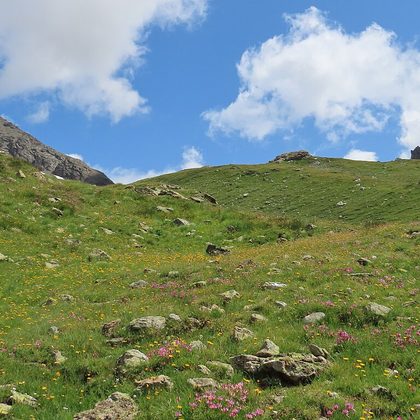
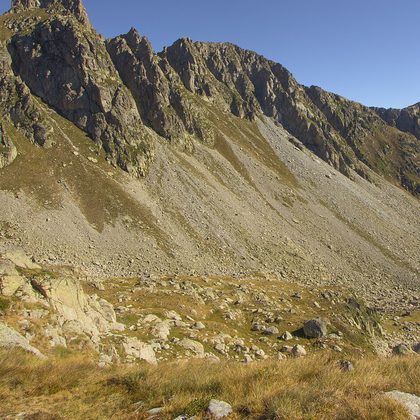
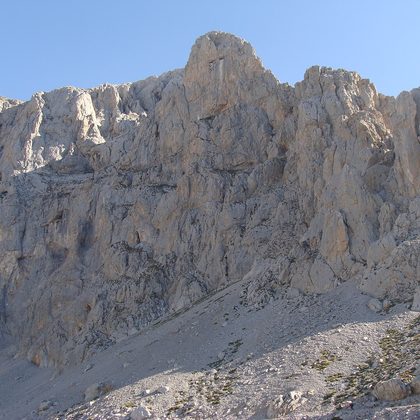
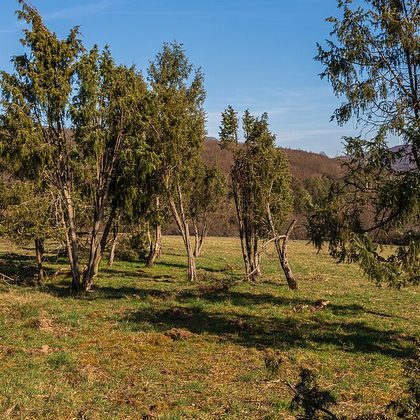
Steep, sunny south-facing slopes at and just above the treeline: short alpine grassland cut by rock ribs, screes, abandoned summer pasture and dwarf scrub, mostly between eight hundred and two thousand five hundred metres. In winter birds drop to snow-free southern flanks and sometimes into valley meadows. North slopes and dense, closed vegetation are avoided.
Where the bird is most at home, classified with EUNIS — the European standard for habitats.
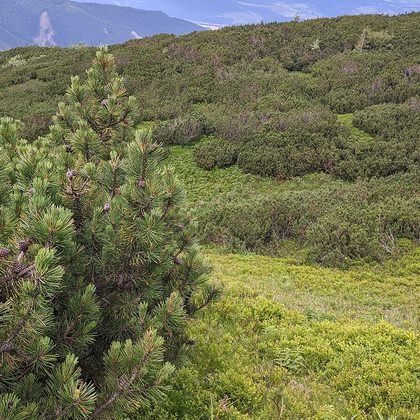
Range and movements
A southern European bird in three separate blocks: the Alps from France to Slovenia, the Apennines with a distinct race on Sicily, and the Balkans from Croatia to Greece. In Bulgaria and north-east Greece the range abuts that of Chukar. It has never occurred in Britain other than as an escape from captivity, so any Alectoris at home is a Red-leg, a Chukar or a hybrid until proved otherwise.
- Breeding (summer)
- Passage
- dark = core range, pale = thinly spread
Where and when to look
Gran Paradiso, the Vanoise or the Dolomites in June, or the mountains of northern Greece and North Macedonia. Climb to a south-facing slope above the treeline at first light and listen; then sit down and scan the rock ribs between the grass runs. Do not keep walking — Rock Partridges run away from you and only flush when you are on top of them.
Conservation status
Near Threatened, and declining across most of the range. In the Alps the main cause is the closing over of mountain pasture once summer grazing is given up, together with hunting pressure, disturbance from winter sports, and cold wet springs that wreck clutches. In Italy and the Balkans, mixing with released Chukars and reared stock is added to that.