All species › Gamebirds › Pheasants and partridges › Chukar partridge
Chukar partridge
Alectoris chukar | Aziatische steenpatrijs | Perdiz chukar
A bird of hot, bare stony slopes in the southern Balkans and the Aegean islands. In Britain it is a ghost of the shooting field rather than a wild bird, but on a Greek hillside it is unmistakable: the call carries the length of a valley, and the bird itself is one more grey stone among stones.

Voice
The name is the call: a series of hard chuck notes that accelerates into a rolling chuck-chuck-chukar-chukar, usually delivered from a boulder in the first hour after sunrise. On flushing, a sharp rising whit-oo. Rock Partridge sounds more irregular and throatier and lacks this settled rhythm.
No freely licensed recording is available for this species yet.
Identification
Rounded grey-brown gamebird with coral-red bill, red eye-ring and red legs. Throat and cheeks cream to yellowish-white, ringed by an unbroken black gorget that is slightly broad and ragged along its lower edge. Crown and nape grey-brown with a vinous cast; a rufous ear patch sits inside the black eye-stripe. Flanks narrowly and closely barred, mainly black and white. Flight low, fast and brief, showing rusty tail sides.
Confusion species
The four Alectoris partridges part company on the throat and neck. Chukar has a cream throat, never pure white, and the black surround stays closed, broadening into a slightly ragged lower edge; crown and nape are grey-brown with a vinous cast and a rufous ear patch inside the black eye-stripe. Rock Partridge has a pure white bib that runs further down onto the upper breast, edged by a narrow, unbroken, knife-sharp black line, with black at the base of the bill; crown and nape blue-grey, flank bars broader and more widely spaced. On Red-legged Partridge the line does not stay closed at all: it dissolves downwards into a broad field of black streaks and drops across the neck and upper breast, the crown is warm chestnut, and the flank bars carry chestnut as well as black and white. Barbary Partridge has no black gorget, but a broad chestnut collar spangled with white spots around a blue-grey face, under a chestnut crown. Hybrids are the real problem for a British observer. Chukars and Chukar × Red-legged crosses were released here in quantity until releasing them was outlawed in the early 1990s, and hybrid stock has never entirely gone from the rearing pens. Look for a creamy rather than white throat, a gorget only half broken into streaks and flanks short of chestnut, and record such a bird as an uncertain Alectoris rather than a species. In the wild the ranges meet in north-east Greece and Bulgaria, where Chukar takes over from Rock Partridge.
Habitat
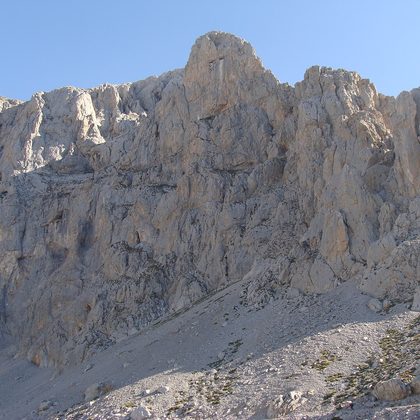
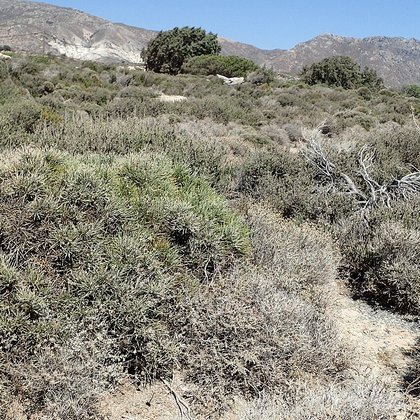
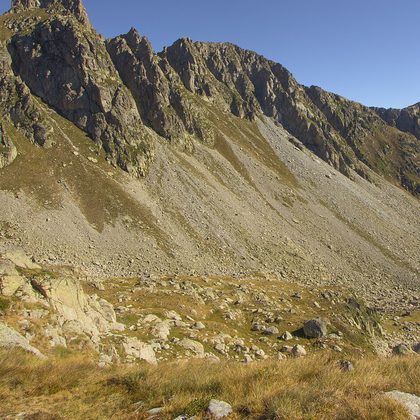
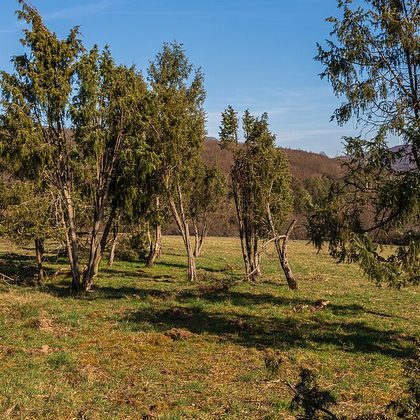
Dry stony slopes with phrygana and scattered thorny scrub, screes, rock outcrops and abandoned terrace walls; from sea level on the islands to well over two thousand metres in the Balkan ranges. Feeds on seeds, buds and greenery on open ground between the stones, and works old terraces and small stubble patches at village edges.
Where the bird is most at home, classified with EUNIS — the European standard for habitats.
Range and movements
In Europe from Bulgaria and north-east Greece eastwards across the Aegean islands, Crete, Rhodes and Cyprus into Asia Minor, and on through central Asia to China. West of that line Rock Partridge replaces it. Introduced far outside the natural range in North America, New Zealand and Hawaii, and released for shooting in Italy, Spain and Britain, where the British birds go back to released stock and no self-sustaining population took hold.
- Resident
- Winter
- Passage
- dark = core range, pale = thinly spread
Where and when to look
Lesbos, Samos or Cape Sounion in April and May, just after sunrise. Take a path with a whole hillside in view and wait for the call; the birds walk uphill into the sun and cross the bare rock crowns for a moment. In the midday heat the chances are poor.
Conservation status
Not globally threatened, but European numbers are falling with hunting pressure, the abandonment of terrace farming and heavy grazing. The greater worry is the annual release of reared birds of uncertain stock, which mix with wild Chukars and, in the contact zone in Bulgaria and northern Greece, with Rock Partridge.