All species › Tubenoses › Northern storm petrels › Leach's storm-petrel
Leach's storm-petrel
Hydrobates leucorhous | Vaal stormvogeltje | Paíño boreal
Leach's Storm-petrel is the storm-petrel of late autumn: an open-Atlantic bird that only reaches the North Sea after a heavy westerly gale and is then sometimes blown right into inland waters. It is the harder of the two small storm-petrels, and the reason seawatchers chase every black speck behind the swell.

Voice
Completely silent at sea; in north-west European coastal waters you will never hear it call. At the colony, and only at night, a rhythmic staccato chattering and cackling rises from the burrows, while over the slopes birds give a shrill, laughing, rising and falling wee-chee-chee-oo that bounces around in the dark. Audible from June to August on islands such as St Kilda and the Westman Islands.
No freely licensed recording is available for this species yet.
Identification
Larger and longer-winged than European Storm-petrel, with an angular wing clearly kinked at the carpal and tapering to a narrow tip. The flight is the best character: powerful, angular and unpredictably veering, deep beats broken by short glides, higher above the water and far more given to changes of direction than the fluttering European — the effect of a small, nervous nightjar over the sea. A conspicuous pale greyish-brown diagonal band runs across the upperwing from carpal to wing bend, and it often catches the eye before the rump does. The rump patch is narrower and V-shaped, does not extend far onto the flanks, and is usually split by a dark central line. The tail is forked, though that is rarely seen well at sea. Underwing: uniformly dark, with no white bar.
Confusion species
European Storm-petrel is the confusion species, and the separation hangs on three things. First the rump: European shows a large square white block wrapping onto the flanks, Leach's a narrower V-shaped patch, often divided down the middle and leaving the flanks dark. Second the wing: Leach's has an obvious pale diagonal band across the upperwing and no white bar beneath the wing; European has that white underwing bar and virtually no pattern above. Third the flight: fluttering and low in European, angular, veering and powerful in Leach's. Wilson's Storm-petrel is smaller and more compact, with short rounded wings, projecting legs with yellow webs and a square tail. Swinhoe's Storm-petrel, an extreme rarity, is grey rather than brown-black, with a deeply forked tail and a grey rump.
Habitat
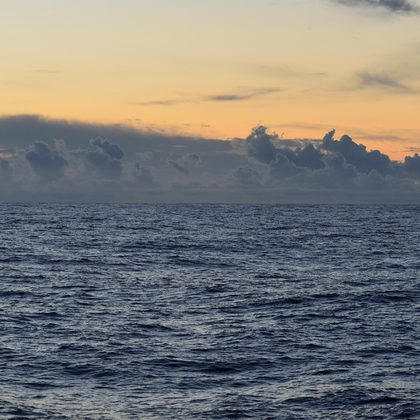
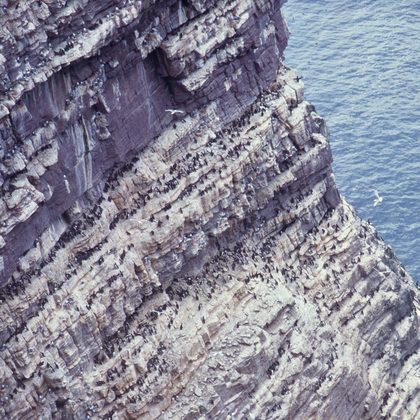
Outside the breeding season on the open ocean, generally far from land and over deep water; unlike European Storm-petrel it avoids the shallow coastal zone and appears there only when wind pushes it in. Breeds colonially in self-dug burrows on grassy slopes of remote islands, visiting them only on dark nights. Feeds by fluttering and veering over the surface, taking plankton, small squid and fish remains.
Where the bird is most at home, classified with EUNIS — the European standard for habitats.
Range and movements
In Europe it breeds in Iceland, the Faroes, Norway, Scotland (St Kilda the stronghold) and Ireland; the great bulk of the world population breeds in the North Atlantic off Newfoundland and in the Pacific. In the Netherlands it is a rare but near-annual autumn visitor, tightly tied to prolonged westerly to north-westerly gales, with striking wrecks in which birds end up on the IJsselmeer and inland lakes. In Spain it is regular off Galicia and in the Bay of Biscay during autumn storms, scarcer in the Strait of Gibraltar.
- Winter
- Passage
- dark = core range, pale = thinly spread
Where and when to look
This is a storm species above all. In the Netherlands, count on the second or third day of a sustained westerly to north-westerly gale in October or November, ideally from Westkapelle, the Brouwersdam or IJmuiden, and stay put when the wind veers: that is when birds come close. Judge the flight and the upperwing band first and the rump second, because the rump misleads in poor light. In Galicia, Estaca de Bares in an October north-westerly gives the best numbers; a chummed pelagic over the shelf edge of the Bay of Biscay gives the calmest views.
Conservation status
Vulnerable on the global Red List. The species was uplisted in 2019 after it emerged that the vast Newfoundland colonies — including Baccalieu Island, the largest in the world — had shrunk by tens of percent within a few decades. European colonies are declining too. Predation by large gulls and introduced mammals, light pollution, warming-driven changes in the plankton and contamination with mercury and plastic have all been implicated; the full picture is still unclear.