All species › Tubenoses › Petrels and shearwaters › Northern fulmar
Northern fulmar
Fulmarus glacialis | Noordse stormvogel | Fulmar boreal
At range the Northern Fulmar looks like a gull, but it flies like nothing in that family: stiff, on straight rigid wings, arcing along the troughs of the swell. It is the only tubenose that is present in north-west European seas all year, and the only one that will sit tight at the colony while you watch it from a few dozen metres.

Voice
Silent at sea, except in squabbles behind a trawler, when a hoarse cackle breaks out. At the colony it is noisy: a deep, rattling, gurgling ag-ag-ag-arrr that a pair throws at each other with open bill and outstretched neck, from the ledge or the nest scrape. Audible from March to August on cliffs in Scotland, Norway, Iceland and on Heligoland.
Recording: British Library — CC BY-SA 4.0 · Wikimedia Commons
Identification
The flight does everything. The wings are straight, stiff and noticeably narrow at the base, the neck thick and short and the blunt head pushed forward; the bird holds the wings almost motionless, alternating short bursts of fast beats with long, dead-straight glides that shear through the wave troughs. In good light the body is white, the wing grey with a pale patch at the base of the primaries, and the tail grey with no black band. From below it is uniformly white with a greyish wing edge. The bill is short, thick and yellow with an obvious tube-nose on top, the clinching character at close range. Northern populations include dark 'blue' morphs, uniformly grey with no white.
Confusion species
Herring and Common Gulls are the perennial confusion on seawatches: they show black wingtips with white mirrors, a longer neck, angled wings, and they flap with loose deep beats, where a fulmar holds its wings stiffly straight. Kittiwake has sharply cut black tips without white and a much lighter, dancing flight. Great Skua is darker and shows white primary flashes on both wings. The genuinely hard call is a dark-morph fulmar against a Sooty Shearwater: look then at the fulmar's thick neck, blunt head and far stiffer wings.
Habitat
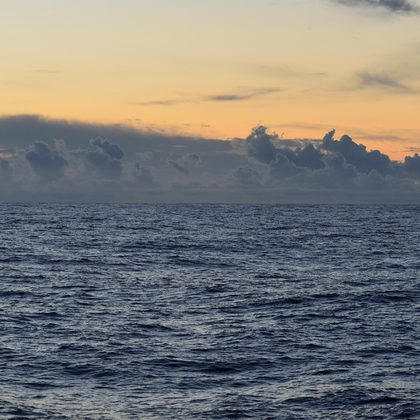
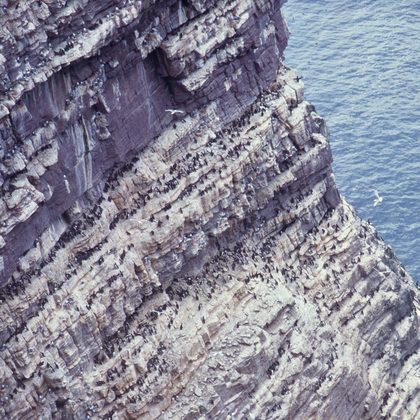
Outside the breeding season entirely on the open sea, often over the shelf edge and around fishing grounds, where it scavenges offal and oily scraps behind trawlers. Breeds on rock ledges and cliffs, including low coastal cliffs and occasionally buildings and old bunkers, laying a single egg on bare rock. It defends the nest by spitting a foul stomach oil that ruins the plumage of an attacker.
Where the bird is most at home, classified with EUNIS — the European standard for habitats.
Range and movements
Breeds in Iceland, the Faroes, Norway, Svalbard, Britain, Ireland, Brittany and on Heligoland. The Netherlands has no colonies, but the species is present on the North Sea year-round, with the highest inshore numbers during sustained north-westerly winds in late autumn and winter; birds regularly wash up with plastic in the stomach. In Spain it is chiefly a winter visitor in the Bay of Biscay and off Galicia, in smaller numbers towards the Strait of Gibraltar.
- Resident
- Breeding (summer)
- Passage
- dark = core range, pale = thinly spread
Where and when to look
Seawatch in a north-westerly to northerly gale between October and February for the best chance; Westkapelle, the Brouwersdam, IJmuiden and Camperduin are the classic stations and the first hour after sunrise is the most productive. Identify it at long range by the stiff, cutting glide through the wave troughs, not by plumage. Off Galicia and in the Bay of Biscay the Plymouth – Santander and Portsmouth – Bilbao ferries deliver tens to hundreds per crossing from October to March; in the Strait of Gibraltar, by contrast, it is scarce.
Conservation status
Not threatened globally, but faring badly in Europe: the European Red List treats it as Endangered after a prolonged decline of colonies in Scotland and the Faroes. The collapse of the fishery discard supply, climate change and shifting food availability in the North Sea all play a part. Fulmars are also the standard species in the European monitoring scheme for plastic pollution: the great majority of beached birds carry plastic in the stomach.