All species › Falcons › Falcons › Gyrfalcon
Gyrfalcon | Falco rusticolus
Giervalk | Halcón gerifalte
The largest falcon in the world, a bird of the high north that nests on cliff faces in Iceland, Lapland and Arctic Russia. For centuries it was the most prized hunting bird of kings and caliphs; south of the tundra it is an exceptional winter visitor.

Voice
At the eyrie a deep, hoarse series of kyek-kyek-kyek, slower and far heavier than a Peregrine's alarm; the female calls lower still than the male. There is also a plaintive hee-yek at food passes. Essentially silent away from the breeding grounds, so a wandering winter bird is never heard.
Recording: Bubulcus — CC BY 3.0 · Wikimedia Commons
Identification
Big and broad, with a heavy chest, a broad wing base and a tail that looks noticeably long in flight. The wingbeats are slow and deep and the hunting flight is low and direct, closer to a goshawk than to a Peregrine. Three colour forms occur: white with black flecking, grey with barring, and dark; Icelandic birds are mostly grey. Adults have a yellow cere, eye-ring and feet and a faint, narrow moustache; juveniles are browner, more heavily streaked, with a blue-grey cere.
Confusion species
Peregrine is the only real confusion. A Gyrfalcon is far heavier and broader, beats noticeably more slowly, has a much less sharply drawn moustache on a plainer head and looks longer-tailed in flight; a Peregrine is compact, short-tailed and carries a broad, crisply cut black moustache on a white cheek. Saker in eastern Europe: paler and browner, with a light crown and a narrow moustache, but slimmer-winged and without the heavy chest. A dark juvenile Gyrfalcon passes easily for a Peregrine at range; judge it on build and beat rate, not on colour.
Habitat
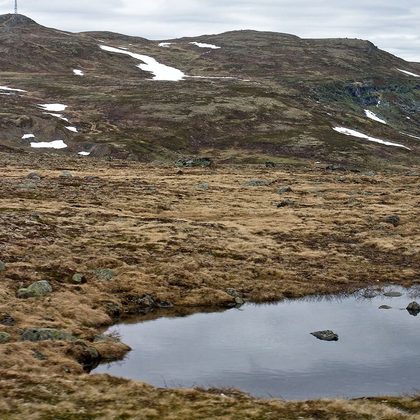
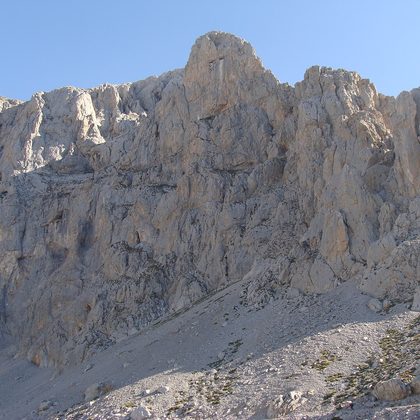
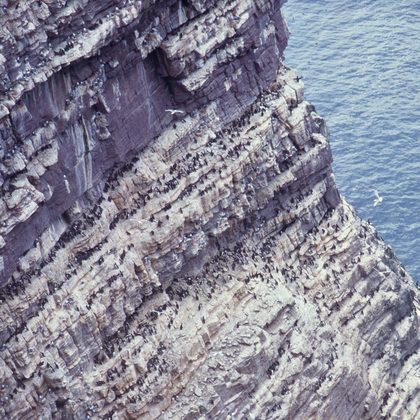
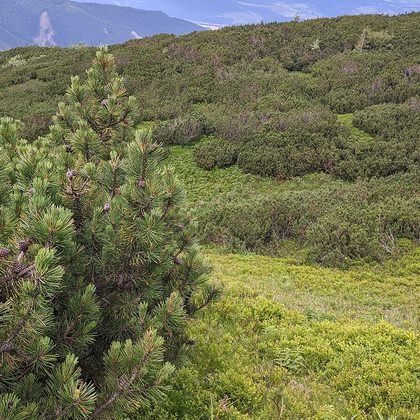
Treeless tundra, rock faces and sea cliffs above the tree line, and in Iceland lava fields and heaths full of ptarmigan. It nests on a ledge or in an old Raven or Rough-legged Buzzard nest, often on the same face for generations. In winter along coasts and far out over the sea ice, wherever seabirds and ducks can be taken.
Where the bird is most at home, classified with EUNIS — the European standard for habitats.
Range and movements
Breeds in Iceland, northern Scandinavia and Arctic Russia, and on round the Pole through Greenland, Canada and Alaska. Northern birds wander south in winter, reaching southern Scandinavia and, very rarely, the North Sea coasts. The Netherlands has about ten accepted records since 1849, almost all between October and March and mostly in the coastal provinces; it is absent from Spain.
- Breeding (summer)
- Winter
- Passage
- Migration direction
- dark = core range, pale = thinly spread
Where and when to look
To see one you travel north: Iceland in May and June, or Varanger in northern Norway. Look for a heavy, broad falcon hunting ptarmigan low and straight across the heath, and work the cliff faces with a telescope — an occupied ledge gives itself away at distance by white streaks of droppings and a scatter of feathers.
Conservation status
Not globally threatened (IUCN: Least Concern), but the European population is small and numbers swing with the ptarmigan: in a trough many pairs raise nothing. Theft of young and eggs for falconry remains a problem in the north, and the warming of the Arctic is changing both the ptarmigan cycle and the snow and rain that fall on the nesting ledges.