All species › Falcons › Falcons › Lanner falcon
Lanner falcon | Falco biarmicus
Lannervalk | Halcón borní
A slim, long-tailed large falcon of dry, rocky Mediterranean country, hunting low and gliding along slopes and over steppe rather than stooping from a height. Pairs often hunt together, driving partridges and pigeons between them. In Europe it has become rare, with most of the last pairs on Sicily.

Voice
At the nesting cliff a hoarse, grating kray-kray-kray, lower and rougher than the Peregrine's furious rattle and delivered more slowly. Also a plaintive weeek between the pair. Mainly February to May, when pairs circle over the rock face and pass food.
No freely licensed recording is available for this species yet.
Identification
About the size of a Peregrine but noticeably slimmer, with a longer tail, a narrower wing base and a calmer, more gliding flight. Grey-brown to slate-brown above with fine barring, creamy white below with small round spots that thicken towards the flanks and trousers. The head settles it: crown and nape rusty brown — creamier in the pale North African birds — the cheek white, and the moustache narrow and stripe-like. Cere and legs yellow in adults. Juveniles are browner, streaked rather than spotted below, with blue-grey legs.
Confusion species
Peregrine: bulkier and more compact, shorter-tailed and broad-based in the wing, slate-grey above and with a broad black moustache on a white cheek; its underparts are finely barred, not spotted. Saker: larger and heavier, browner above, with a much paler, almost plain creamy white head, barely a moustache, and coarse drop-shaped spots on flanks and trousers. Kestrel is far smaller and lighter, hovers, and has a rufous back.
Habitat
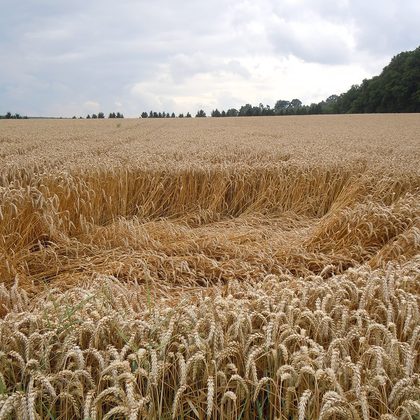
Warm, open, dry landscapes with rock: limestone cliffs, gorges and steep ravines surrounded by thin grassland, garrigue, steppe and cereal fields. In North Africa and the Middle East it reaches into semi-desert and the desert edge. It breeds on a cliff ledge, sometimes in an old Raven or raptor nest, and in the south also on pylons.
Where the bird is most at home, classified with EUNIS — the European standard for habitats.
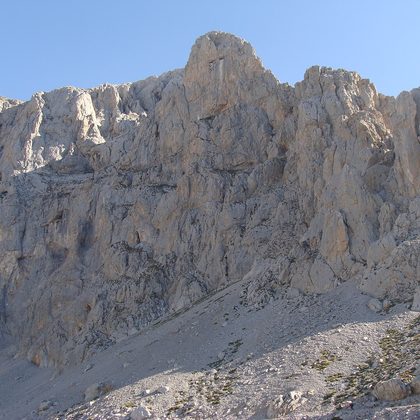
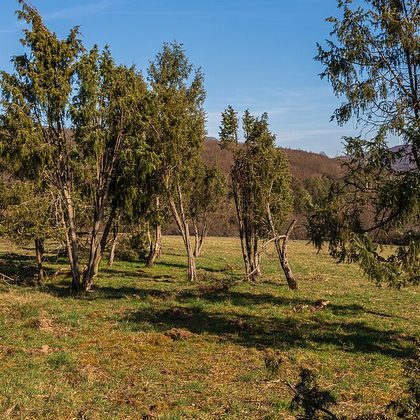
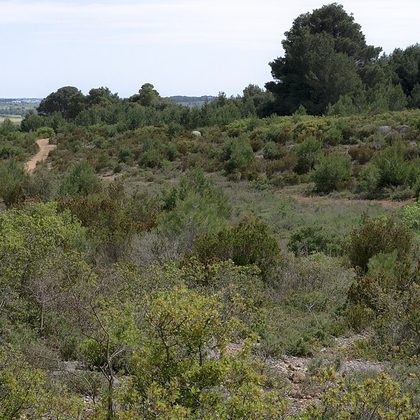
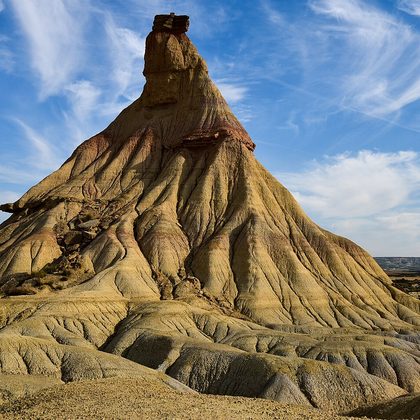
Range and movements
In Europe only in the south: Sicily and southern Italy, with small remnant populations in the Balkans and Turkey. Beyond that it breeds throughout North Africa, in Arabia and the Levant, and across much of Africa far south of the Sahara. Resident; young birds wander, but there is little true migration. In Britain it is not admitted to the list as a wild vagrant: the birds seen there go back to escaped falconers' birds.
- Winter
- Passage
- dark = core range, pale = thinly spread
Where and when to look
Sicily in March and April, at an inland limestone gorge or a coastal cliff: sit well back and wait for the display flight over the face. In Morocco and Tunisia the odds are far better; there, scan pylons, poles and isolated boulders in open steppe, where it likes to perch and watch.
Conservation status
Not globally threatened (IUCN: Least Concern) thanks to its huge African range, but the European subspecies is in trouble: the whole European population was recently put at some 120 to 170 pairs, most of them on Sicily. Disturbance at the nesting cliff, robbing of nests for falconry, electrocution on medium-voltage lines and the loss of extensively grazed steppe weigh heaviest.