All species › Falcons › Falcons › Saker falcon
Saker falcon | Falco cherrug
Sakervalk | Halcón sacre
The largest falcon of mainland Europe: a heavy, broad-winged bird of the steppe with a strikingly pale head, hunting low over the plain for ground squirrels, hamsters and pigeons. It builds no nest of its own but takes over old ones, nowadays mostly artificial baskets on electricity pylons.

Voice
At the nest a hard, hoarse kyek-kyek-kyek, deeper, slower and rougher than the Peregrine's sharp alarm; it barks rather than rattles. The female begs with a drawn-out, plaintive wheep. Silent outside the breeding season; April and May at an occupied nest basket give the best chance.
No freely licensed recording is available for this species yet.
Identification
Large and powerfully built, bulkier than a Peregrine, with broad, full-based wings and a long, fairly broad tail. Warm brown above with pale feather fringes, creamy white below with coarse, drop-shaped dark spots that gather on the flanks and especially the trousers. The head is conspicuously pale, often almost plain creamy white, with a fine dark eye-stripe and at most a faint, narrow moustache. In flight the dark trousers and axillaries stand out against paler flight feathers. Juveniles are darker and more heavily streaked, with blue-grey legs.
Confusion species
Peregrine: smaller and more compact, slate-grey above, with a broad black moustache, a sharply cut white cheek and barred underparts; its flight is stiffer and its stoop steeper. Lanner: smaller and slimmer, longer-tailed, with a rusty crown, a narrow but distinct moustache, and fine round spots rather than coarse drops. Gyrfalcon is larger still and whiter, with a blunter wingtip, and stays in the far north. A distant Common Buzzard can suggest a Saker, but has broad, rounded wings and a short tail.
Habitat
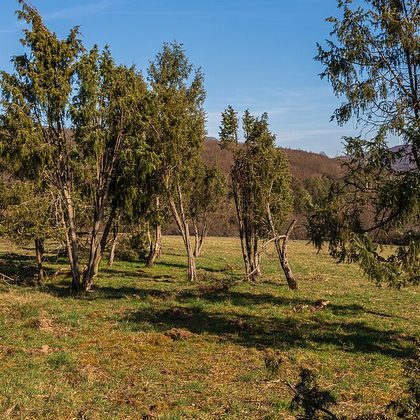
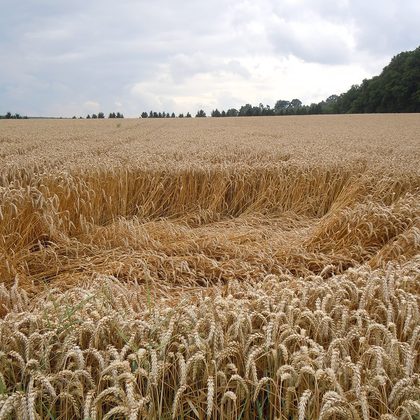
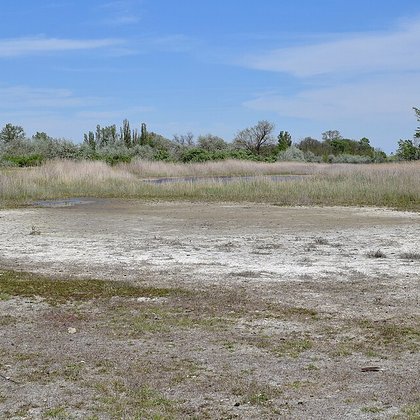
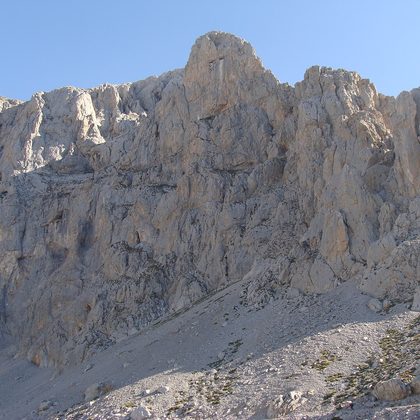
Wide, treeless plains: steppe and puszta, dry and saline grassland, large arable landscapes with rough strips, and the edges of inland salt pans. It needs open hunting ground rich in burrowing mammals and a raised nest site: an old crow, raven or eagle nest in a solitary tree, a cliff ledge, or an artificial basket on a pylon.
Where the bird is most at home, classified with EUNIS — the European standard for habitats.
Range and movements
Breeds from central and eastern Europe — Austria, Czechia, Slovakia, Hungary, Serbia and Romania — through Ukraine and Turkey and east across the Asian steppe to Mongolia and China. European birds stay near their territories or move a short way south; eastern birds winter in the Mediterranean, the Middle East and East Africa. In Britain it is not admitted to the list as a wild vagrant: the birds seen there go back to escaped falconers' birds.
- Breeding (summer)
- Winter
- Passage
- Migration direction
- dark = core range, pale = thinly spread
Where and when to look
Hungary, in the Hortobágy or the Kiskunság, from April to June. Drive the pylon lines across the plain and check the nest baskets; an adult is often sitting on the next tower along. Early morning, when the ground squirrels come up, gives the best chance of a hunting bird.
Conservation status
Globally threatened (IUCN: Endangered). Across the Asian steppe numbers have fallen sharply through trapping for falconry, electrocution on unprotected medium-voltage poles, and poisoning. Central Europe is the exception: targeted protection, guarded nests and hundreds of artificial baskets on pylons brought Hungary to about two hundred territorial pairs in 2024, its highest count so far. The loss of the European ground squirrel remains the main worry there.