All species › Gannets and cormorants › Cormorants › European shag
European shag
Gulosus aristotelis | Kuifaalscholver | Cormorán moñudo
The Shag is the cormorant of rocky coasts: smaller, slimmer and bottle-green, with an emerald eye and, in spring, a forward-curling crest. It stays close to the sea and almost never visits fresh water. Since 2021 it has been placed in its own genus, Gulosus, after two centuries under the name Phalacrocorax aristotelis.

Voice
Silent at sea. At the colony, from February to June, a limited but noisy repertoire: clicking series and growling rasps, from the male a hard ark-ik-ark-ik-ark-ik, and a hissing ssht when disturbed. The sounds come from crevices and caves and echo hollowly along a cliff coast.
Recording: Stanislas Wroza — CC BY-SA 4.0 · Wikimedia Commons
Identification
At 68 to 78 centimetres clearly smaller and slimmer than a Great Cormorant, with a shorter tail that is barely noticeable on swimming birds. The head profile is the best feature: a steep, almost angular forehead above a thin, evenly narrow bill with a fine hook, where the Great Cormorant has a sloping forehead and a heavy wedge of a bill. Of the bare skin only a bright yellow gape shows, running like a stripe below and behind the eye; there is no white chin patch and no extensive yellow pouch. The plumage is black with a bottle-green gloss, and from December to April a short forward-curling crest. Juveniles of the Atlantic form are brown with a dark belly. In flight it goes low over the waves with fast beats, the neck straight and unkinked and the wings compact and pointed; it leaps clear of the water as it dives.
Confusion species
Great Cormorant is larger and heavier, with a white chin patch, plenty of bare yellow skin around the bill base and a sloping forehead; it flies higher on a thick kinked neck and is often found inland, and its juveniles are brown with white to dirty-white underparts. That is exactly where the trap lies in the south: juveniles of the Mediterranean form desmarestii are pale to almost white below, with pale pink legs and feet instead of the black of Atlantic birds, so belly colour is useless in Spain and you must work from the forehead, the bill shape and the yellow gape. Adult desmarestii also shows more yellow at the bill base and a slightly longer, thinner bill than Atlantic birds. Pygmy Cormorant is far smaller, with a tiny head, a short little bill and a long tail, and lives on fresh water in south-east Europe.
Habitat
Rocky coasts and sea cliffs with crevices, boulders and caves, and the clear shallow sea in front of them. It usually fishes within a few kilometres of the shore over rock and sandbanks, taking prey close to the bottom. It rests on low rocks, harbour walls and buoys; unlike the Great Cormorant it avoids lakes, rivers and muddy inland waters.
Where the bird is most at home, classified with EUNIS — the European standard for habitats.
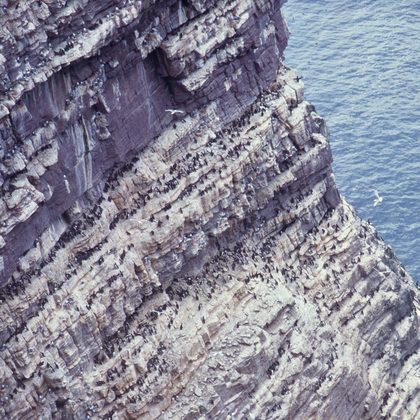
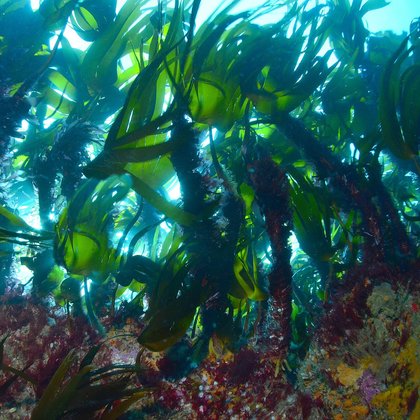
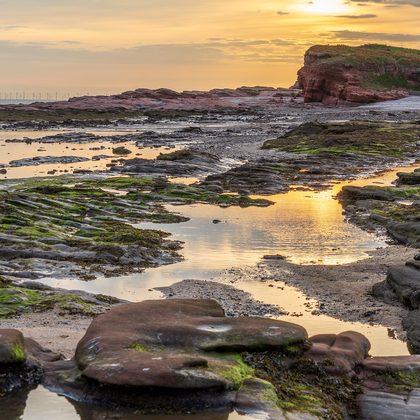
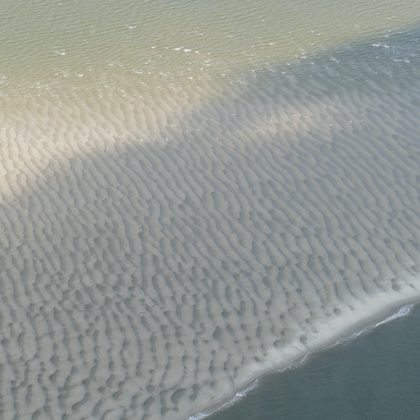
Range and movements
From Iceland, Norway and the Kola peninsula to Brittany, Iberia and Morocco, and on through the Mediterranean into the Black Sea. The Atlantic form aristotelis holds the northern coasts, the form desmarestii the Mediterranean, the Balearics and the Black Sea, with an estimated nine to eleven thousand pairs. Spain has around 4,400 pairs: some 2,900 on the Cantabrian and Atlantic coast, centred on the Cíes and Ons islands, about 1,300 in the Balearics, some fifty along the mainland Mediterranean and a small group at Gibraltar. In the Netherlands it is a scarce but annual winter visitor to the North Sea coast, chiefly at the Delta works and the piers; it first bred in 2013, in a cormorant colony at Neeltje Jans.
- Resident
- Breeding (summer)
- Winter
- Passage
- dark = core range, pale = thinly spread
Where and when to look
In Spain the Islas Cíes are the surest bet: take the boat from Vigo between April and June, when the birds sit on the rocks below the cliffs and still carry the crest; early in the day the sea is calmest and the birds perch lowest. In the Balearics, Cap de Formentor or a boat around Cabrera gives the Mediterranean form, pale juveniles included. In the Netherlands the Brouwersdam from November to February is the classic spot, best in an offshore wind, when birds fish right along the rock armour.
Conservation status
Not globally threatened (IUCN: Least Concern), though the Spanish red data book lists the Atlantic form as endangered and the Mediterranean one as vulnerable. North Sea numbers have fallen sharply in recent decades; fisheries that remove sandeels, bycatch in set nets, oil pollution and disturbance at colonies all press on the population, while introduced rats and cats empty nests on islands. Clearing islands of rats and restricting gillnets are the measures with a demonstrable effect.