All species › Gannets and cormorants › Cormorants › Pygmy cormorant
Pygmy cormorant
Microcarbo pygmaeus | Dwergaalscholver | Cormorán pigmeo
The Pygmy Cormorant is the smallest cormorant of the Old World, no bigger than a Coot and with a tail almost as long as its body. It belongs to overgrown fresh water and usually sits low in willows or reeds along the bank rather than out on a windy groyne.

Voice
Almost always silent away from the colony. At the colony, from April to July, short hoarse barking and pig-like grunting: a low korr-korr and a hoarse ga-ga-ga, thinner and higher than the deep rumble of a Great Cormorant. At roosts a little squealing accompanies arrival, but otherwise they are remarkably quiet.
No freely licensed recording is available for this species yet.
Identification
Small and compact, 45 to 55 centimetres, with a long tail often held cocked, which makes the silhouette back-heavy; on swimming and perched birds that is the quickest thing to see. The head is small and round with a steep forehead, the bill short, thin and slightly hooked, without the heavy jaw of a Great Cormorant. The bare skin around the bill base is small and dark to dull yellow; there is no white chin patch and no orange-yellow gular pouch at all. Breeding birds are black with a green gloss, with a rusty-brown head and fine white hair-like feathers over head and neck; outside the breeding season the head is dull brown with a pale throat. In flight it stands out by its small size, fast wingbeats and straight neck: short in front, long behind, the reverse of the Great Cormorant shape.
Confusion species
Great Cormorant is nearly twice the size, has a white chin patch, bare yellow skin around the bill base and a short tail, and flies with a thick, kinked neck; a Pygmy Cormorant holds its neck straight. Shag is also larger, has a steep forehead with a thin bill and a bright yellow gape line, and keeps to rocky coasts and open sea rather than marshy water. A juvenile Great Cormorant is brown and may cause a moment's doubt on a lone bird, but is at once far bulkier and much longer billed. At a distance a swimming Pygmy Cormorant looks most like a Coot or a small duck; the tilted-up little bill and the long tail settle it.
Habitat
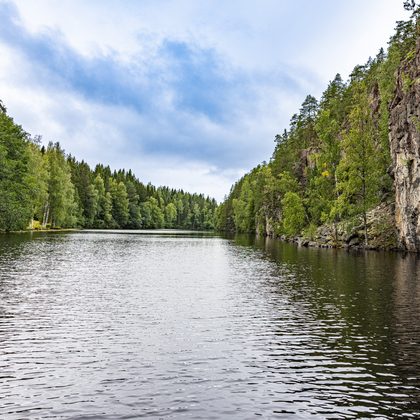
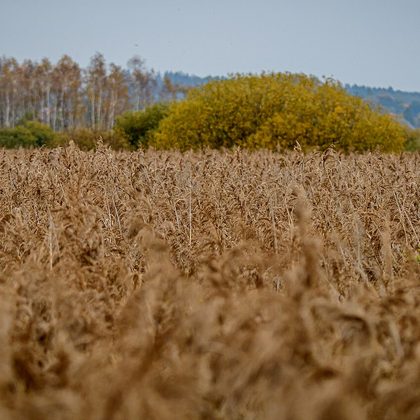
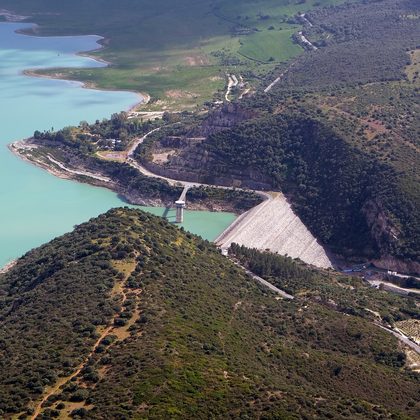
Structured lowland fresh water: overgrown lakes and oxbows, slow rivers and delta channels, extensive reedbeds and the willow scrub along the bank, where it loafs by day and roosts at night. Also fish farms, rice fields and canals. It fishes in shallow, sheltered water and will hunt right into narrow ditches, which the Great Cormorant does not.
Where the bird is most at home, classified with EUNIS — the European standard for habitats.


Range and movements
The core lies in south-east Europe and south-west Asia: the Danube delta, the Balkans, Greece with Kerkini and Prespa, Turkey, the Caucasus and the Caspian region. Since the 1980s the western edge has been moving. Italy had its first breeding in 1981 at Punte Alberete; there are now more than two thousand pairs, chiefly in the Po delta and the Venice lagoon, with winter concentrations of over ten thousand birds along the northern Adriatic. Hungary, Austria and Slovakia hold breeders too, and Bavaria has had two colonies since 2022. In Britain and the Low Countries it remains a vagrant; the Netherlands has fourteen accepted records, the first at Montfoort in January 1999, and lately almost annual in spring and summer.
- Resident
- Breeding (summer)
- Winter
- Passage
- dark = core range, pale = thinly spread
Where and when to look
Do not wait for one in the north; go to the northern Adriatic. From November to February the Po delta and the Venice lagoon hold communal roosts of hundreds to thousands of birds in willow and reed. Stand near such a roost an hour before sunset and they come in low over the water in small fast parties. To see the breeding plumage with its rusty-brown head, visit Lake Kerkini in northern Greece in April or May at first light, from the dyke along the southern shore.
Conservation status
Not globally threatened (IUCN: Least Concern); the species formerly sat in a higher category and was downlisted once numbers recovered. In Europe the population is rising and the breeding range is shifting west. The main threats are the draining and dredging of marshes, winter reed burning, disturbance of roosts, drowning in fishing nets, and shooting by birds being taken for Great Cormorants.