All species › Cranes, rails and allies › Cranes › Demoiselle crane
Demoiselle crane
Grus virgo | Jufferkraanvogel | Grulla damisela
The smallest crane in the world, a bird of dry steppe, with long white ear tufts and a black plume trailing over the breast. In western Europe it shows up among Common Cranes — and the first question is almost always where it came from.

Voice
A high, harsh trumpeting, krik-krik, shorter and shriller than the deep krooh-krooh of Common Crane and with a distinct rasp to it. A passing flock calls continuously. You will rarely hear it in western Europe, and a bird calling wrongly within a crane flock is the fastest way to be alerted.
Recording: Sudipto Roy — CC BY-SA 3.0 · Wikimedia Commons
Identification
Clearly smaller and slighter than Common Crane, with a pale grey body. The head and foreneck are black, and the black of the foreneck runs on as a long plume over the breast. A long, narrow white tuft trails back from behind the eye. The bill is short and horn-coloured with a reddish tip; the eye is red. The tertials are black and pointed and project as a spike beyond the tail. Juveniles are duller grey with grey rather than white ear tufts.
Confusion species
In a crane flock, size registers first: a head shorter and far finer, with a thinner neck. Then the head — no red crown and no white stripe down the side of the neck, but a black head with a long white ear tuft, and the black plume worn on the breast rather than the rear. Finally the tertials: a woolly grey bustle on Common Crane, black pointed feathers tapering to a narrow spike on Demoiselle. In flight it looks shorter-necked and beats faster.
Habitat
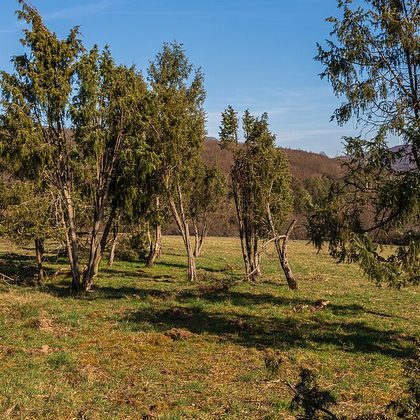
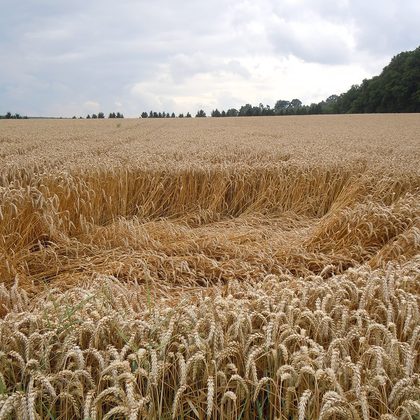
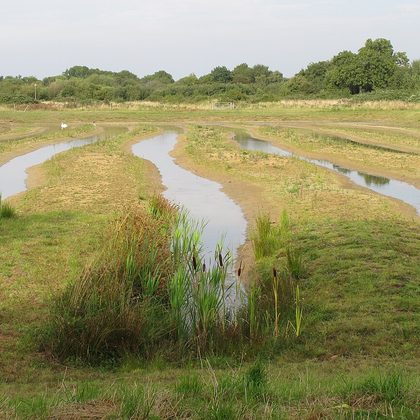
Dry open steppe and semi-desert with short cover, preferably within walking distance of drinking water, plus cereal fields and fallow in the steppe zone. Outside the breeding season on stubble and around waterholes. Birds appearing in western Europe are usually standing on arable or wet grassland among cranes, or at the edge of a shallow-water roost.
Where the bird is most at home, classified with EUNIS — the European standard for habitats.

Range and movements
Breeds in the steppe belt of Ukraine and southern Russia, including Kalmykia, east to Mongolia and north-east China; the former Turkish and Atlas populations are gone. Winters in the Sahel and on the Indian subcontinent. That is the wild picture. In north-west Europe the species is also a common bird in collections, and records in Britain, the Netherlands and Belgium are seldom accepted as wild: many go back to escaped birds. Check for rings, for worn or clipped flight feathers and for tame behaviour, and weigh the date and the company it keeps.
- Breeding (summer)
- Passage
- dark = core range, pale = thinly spread
Where and when to look
The only way to be certain you are watching wild birds is to go where they breed: the Black Sea steppe or Kalmykia in May and June, or Rajasthan in winter. If you want to try in western Europe, work passing crane flocks in April and May, and photograph any candidate with legs and wings in the frame.
Conservation status
Not globally threatened, with a large Central Asian population, but the western arm in Ukraine and southern Russia is small and vulnerable. Conversion of steppe to arable, drying waterholes and disturbance during the breeding season press on numbers there, and hunting along the flyway continues.