All species › Pelicans, herons and ibises › Pelicans › Dalmatian pelican
Dalmatian pelican
Pelecanus crispus | Kroeskoppelikaan | Pelícano ceñudo
The Dalmatian pelican is among the heaviest flying birds in Europe and at the same time the more plainly marked of the two pelicans: dirty white to grey, with an untidy mass of curly feathers over the hindcrown. It usually fishes alone, where the great white pelican works in teams.

Voice
Practically silent away from the colony; a bird passing overhead is heard only as a rush of wings. At colonies and in squabbles at a roost it gives deep, belching growls, a low orrr, hissing chhh notes and dry bill-clattering. Young birds beg with a plaintive, whining ee-eh. Display in March, when the pouch turns orange-red, is the one period when a colony is audible from any distance.
No freely licensed recording is available for this species yet.
Identification
A very large, bulky waterbird with a heavy, broad-based bill. The plumage is grey-white to dirty white, without the pink wash of the great white pelican, and in strong light looks almost silver-grey. Over the crown and hindcrown stands a dense mass of loose, curly feathers that gives the species its name. The bare skin around the eye is pale yellowish white to lilac and grades gradually into the head feathering rather than ending in a sharp line; the eye is pale, usually yellowish white, and so barely shows against the pale side of the head. The pouch is yellow to dull yellow outside the breeding season and turns orange-red in early spring. The legs are dark lead-grey. In flight it shows an evenly grey-white wing: only the primaries are slightly darker grey and the extreme tips a dull blackish grey, with no sharp boundary, while the underwing is pale with a whiter central band. Immatures are dull grey-brown, and even then show no black in the wing.
Confusion species
Great white pelican is the only real confusion species, and in flight the question is answered at once: that species has jet-black flight feathers standing out sharply against the white coverts both above and below, whereas the Dalmatian shows an evenly grey-white wing with no black trailing edge. Perched, the great white gives itself away by its cream-white, pink-washed plumage, the pink to flesh-coloured bare skin around a dark eye, the smooth pointed drooping crest on the nape and the flesh-coloured legs; the Dalmatian is grey-white, with a paler yellowish white eye surround and a pale eye, curly crest feathers over the whole hindcrown and lead-grey legs. Behaviour helps at range too: Dalmatians fish alone or loosely scattered, great whites in a closed crescent. Pink-backed pelican from Africa, at most a vagrant as far as Egypt within this region, is clearly smaller and greyer, with grey-pink legs and a slimmer bill. Soaring flocks can suggest storks or cranes at a distance, but the drawn-in neck with the bill on the breast names the pelican.
Habitat
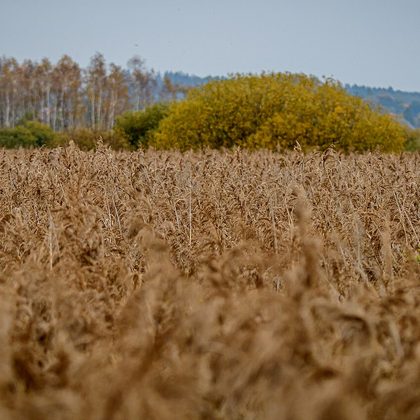
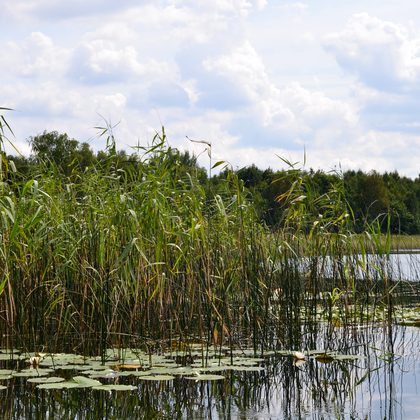
Large, shallow freshwater lakes and river mouths with extensive reedbeds, also the lower reaches of rivers, reservoirs and, in winter, brackish lagoons and coastal bays. It rests on sandbars, floating reed mats and low islets. It usually fishes alone or in a loose, widely scattered group, swimming quietly and scooping ahead of itself, and only rarely works in the coordinated crescent the great white pelican uses. That difference in fishing behaviour is often the first usable clue at long range.
Where the bird is most at home, classified with EUNIS — the European standard for habitats.



Range and movements
Breeds from the Prespa lakes and Lake Kerkini in Greece through Albania, Montenegro, Bulgaria and the Danube Delta to Turkey, the Caspian region and Central Asia; Balkan birds largely stay in the region all year, while northern breeders move to Greece, Turkey and the Middle East. In Britain, Ireland and the Low Countries any pelican seen is almost certainly a bird from a collection, and the species has never been admitted to those national lists on merit. Seeing a wild Dalmatian pelican therefore means a trip to northern Greece or the lower Danube, which is no hardship: the birds there are approachable and the colonies well signposted.
- Resident
- Breeding (summer)
- Winter
- Passage
- Migration direction
- dark = core range, pale = thinly spread
Where and when to look
Go to Mikri Prespa or Lake Kerkini in March or early April: the birds are then at their best, with an orange-red pouch and a full curly crest, and they sit close inshore. At Kerkini walk the reed edge from the dam at Kerkini village during the first two hours after sunrise, when the light is low and the water flat; the grey cast to the wing and the lead-grey legs are then beyond doubt. From December to February large numbers gather as well, but the pouch is still a dull yellow then.
Conservation status
Near Threatened. The species declined steeply through the twentieth century through the draining of marshes, persecution by fishermen and disturbance at colonies, but has recovered strongly in Europe since about 1990 thanks to colony protection, quiet zones and the marking or burying of power lines; in 2017 the category was accordingly revised from Vulnerable to Near Threatened. Collisions with cables, disturbance in the breeding season, fluctuating water levels and avian influenza remain the main threats: an outbreak in early 2022 killed about forty per cent of the Greek breeding birds and counts as the worst wildlife disaster recorded in that country.