All species › Pelicans, herons and ibises › Pelicans › Great white pelican
Great white pelican
Pelecanus onocrotalus | Roze pelikaan | Pelícano común
The great white pelican is the more strongly patterned of the two European pelicans: on the water a heavy, cream-white bird with an orange-yellow pouch, in the air a white sail with jet-black flight feathers. It lives in dense flocks and fishes as a team, and that behaviour often gives it away before any detail of the head does.

Voice
Practically silent away from the colony: flying and fishing birds normally say nothing, and a flock passing low is heard only as a rush of wings. At colonies and communal fishing grounds it gives deep, throaty growls, a low oo-ooh and a short, harsh chrr, with bill-clattering added. Young birds beg with a shrill, whining eehh that carries right across the colony.
Recording: Marco Dragonetti — CC BY 4.0 · Wikimedia Commons
Identification
A very large, bulky waterbird with a huge bill and a pouch that glows orange-yellow on adults. The plumage is clean white with a pink wash, in the breeding season with a yellow patch on the breast and a short, pointed drooping crest on the nape. The bare skin around the eye is pink to flesh-coloured and stands out sharply against the white head feathering; the eye itself is dark. On the forehead the feathering runs to a clear point at the base of the bill. Legs flesh-pink to yellowish pink. In flight the pattern is the most telling feature: the upperwing is white with a broad, jet-black trailing edge and black primaries, the underwing white with equally sharply defined black flight feathers. Immatures are brown with a dark saddle-shaped mark across the wing.
Confusion species
Dalmatian pelican is the only real confusion species, and in flight the matter is settled at once: that species shows an evenly grey-white wing on which only the primaries are a slightly darker grey, without the black trailing edge the great white shows both above and below. Perched or swimming, the great white is cream-white with a pink wash against the dirty white to grey plumage of the Dalmatian; its bare eye surround is pink and sharply outlined, the Dalmatian's pale yellowish white and fading out gradually. The great white has a dark eye, a smooth pointed nape crest and flesh-coloured legs; the Dalmatian a pale eye, an untidy mass of curly feathers over the whole hindcrown and lead-grey legs. Behaviour helps too: great whites fish in a closed crescent, Dalmatians almost always alone. Pink-backed pelican, an African species recorded as a vagrant as far as Egypt and Israel, is clearly smaller and greyish, with grey-pink legs and a washed-out wing pattern. At long range soaring flocks can suggest storks or cranes; the drawn-in neck with the bill resting on the breast then names the pelican.
Habitat
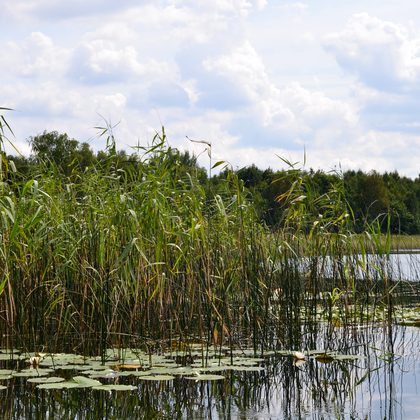
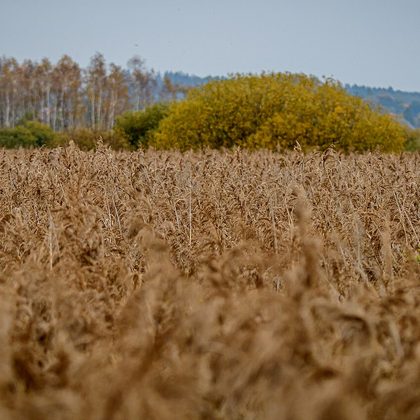
Large, shallow fresh and brackish waters: delta lakes, lagoons, reservoirs and saline steppe lakes, with roosts on sandbars, mudflats and floating reed mats. It nearly always fishes in a group: six to ten birds form a crescent or horseshoe, swim the fish into shallow water and then scoop in unison. It does not plunge-dive but scoops while swimming, and commutes tens of kilometres a day between roost and fishing grounds.
Where the bird is most at home, classified with EUNIS — the European standard for habitats.



Range and movements
Breeds in south-east Europe and south-west Asia, with the largest European colony in the Danube Delta and further colonies at the Prespa lakes in Greece, in the Turkish lake district and around the Caspian Sea; these birds winter in north-east Africa and the Middle East. For a birder based in Britain, Ireland or anywhere in north-west Europe the species is not a realistic wild vagrant: pelicans that turn up in the north are almost always birds from collections, and rings, clipped wings or abnormally worn primaries usually settle the case. Wild birds mean a trip to Romania, Greece or Turkey.
- Resident
- Breeding (summer)
- Winter
- Passage
- Migration direction
- dark = core range, pale = thinly spread
Where and when to look
Take a boat from Tulcea in the Danube Delta in May or early June and be on the water before sunrise: between five and half past six the birds leave the colony in waves, and until about ten they fish in teams in the shallow channels. Lake Kerkini in northern Greece gives you the same show from the dam without a boat. Go early there as well, because in the afternoon heat the birds circle high on thermals and can only be followed as specks.
Conservation status
Not globally threatened (IUCN: Least Concern): the range is vast and the world population large, mainly thanks to the African birds. In Europe the species is far scarcer than that figure suggests, because the number of colonies is small and the Danube Delta carries the bulk of the European breeders. Disturbance at colonies, the drying out of shallow feeding areas, collisions with power lines and outbreaks of avian influenza are the main pressures; colony protection and quiet zones in the deltas are the measures that work best.