All species › Sandgrouse › Sandgrouse › Black-bellied sandgrouse
Black-bellied sandgrouse
Pterocles orientalis | Zwartbuikzandhoen | Ganga ortega
The bulkier and darker of Europe's two sandgrouse, and a bird of the stoniest, barest steppe. Perched, it is a rounded, heavy-bodied bird with an orange throat; flushed, it shows a solid black belly set against white underwing coverts.

Voice
The flight call is a low, rolling, slightly guttural churrr-re-ka, dropping a little at the end, with a growling undertone often likened to a horse snorting at a distance. Birds call less continuously than Pin-tailed and with longer gaps, but the sound carries a long way over bare ground and is usually all you get from a flock passing high overhead.
No freely licensed recording is available for this species yet.
Identification
Heavily built, with a short pointed tail and no elongated feathers. The male has a blue-grey head and neck, an orange throat patch, a thin black line across the lower breast and ochre scapulars marked with black drops. The female is densely spotted and streaked black above and shares the orange throat. Both sexes have a black belly and white underwing coverts, which give the decisive flight view: a white inner wing pinched between black flight feathers and a black belly.
Confusion species
Pin-tailed Sandgrouse is the only real pitfall, and as the birds are almost always seen passing overhead it comes down to belly, tail, underwing and voice. The belly here is black and cuts the underside sharply in two, whereas Pin-tailed is almost wholly white below. The tail is short and pointed, without the needle-like streamers of Pin-tailed. Both show white underwing coverts, but here the white is trapped between black remiges and a black belly and reads as a narrow pale wedge. The call is the safest character: low, rolling and growling against the high dry rattle of Pin-tailed. Black-bellied is also larger, broader-winged and slower in the beat, more partridge than plover.
Habitat
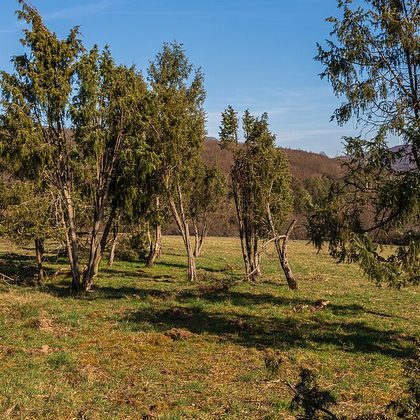
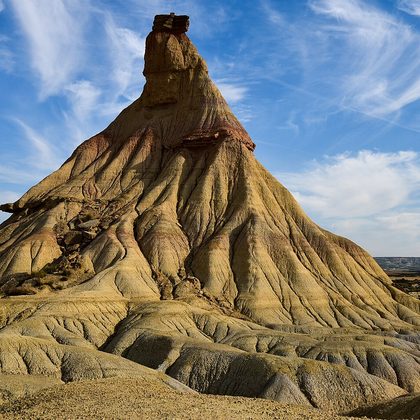
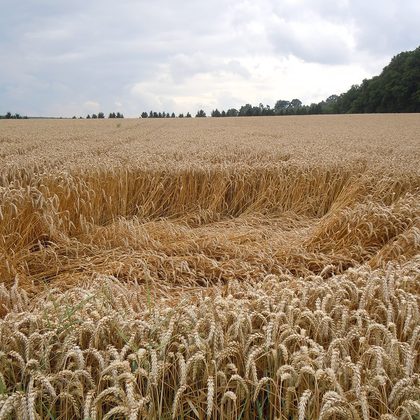
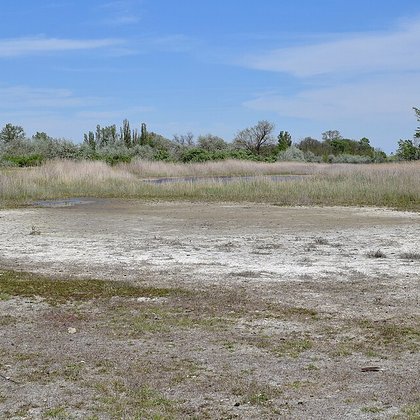
Bare, stony country: high windswept plateaux, gravelly plains with open patches, extensive dry-farmed cereal, fallow and saline flats. The species tolerates more stone, more relief and greater altitude than Pin-tailed and is more often found on coarse, thinly vegetated ground. It too gathers at water early in the morning, and the male soaks his belly feathers there and flies the water back to the chicks.
Where the bird is most at home, classified with EUNIS — the European standard for habitats.
Range and movements
In Europe essentially confined to Spain and Portugal, with a further population on Fuerteventura and Lanzarote. Eastwards it breeds in Turkey, the Caucasus, Iran and Central Asia, and southwards across North Africa. It is not a bird to expect anywhere in north-west Europe.
- Breeding (summer)
- Winter
- Passage
- Migration direction
- dark = core range, pale = thinly spread
Where and when to look
Work the higher, stonier margins of the steppe rather than the flat cereal. Stand on a rise overlooking the plain at first light and listen: the low rolling call betrays flocks that would otherwise pass unnoticed. Winter flocks are larger and more settled, which improves the chances of a view on the ground. On Fuerteventura the birds are approachable and often close to tracks.
Conservation status
Not globally threatened, but in steep decline in Spain, where an estimated 8,500 to 13,500 birds remain, one of the sharpest falls among Spanish steppe birds. Intensification and irrigation of dry farmland, the disappearance of fallow, solar developments on old steppe and the drying out of drinking pools are the main causes.