All species › Tubenoses › Northern storm petrels › Band-rumped storm petrel
Band-rumped storm petrel
Hydrobates castro | Madeirastormvogeltje | Paíño de Madeira
The Band-rumped Storm-petrel is the storm-petrel of the Atlantic islands: a bird of the Berlengas, Madeira, the Selvagens, the Canaries and the Azores that spends the rest of its life far out over deep water. It is the middle one of the three small dark storm-petrels of the region, and the hardest of them to name with confidence at sea.

Voice
Silent at sea. Over the colony at night it gives a rhythmic flight call, a rasping kair chuk-a-chuk chuk chuk repeated irregularly and delivered faster and harsher during chases. From inside the crevice comes a guttural purring urr-rrr-rrr-rrr broken by short wicka notes, and a subdued wick-ick-ick between the pair. A dark autumn night on the Selvagens or on a Canarian islet is the only reliable way to hear any of it.
No freely licensed recording is available for this species yet.
Identification
Clearly larger and longer-winged than European Storm-petrel and about the size of Leach's, blackish brown with a narrow white band running straight across the rump. The band is even in width, has clean edges, is not split by a dark centre line and wraps only a little onto the sides of the undertail, so it reads as a band rather than as a block or a V. The tail is shallowly forked, though at sea it almost always looks square. The pale bar across the greater coverts of the upperwing is dull greyish brown and far less obvious than on Leach's; the underwing is uniformly dark, without a white bar. The feet do not project beyond the tail. The flight is the best clue of all: steady and unhurried on stiff, slightly bowed wings, with long low glides and easy banking from side to side, closer to a miniature shearwater than to a fluttering bat.
Confusion species
European Storm-petrel is smaller and shorter-winged, flutters low through the troughs, shows a broad square white rump wrapping down onto the flanks and, decisively, a white bar along the underwing. Leach's Storm-petrel is the real test: longer and more sharply angled in the wing, with a conspicuous pale diagonal band across the upperwing, a narrower V-shaped rump patch usually divided by a dark line, a forked tail and a bounding, veering flight full of sudden changes of direction, where the Band-rumped glides steadily on. Wilson's Storm-petrel is smaller and blunter in the wing, with long legs projecting beyond a square tail and yellow webs. In the Azores the summer-breeding birds are now treated as a separate species, Monteiro's Storm-petrel, which cannot be separated at sea with any confidence; there the date of the record is often all there is to go on.
Habitat
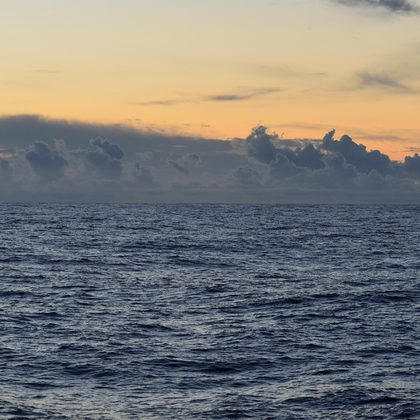
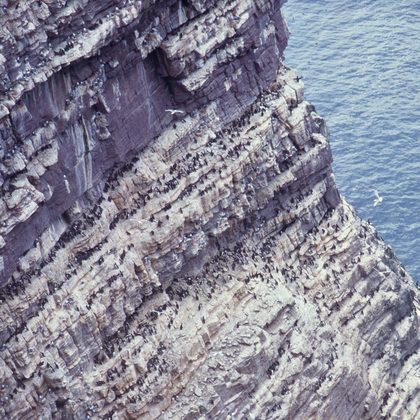
Pelagic away from the colony, mostly over deep water beyond the shelf edge, where it takes small crustaceans, fish fry and oily scraps from the surface while hovering and pattering. It comes ashore only to breed, into crevices, small caves and cavities under boulders on bare rocky islets and sea cliffs, and it does so only at night. Colonies persist only on islands without rats and cats.
Where the bird is most at home, classified with EUNIS — the European standard for habitats.
Range and movements
Within the area of this guide it breeds on the Berlengas off mainland Portugal, on Madeira and the Selvagens, on the Azores, and in the Canaries on islets such as the Roques de Anaga, Alegranza and Montaña Clara; beyond it, on St Helena, Ascension and the Cape Verdes, and in the Pacific off Japan, on Hawaii and in the Galápagos. In Macaronesia most pairs lay in autumn and early winter. Away from the islands the birds spread out over the open Atlantic, are only rarely seen from land, and do not reach the North Sea.
- Passage
- dark = core range, pale = thinly spread
Where and when to look
Take a chummed pelagic out of the Canaries or Madeira — off Tenerife, Lanzarote or Porto Santo — between September and November, when birds are attending the colonies and come readily to a slick. Allow yourself time on each bird: watch the flight action for several seconds before judging the rump, because in poor light a Leach's can look band-rumped and then look like a Leach's again. From land the odds are slim, and a Canarian headland or Cabo de São Vicente after a strong autumn blow is the best of a thin set of options.
Conservation status
Not globally threatened (IUCN: Least Concern), with a world population spread thinly over many small colonies. In Spain the species stands in the national catalogue of threatened species as Vulnerable, because the Canarian colonies are small and confined to a handful of islets. Rats and cats on the breeding islands, light pollution that brings fledglings down on the inhabited islands, and predation by large gulls are the main pressures; clearing rats from Macaronesian islets is the measure that has done most good.