All species › Cuckoos › Cuckoos › Yellow-billed cuckoo
Yellow-billed cuckoo
Coccyzus americanus | Geelsnavelkoekoek | Cuclillo piquigualdo
A slim North American cuckoo that arrives in Europe on the tail of an Atlantic depression in October. Almost every record falls in Ireland and western Britain, and the birds are usually so exhausted that they can be watched at a few metres.

Voice
On the breeding grounds a hollow, wooden kow-kow-kow-kowlp-kowlp that slows and drops towards the end, and a series of soft coo notes. Vagrants in Europe are silent; you will not find one by ear.
Recording: Jonathon Jongsma — CC BY-SA 3.0 · Wikimedia Commons
Identification
Slim and elongated, with a long tail and a slightly decurved bill whose lower mandible and cutting edge are yellow. The upperparts are plain grey-brown with a coppery sheen, the underparts clean white. The open wing shows rufous primaries. The undertail is black with six large, sharply defined white ovals, and a narrow yellow ring surrounds the eye.
Confusion species
Black-billed Cuckoo is the only serious pitfall. It has an all-dark bill with no yellow, a red orbital ring on adults rather than a yellow one, and no rufous in the wing. The feature that repays photographs is the undertail: large white ovals on black on Yellow-billed, narrow white tips to grey-brown feathers on Black-billed. Take care with young birds: a juvenile Black-billed can show a pale bill base and a buff-yellow eye-ring, and a juvenile Yellow-billed has a vaguer tail pattern and less yellow on the bill. Assess wing and tail together, never one feature on its own.
Habitat
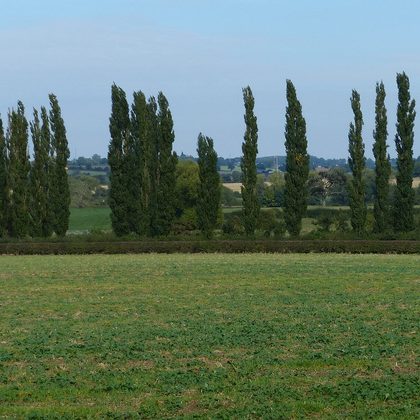
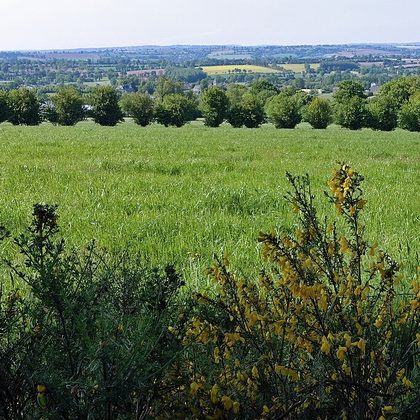
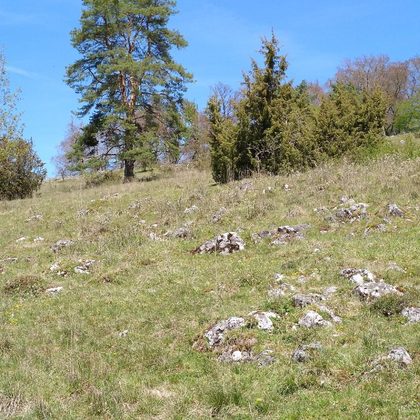
In North America, riverside willow and cottonwood, dense thickets and neglected orchards. In Europe the bird sits in the first cover it reaches after landfall: sycamores round an island churchyard or farm, gardens with thick shrubs, hedges and willow scrub.
Where the bird is most at home, classified with EUNIS — the European standard for habitats.

Range and movements
Breeds across eastern and central North America and winters in South America. In Europe it is an autumn vagrant, with the great majority of records in Ireland, Cornwall, Scilly, Wales and the Western Isles, plus a run of records in the Azores. Records elsewhere on the continent are few.
Where and when to look
Track deep depressions crossing the Atlantic from Newfoundland in late September and October; the best chance comes two to four days later. On an island, work the densest sheltered bushes and the sycamores. Birds feed slowly and low and often allow a close approach, so do not push them.
Conservation status
Not threatened globally, but the western population in the United States has shrunk badly with the loss of riverside woodland and is separately protected there. Eastern numbers are also falling through fragmentation and pesticide use. For Europe the interest is purely as a vagrant.