All species › Waders, gulls and terns › Gulls and terns › Slender-billed gull
Slender-billed gull
Chroicocephalus genei | Dunbekmeeuw | Gaviota picofina
A gull of salt pans and coastal lagoons, and away from the Mediterranean a genuine rarity. Long-necked, small-headed and long-billed, it looks less like a Black-headed Gull than like something halfway to a tern.

Voice
A hoarse, nasal call recalling Black-headed Gull but fuller and lower. At the colony adults give long series of six to ten hard kraah notes closed off by a higher krerr. Over a salt pan the effect is a continuous din from dozens of birds, louder than a Black-headed Gull colony of the same size.
No freely licensed recording is available for this species yet.
Identification
Bigger and longer than a Black-headed Gull, with a long, gently drooping bill that reads black at range and dark red up close. The head is small and rounded with a high forehead running smoothly into the bill base; neck and legs are long, so a swimming bird sits high and stretched. The head stays white all year with no hood, the iris is pale yellowish-white and the eyelid ring a thin red line. Mantle pale grey, underparts white with a rosy flush that can be strong in spring. In flight a white primary wedge as in Black-headed Gull, tipped black.
Confusion species
Black-headed Gull is the bird to work against. Slender-billed shows a longer, evenly drooping bill without the angled gonys, a small round head with a high forehead, and noticeably longer neck and legs. In summer plumage it lacks the chocolate hood altogether, keeping at most a dusky smudge behind the eye, and the breast carries a pink flush that Black-headed rarely matches. The pale iris against Black-headed's dark eye settles most birds at close range.
Habitat
Salt pans, coastal lagoons, river mouths and the shallow inshore water in front of them. Breeds colonially on bare sand and shell islets with sparse halophytic vegetation, usually alongside terns, avocets and other gulls. Feeds by walking and picking over mud and by flying low over shallow water, dropping from about a metre to seize fish, shrimps and insects.
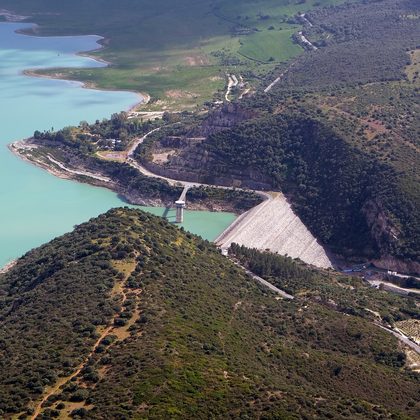
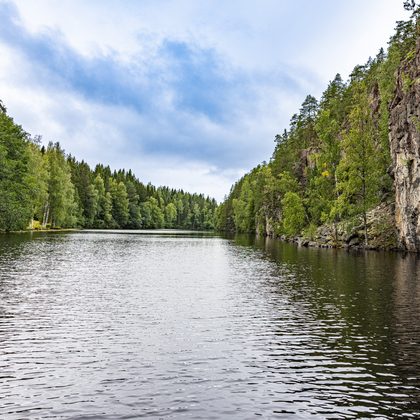
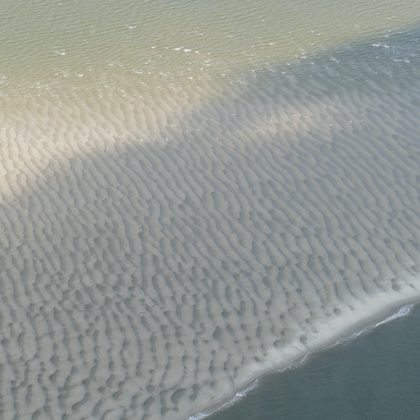
Where the bird is most at home, classified with EUNIS — the European standard for habitats.

Range and movements
Scattered colonies around the Mediterranean, the Black Sea and the Caspian, east to Kazakhstan and north-west India, and along the coasts of Mauritania and Senegal. Spain holds the western stronghold, with the Ebro delta, the Alicante salt pans and the Andalusian marshes. North of the Pyrenees it is a rare visitor, in the Netherlands recorded only in spring and always in single figures per decade.
- Resident
- Breeding (summer)
- Winter
- Passage
- Migration direction
- dark = core range, pale = thinly spread
Where and when to look
In north-west Europe this is a bird you wait for rather than look for. To see it reliably, work the Ebro delta or the Santa Pola salt pans in April or May, scanning from the dyke tracks. Pick out the shape first: the long neck and drooping bill carry further than any plumage detail.
Conservation status
Not globally threatened, but the European population is small and concentrated at few sites, which makes it vulnerable to changes at any one of them. The Spanish population is growing and passed 2,500 pairs in the 2020 census. The main pressures are altered water management in working and abandoned salt pans, generalist predators reaching the nesting islets, and disturbance, since a colony that flushes does not always settle again.