All species › Waders, gulls and terns › Gulls and terns › Ivory gull
Ivory gull
Pagophila eburnea | Ivoormeeuw | Gaviota marfileña
A snow-white gull on short black legs, at home on pack ice and drift ice. It is the only European gull that carries no grey saddle at any age, and the only one that spends its whole life within reach of the sea ice.

Voice
Shrill and tern-like, nothing like the barking of the large gulls: a hard, carrying kreee and a rattling, grating scream in disputes over carrion. Vagrants wintering in Britain and Ireland are silent. At the colony the noise is nearly continuous, with short alarm calls flung out over the rock.
No freely licensed recording is available for this species yet.
Identification
Adults are wholly white, with no grey in mantle or wing, short black legs, a blue-grey bill tipped yellow to orange, and a small dark eye inside a red orbital ring. The build is compact: plump body, short neck, small head and long, pointed wings. First-year birds show a dusky, smudged face, black spotting across the wing coverts and a line of black spots along the tail tip.
Confusion species
At range over the sea the first thought is often a white pigeon or a bleached gull, and both are straightforward to rule out. Against a white feral or racing pigeon, the Ivory Gull has short black legs where a pigeon has pinkish-red ones, and a blue-grey bill with a yellow tip against the pigeon's stubby pale bill with its fleshy cere. The flight genuinely does mislead: the Ivory Gull beats stiffly and shallowly and glides low over the ice with a pigeon-like feel, but the wings are longer and more pointed, the bird changes course far more easily, and the small gull head and short, slightly wedge-shaped tail come through on a decent view. On the ground it walks with quick, pigeon-like steps, which keeps the confusion alive. Against a bleached or leucistic gull, the black legs settle it: Herring, Glaucous, Iceland and Kittiwake carry pink, yellow or black legs in other combinations, never this short jet-black pair under a wholly white body. Then check the bill, because no pale gull has that blue-grey shaft with a sharply defined yellow tip and no red gonydeal spot. A bleached Herring Gull also keeps dark shafts in worn primaries and a grey cast to the mantle, while an Ivory Gull stays pure white even when the plumage is abraded; and a first-year Ivory Gull is unmistakable anyway, with black spotting on the coverts and a black-edged tail.
Habitat
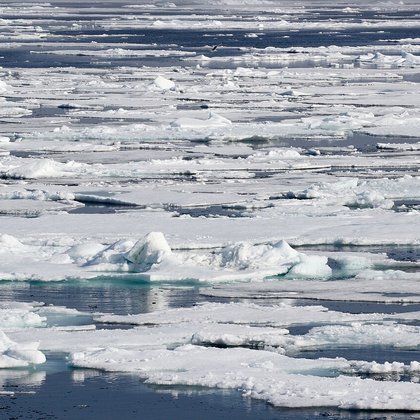
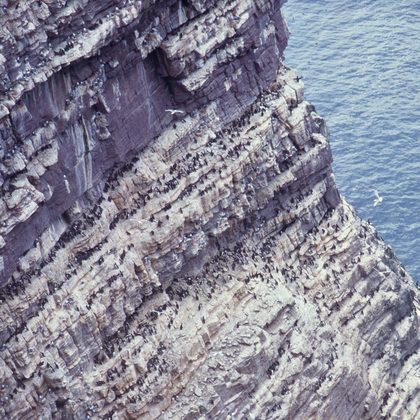
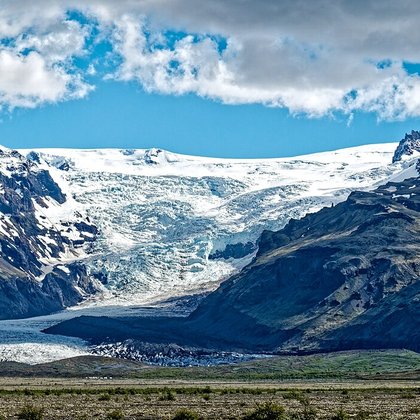
Pack ice and drift ice are the element: it feeds along leads and open holes, at the ice edge and behind polar bears, taking the remains of seals. Colonies sit on steep cliffs, on nunataks standing out of the ice cap and on bare gravel ridges of the high Arctic, usually within reach of open water. Outside that zone the bird is out of place, and European vagrants are usually weakened birds.
Where the bird is most at home, classified with EUNIS — the European standard for habitats.
Range and movements
Breeds on Svalbard, Franz Josef Land, Severnaya Zemlya, north-east Greenland and in the Canadian Arctic, wintering along the ice edge of the Barents Sea, Davis Strait and Bering Sea. Britain and Ireland have a long but thin record: most accepted birds are in Shetland, Orkney and the north-east coast, in the second half of winter, and a bird that lingers for a few days can be the twitch of the season.
- Winter
- Passage
- dark = core range, pale = thinly spread
Where and when to look
This is not a species you search for; you go to it. Watch the news services from mid-December to March and plan for one day, because a tired Ivory Gull may stay a week on a beach or in a harbour but just as often is gone by the next morning. On arrival look at the legs and the bill first, since both are decisive even on a poor photograph.
Conservation status
Near Threatened, with a declining world population. Shrinking sea ice removes the platform it feeds from, and it carries the highest mercury burden of any Arctic seabird, which tells on eggshells and breeding success. The Canadian Arctic population has fallen sharply since the 1980s, and colony disturbance and hunting in Greenland add to the pressure.