All species › Waterfowl › Ducks, geese and swans › Ross's goose
Ross's goose
Anser rossii | Ross' gans | Ánsar de Ross
A white goose barely larger than a Mallard, with a rounded head and a stubby triangular bill lacking the black grin patch. Beside Snow Geese it looks like a scale model. The identification is easy; the assessment is not, because hybrids with Snow Goose are frequent and the species is widely kept in collections.

Voice
Higher and weaker than Snow Goose: a short grunting konk in flight and a thin cackling kek-ke-gah from the flock. In a mixed goose flock it is swamped by the yelping of Greenland White-fronts. This is a bird for the scope, not the ear.
No freely licensed recording is available for this species yet.
Identification
Adults are white with black primaries, pink legs and a short, deep, triangular pink bill. There is no black grin patch along the cutting edge, and older birds show blue-grey warty caruncles at the bill base. The border between bill and head feathering runs straight up rather than sloping back. The head is round, the neck short and thick, the body compact. Juveniles are white with a light grey wash over the crown and mantle and a greyish bill, far whiter than a young Snow Goose. A blue morph exists but is very rare.
Confusion species
Snow Goose is the main confusion: distinctly bigger and longer-necked, with a longer bill showing an obvious black grin patch, and often a rusty stain on head and neck. Check the feather border at the bill base, sloping on Snow and vertical on Ross's. Ross's × Snow hybrids are regular and show intermediate size with some black along the cutting edge; leave those alone. In a mixed flock the smallest goose present can also read as a Lesser White-fronted Goose, but that bird is brown with a white blaze and a yellow eye-ring, where Ross's is snow-white with black wingtips.
Habitat
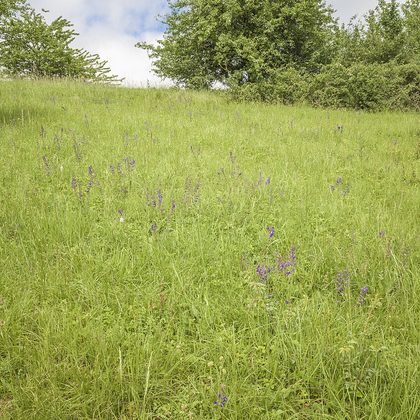
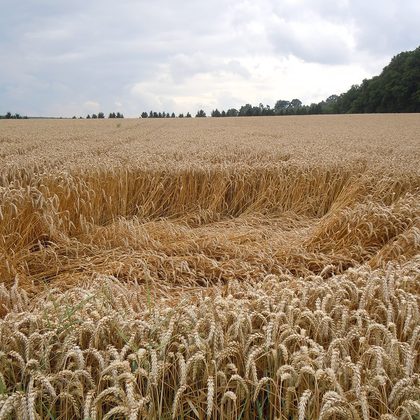
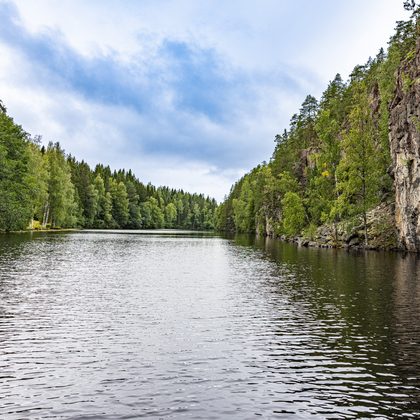
In Europe found only among other geese: closely grazed grassland and winter cereals, flooded fields, stubbles and saltmarsh, with roosts on shallow fresh water or estuary flats. It grazes head-down and betrays itself in a flock as a small white patch sitting below the skyline of the surrounding White-fronts.
Where the bird is most at home, classified with EUNIS — the European standard for habitats.

Range and movements
Breeds in the central Canadian Arctic and winters in California, Texas and the Mississippi valley. In Europe a rare vagrant. The BOU moved it to Category A in November 2021 on the strength of a bird that returned to Plex Moss, Lancashire, from December 1970 until 1974. The species is nonetheless widely kept in wildfowl collections and escapes occur, so every European record is judged on origin first: a bird embedded in a flock of wild Greenland or Icelandic geese carries weight, a tame bird on a park lake does not.
Where and when to look
From October to March go through the Pink-footed Goose flocks in Norfolk and Lancashire and the Greenland White-front and Barnacle flocks on Islay and at Wexford, checking every white goose. Photograph the bill base in profile, because without a clear view of the grin patch and the feather border a claim will not stand. Note leg rings and how the bird behaves when the flock flushes.
Conservation status
Not threatened. The world population has grown from a few tens of thousands in the mid twentieth century to over a million, helped by abundant crop food in the wintering range. Those numbers now strip the vegetation of parts of the Arctic breeding grounds, which is the main concern for the species. Hybridisation with Snow Goose is widespread but does not put it under pressure.