All species › Waterfowl › Ducks, geese and swans › Cackling goose
Cackling goose
Branta hutchinsii | Kleine canadese gans | Barnacla canadiense chica
A Canada Goose in miniature, barely larger than a Barnacle, with a stubby bill and a steep forehead. In Europe it is nearly always buried in a flock of Barnacle or Greenland White-fronted Geese, which is exactly where it gets found. Look at proportions, not colour.

Voice
Higher and thinner than Canada Goose: a rapid, yelping cackle, kek-kek or rink-rink, without the deep two-note trumpeting. In a mixed flock it is often the first thing that catches the ear, and it is worth working the whole flock with the scope once you hear it.
No freely licensed recording is available for this species yet.
Identification
Black head and neck with a white chinstrap, brown mantle and flanks, white stern and black tail: the Canada Goose pattern in a compact bird with a short thick neck, a rounded crown and a bill clearly shorter than the depth of the head. Breast colour varies by race: hutchinsii, the form that reaches Britain and Ireland, is pale greyish-brown, minima is small and dark chocolate, and leucopareia often shows a white collar at the base of the black. In flight it looks short and quick, with faster wingbeats than its larger namesake.
Confusion species
Canada Goose is the trap, particularly the smaller feral birds: much bigger, long-necked, with a long bill and a sloping forehead. Compare bill length with head depth, the most reliable measure in the field. Runt Canadas and hybrids with Barnacle or Greylag account for most mistaken claims. Barnacle Goose has an entirely white face rather than a chinstrap and a silver-grey, black-barred mantle; Brent lacks the chinstrap altogether and shows only a white neck flash.
Habitat
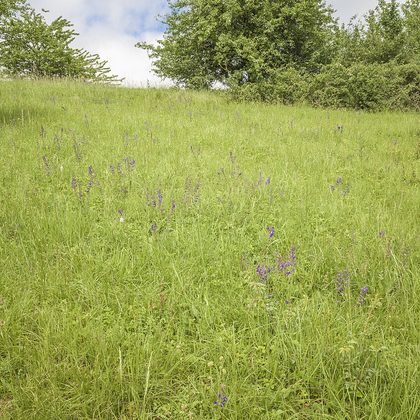
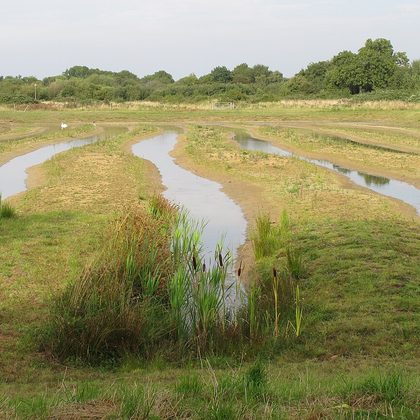
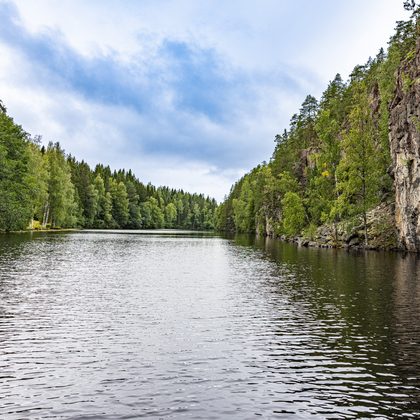
Saltmarsh and salt-grazed swards, short-cropped machair and eelgrass flats, wet inland pasture and stubbles, roosting on shallow water, lagoons and estuary flats. In Europe almost always inside a flock of Barnacle, White-fronted or Brent Geese, flighting with them to roost.
Where the bird is most at home, classified with EUNIS — the European standard for habitats.

Range and movements
Breeds on the tundra of Alaska and northern Canada and winters in North America. In Europe a rare vagrant, concentrated in Ireland and western Scotland among Barnacle and Greenland White-fronted Geese; a handful are thought to arrive each year. The Netherlands has eleven accepted records of hutchinsii since 1997, most of them in Friesland. Because small feral Canada Geese breed in western Europe and the forms are kept in collections, the company a bird keeps matters as much as its structure.
Where and when to look
Work Islay in October and November, and the Wexford Slobs and Lough Foyle from November onwards, going along the edge of each Barnacle and White-front flock. Look for a goose that reads as noticeably smaller with a blunt little bill, then check head depth against bill length. Photograph it beside a Barnacle in the same posture; that image is what a record hangs on.
Conservation status
Not threatened; most races are numerous. The Aleutian form leucopareia has recovered strongly since introduced Arctic Foxes were cleared from the breeding islands. The pressures are hunting along the flyways, predation on the breeding grounds and the loss of saltmarsh and wet grassland in the wintering range.