All species › Swifts › Swifts › Horus swift
Horus swift
Apus horus | Horusgierzwaluw | Vencejo horus
The Horus Swift is an African swift of bare sandy banks, where it takes over the nest tunnels dug by bee-eaters, kingfishers and martins. It has a broad white rump band and a shallowly forked tail. It lies almost entirely outside the area of this guide: one bird on Schiermonnikoog in September 2019 is the only accepted European record.

Voice
At the burrow colonies the birds give a rapid, dry chattering trill, tsirr-tsirr-rrr, thinner and less carrying than the scream of a Common Swift, with squeaky notes at the tunnel mouth. Away from the colony the species is largely silent, and freely licensed recordings are hard to find. In the area of this guide the voice is of no practical use, since the single European bird was a lone migrant.
No freely licensed recording is available for this species yet.
Identification
A medium-small swift, 13–15 cm long, sooty blackish brown with a faint gloss, heavier in build than a Common Swift and with broader wings. The white rump forms a broad, clean band that continues a short way onto the rear flanks, so it stays visible from most angles, but it does not run forward as far as on a Little Swift. The tail is of medium length with a shallow fork, the notch measuring only about one centimetre, so a closed tail shows a small nick rather than a spike. Chin and throat carry a fairly large pale patch, less sharply defined on worn birds. Flight is strong and steady, with deep beats and long glides.
Confusion species
Common Swift is bigger (17–18.5 against 13–15 cm), with stiff scythe-shaped wings, a short forked tail and uniform sooty brown plumage showing at most a pale throat patch; it never has a white rump. Pallid Swift is browner, with a stronger head and throat pattern and broader-based wings, and also lacks a white rump. Alpine Swift is far bigger and has a white belly, not a white rump. Among the three small white-rumped swifts, Horus Swift sits in the middle: the rump band is broad, much as on a Little Swift, but it stops on the rear flanks instead of running well forward, and the tail is shallowly forked rather than square-cut. Little Swift is smaller and stockier, with the broadest, squarest white rump, the largest white throat and a square tail. White-rumped Swift is slimmer, with a narrow white crescent that does not reach the flanks and a long, deeply forked tail carried closed in a point.
Habitat
Bare sandy and clay banks along rivers, in erosion gullies, road cuttings, quarries and mine dumps, where it uses the old tunnels of bee-eaters, kingfishers, ground woodpeckers and martins; it digs nothing itself. Hunts over open grassland, savanna and semi-desert and over the water of nearby rivers and lakes, mostly at low to moderate height.
Where the bird is most at home, classified with EUNIS — the European standard for habitats.
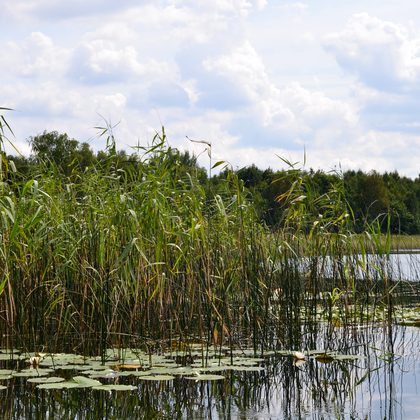

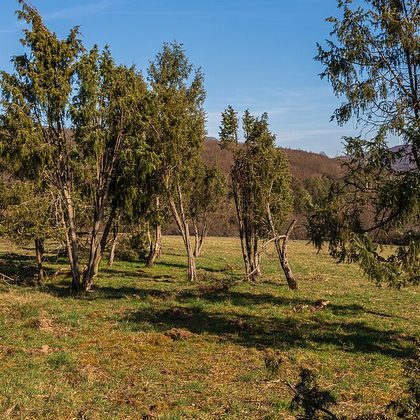
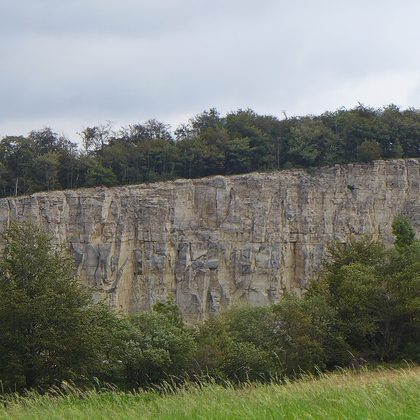
Range and movements
Breeds patchily across sub-Saharan Africa, from Nigeria and Cameroon east to Ethiopia and south to Angola and the Cape, with the bulk of the population in South Africa. There is no breeding population anywhere inside the area of this guide and no regular passage: the northernmost regular records come from Sudan and Ethiopia, far south of the Egyptian border. A discovery in northern Senegal in 2018 moved the known range about 1,600 km west and made a European record thinkable; the bird photographed on Schiermonnikoog in the Netherlands on 26 and 27 September 2019 remains the only one so far.
Where and when to look
In Britain and the Netherlands the practical advice is to photograph every white-rumped swift from as many angles as possible. The width of the rump band, how far it reaches onto the flanks and the depth of the tail fork are what a records committee will weigh, and none of the three can be settled by eye in a few seconds. In Africa, watch a sandbank colony from the top of the opposite bank in the first hours after sunrise, when the birds come and go most often.
Conservation status
Not globally threatened (IUCN: Least Concern). Man-made banks — road cuttings, quarries and mine dumps — add nest tunnels once bee-eaters and martins have dug them, and numbers appear stable. Within the area of this guide the species has no conservation status of its own, because it occurs here only as a vagrant.