All species › Waders, gulls and terns › Gulls and terns › Great black-backed gull
Great black-backed gull
Larus marinus | Grote mantelmeeuw | Gavión atlántico
The Great Black-backed Gull is the heaviest gull in the world, and on a groyne full of Herring Gulls it is instantly the bird that looks a size too big. It is as much predator as scavenger, killing auks, storm-petrels and ailing ducks outright.

Voice
Much deeper and hoarser than other gulls: a short barking owk or ough that sounds almost canine, and a slow, heavy laughing call given with the head thrown back. It is heard at island and dyke colonies from March to June, and along the coast and at landfills in winter too. At sea the bird is usually mute; the voice often gives it away before the telescope does.
Recording: Doug Hynes — CC BY-SA 4.0 · Wikimedia Commons
Identification
Start with bulk and head shape: a blocky head with a flat crown, a huge bill with a pronounced gonydeal angle, yellow with a large red spot from the fourth calendar year. The mantle is slate-black, clearly blacker than the dark slate-grey of Lesser Black-backed Gull, and the legs are fleshy pink, never yellow. The eye is pale yellow with a red orbital ring; the wingtip carries little black and a great deal of white, with a big mirror on p10 that often merges with the white tip and a smaller one on p9. First calendar year birds show a chequerboard of black and white above, a strikingly white head and neck, an all-black bill and pale inner primaries. Through the second and third calendar year the black saddle comes through in patches and the bill base pales, so age is read from the mix of brown coverts and black feathers.
Confusion species
Lesser Black-backed Gull is smaller and slimmer, with yellow legs, a slate-grey rather than black mantle and far more black in the wingtip with smaller mirrors. Herring Gull shares the pink legs but has a pale grey mantle and a much lighter bill; side by side, the size difference settles it at once. In immatures the upperpart pattern is decisive: a first-year Great Black-backed shows a black-and-white chequered saddle and a pale head, while a first-year Herring Gull is more evenly coffee-brown with a dark head. Yellow-legged and Caspian Gulls can catch the eye on bill size alone, but both have far paler mantles and bright yellow or dull pinkish legs respectively.
Habitat
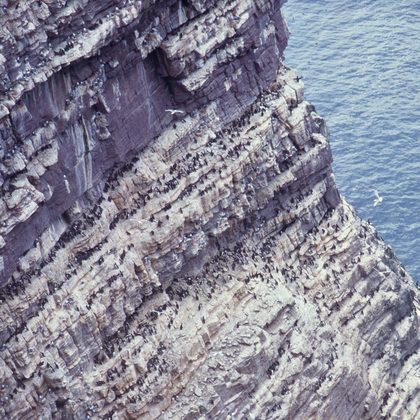
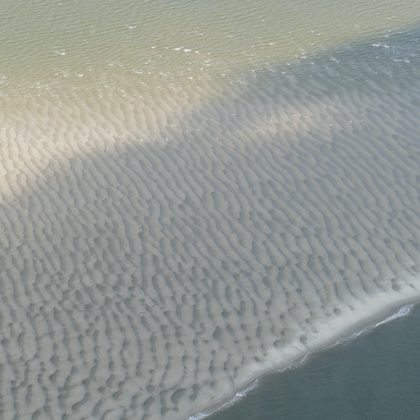
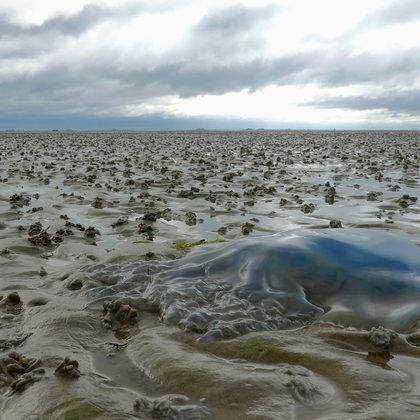
Rocky coasts, islets, harbour walls, groynes and dykes, and outside the breeding season the shallow North Sea and the tidal flats. It feeds on fish behind trawlers, on carrion along the tideline, on shellfish and above all on other birds, plucking auks and young gulls off the water and raiding colonies. In the Netherlands it nests on stone revetments and man-made islands in the Wadden Sea and the Delta, usually singly at the edge of a Herring Gull colony.
Where the bird is most at home, classified with EUNIS — the European standard for habitats.

Range and movements
Breeds in Iceland, the Faroes, Norway, Britain, Ireland, the Baltic and north-west France, and across the ocean from eastern Canada to New England. The Netherlands was colonised late: well over a hundred pairs now nest in the Wadden and Delta areas, while tens of thousands of birds winter along the coast and around the IJsselmeer. In Spain it is a scarce winter visitor to the Cantabrian and Galician coasts; further south and into the Mediterranean it is a rarity.
- Resident
- Breeding (summer)
- Winter
- Passage
- dark = core range, pale = thinly spread
Where and when to look
From November to February work a harbour wall or fishing port such as IJmuiden, Scheveningen or the Maasvlakte, and scan the loafing gulls: the Great Black-backed literally stands above the Herring Gulls and tends to keep its distance. At a high-tide roost in the Delta or along the Wadden Sea a falling tide lets you compare birds directly and judge both mantle tone and leg colour. On a seawatch, watch for the slow, heavy wingbeats, which recall a small gannet far more than a gull.
Conservation status
Not globally threatened, but European numbers are falling: breeding totals in Britain and Norway have dropped sharply since the 1980s as fishery discards dwindled and landfills closed. The Dutch trend runs the other way, with a growing but still small breeding population listed as sensitive on the national Red List. Avian influenza hits the species especially hard because it eats sick and dead birds; infected Great Black-backed Gulls turned up in numbers along the North Sea coast in 2022 and 2023.