All species › Waders, gulls and terns › Gulls and terns › Glaucous gull
Glaucous gull
Larus hyperboreus | Grote burgemeester | Gavión hiperbóreo
The white-winged giant of the northern winter. Nothing in the bird is black: the primaries are white, the mantle is pale grey, and the build is heavy, bull-necked and flat-crowned. Every winter a scatter of them reaches Scotland, Shetland and Ireland, and the fish quay is where you meet them.

Voice
Deeper, hoarser and slower than Herring Gull: a growling gah-gah-gah and a low barking alarm. Wintering birds in Britain and Ireland are almost always silent and give themselves away by shape, not sound. At the colony the long call rolls off a ledge heavier and more deliberate than any Herring Gull can manage.
No freely licensed recording is available for this species yet.
Identification
Adults show a pale grey mantle, a shade paler than Herring Gull, and wholly white primaries with no mirror and no black. The bill is yellow with a red gonydeal spot, the iris pale yellow inside a yellow orbital ring, the legs flesh-pink. First-winter birds are coffee-and-cream, evenly and finely barred all over, with cream primaries and a pink bill ending in a cleanly cut black tip. In a Herring Gull flock the bird stands a size above the rest: deep chest, thick neck, big flat head.
Confusion species
Iceland Gull is the comparison that matters, and it is worth doing in a fixed order. Size and build first: Glaucous is bulky and deep-chested, bull-necked, flat-crowned, usually larger than a Herring Gull, while Iceland is slighter, round-headed and gentle-faced, almost dove-like. Then bill length and forehead shape: Glaucous carries a long, thick bill with a pronounced gonydeal angle below a low, sloping forehead, so the eye looks small and set well forward; Iceland has a short, fine bill under a steeply rising forehead, and the large eye sits high in a domed head. Primary projection beyond the tail is just as decisive: on Glaucous the wingtips barely clear the tail and fall short of the bill length, so the bird looks long-bodied and short-winged; on Iceland they project clearly further than the bill is long, giving a long, attenuated rear end that is obvious on a swimming bird. On first-year birds the bill-tip demarcation settles it: Glaucous has a pink bill with a straight, sharply cut black tip confined to the outer third at most, while a first-year Iceland has a largely dark bill whose paler base only breaks through in the second winter and stays diffusely bordered. Within Iceland Gull, kumlieni departs from the nominate: adult kumlieni carry grey pigment in the outer primaries, from faint smoky smudges to a clear grey subterminal pattern, often with a darker iris, whereas glaucoides keeps unmarked white primaries; the standing of kumlieni is disputed and British and Irish claims need care, since almost all European birds are nominate. Finally, a bleached or albinistic Herring Gull is taken for a white-winger every winter. Check the primaries: on a genuine Glaucous the shafts and webs are white and the feather tips are smooth and rounded, while a bleached Herring Gull keeps dark shafts and shows worn, ragged, half-translucent tips, with visible contrast between abraded old feathers and fresh dark ones. A leucistic Herring Gull also stays a Herring Gull in structure, bill shape and leg colour, and a true albino has a red eye, where a Glaucous shows a pale yellow iris in a yellow ring.
Habitat
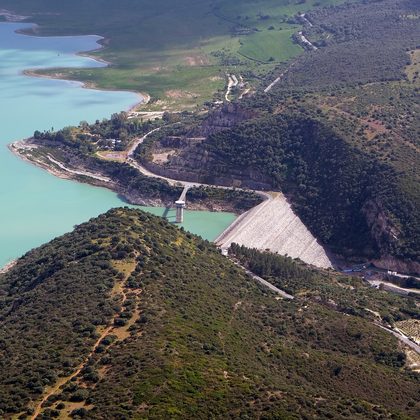
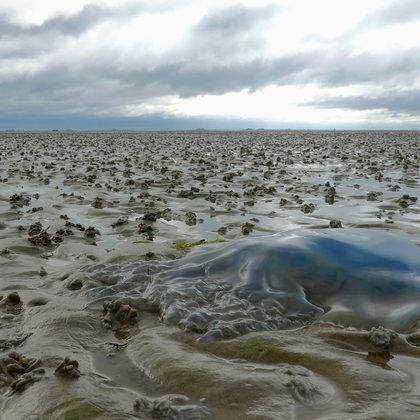
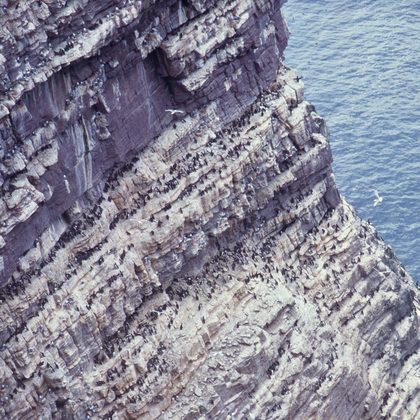
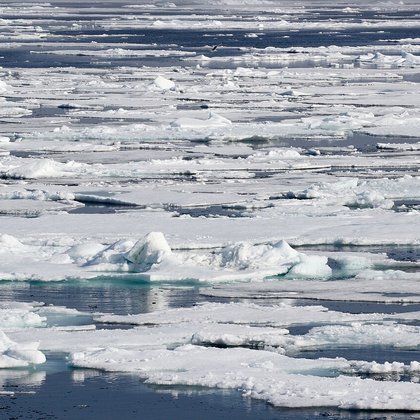
Outside the breeding season a bird of fish quays, harbour walls, slipways and landfills, loafing on tidal flats and roosting on open beaches between meals. In the high Arctic it holds cliff ledges, rock faces and low islands, feeding along the ice edge, around seabird colonies and behind trawlers. The constant is not the landscape but the food: where fish are landed or waste is tipped, the odds are highest.
Where the bird is most at home, classified with EUNIS — the European standard for habitats.

Range and movements
A circumpolar breeder in Greenland, Iceland, Svalbard, northern Scandinavia and Arctic Russia. Part of the population winters within the north, part moves down to the North Sea and the Western Approaches. Shetland, the Outer Hebrides and the Irish fishing ports hold birds every winter, often several at one quay; numbers thin quickly southwards, and in Iberia it is a genuine rarity.
- Resident
- Breeding (summer)
- Winter
- Passage
- Migration direction
- dark = core range, pale = thinly spread
Where and when to look
February on a working fish quay is the whole method. Lerwick and Scalloway in Shetland, Stornoway in Lewis, Peterhead on the Aberdeenshire coast and Killybegs in Donegal all repay an hour with a scope: wait for a boat to come in, let the flock lift, and pick out the bird that is a size larger with no black in the wing. Then check the head and bill before you claim it, because bleached Herring Gulls do the same trick at range.
Conservation status
Not globally threatened, but numbers are falling in parts of the Arctic range. The species sits high in the food chain and accumulates persistent pollutants, which depresses breeding success, and it is also affected by the decline in trawler discards. In Iceland and northern Norway frequent pairing with Herring Gull produces intermediate birds that muddle counts and put a trap under every harbour record.