All species › Passerines › Leaf warblers › Eastern crowned warbler
Eastern crowned warbler | Phylloscopus coronatus
Kroonboszanger | Mosquitero coronado
Eastern Crowned Warbler breeds in the broadleaved woods of the Russian Far East, Korea and Japan, and it is among the rarest vagrants north-west Europe can produce. Some thirteen European records are known from 2000 to 2024, two of them Dutch. Finding one means looking at a large, long leaf warbler with a silvery-white belly and lemon-yellow trousers.

Voice
In Europe the call is all you are likely to get, and it is thin and sharp: a high, reedy tsee or tsu-wee, short and slightly squeaky, less penetrating than a Yellow-browed's and without the hard tack of an Arctic Warbler. Birds call sparingly, often only after long silences, so a European individual is usually identified on plumage first. The song, delivered in the breeding woods from May to July, is by contrast loud, clear and surprisingly musical: a short, measured phrase of a few run-up notes followed by a rising flourish, roughly chee-chee-chee-choo-weet, repeated for hours from a branch halfway up the canopy. It is one of the defining sounds of Japanese and Korean broadleaved woodland in spring.
No freely licensed recording is available for this species yet.
Identification
Large and elongated for a leaf warbler, with a long, heavy bill and a long wing; the size and the bulky head suggest Wood Warbler rather than Yellow-browed. Upperparts olive-green, the crown greyer with two dark lateral stripes enclosing a vague yellowish median stripe that is often only visible in good light or when the crown feathers are raised. The supercilium is long, broad and yellowish-white and runs well behind the eye; below it lie a dark eye-stripe and dark lores. A single narrow yellowish-white bar crosses the greater coverts; a second is absent or at most a trace. The clinching feature is under the tail: the underparts are clean silvery white, but the undertail coverts are bright lemon-yellow and stand out sharply against them. The lower mandible is wholly orange with no dark tip, the legs are greyish-pink to brownish, and the primary projection is long.
Confusion species
Arctic Warbler is the first to rule out: it has no crown stripe, no yellow undertail coverts, and a clearly dark tip to the orange lower mandible. Greenish Warbler is smaller, rounder, greener, and also has white rather than yellow undertail coverts. Wood Warbler comes closest in size and posture and shares the long wing, but on it the yellow is on the throat and breast, above a snow-white belly, and it has neither crown stripe nor wing bar. Yellow-browed Warbler is less than half the size, shows two bold wing bars, and has no yellow beneath the tail. If the light will not let you see the yellow vent, work instead from the combination of size, the heavy orange bill without a dark tip, and the faint pale crown stripe.
Habitat
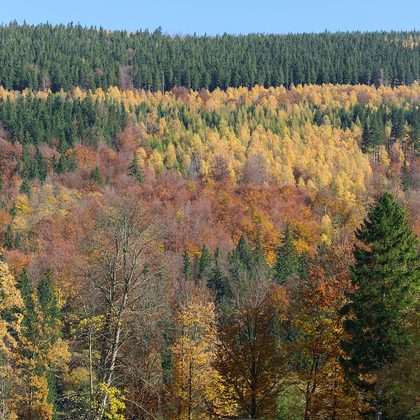
Breeds in tall broadleaved and mixed woodland of hill and mountain country: oak, maple, lime and birch forest with a closed canopy and an open understorey, up to about the upper limit of deciduous woodland in the mountains of Japan, Korea and the Amur region. It is equally at home in mature park woodland, temple groves and wooded city edges. It feeds high, mostly in the middle and upper canopy, and on migration and in winter uses forest and scrub across south-east Asia.
Where the bird is most at home, classified with EUNIS — the European standard for habitats.


Range and movements
Breeds from the Amur region and north-east China eastwards through Korea and across Japan, and winters from eastern India and Bangladesh to Malaysia and Java. In the Western Palearctic it is an exceptional vagrant: the first record came from Heligoland, Britain waited until October 2009 for its first in County Durham, and roughly thirteen European records were accepted between 2000 and 2024. Two of those are Dutch: Katwijk on 5 October 2007 and Castricum from 21 to 23 October 2016. It has never been recorded in Spain or elsewhere in the Mediterranean.
Where and when to look
Realistically you do not find this bird by looking for it, but by taking every large, pale-bellied leaf warbler in an October coastal copse seriously instead of writing it off as a Willow Warbler. The golden rule: on any leaf warbler that looks clearly bigger than a Chiffchaff and shows one wing bar, check the undertail coverts and the tip of the lower mandible. Photograph what you see — with a species on two Dutch records, images are the only thing that will convince a committee. Best conditions: the second half of October on a Wadden island or a coastal headland after a long spell of easterly wind, the same situation that delivers Dusky and Radde's Warblers.
Conservation status
Not globally threatened; the species is numerous across much of East Asia and breeds in planted and urban woodland as readily as in natural forest, which makes it less vulnerable than many woodland birds of the same region. Felling of old broadleaved forest and its conversion to conifer plantation are locally unfavourable. European records have risen slightly in recent decades, in step with other East Asian vagrants, but the species remains in a wholly different class of rarity here from Yellow-browed or Dusky Warbler.