All species › Passerines › Leaf warblers › Two-barred warbler
Two-barred warbler | Phylloscopus plumbeitarsus
Swinhoes boszanger | Mosquitero de Swinhoe
Two-barred Warbler is the eastern link in the chain of forms around Greenish Warbler and the rarest of the three in our area: a bird of Transbaikalia, Mongolia and Manchuria of which north-west Europe has only a scattering of accepted records. It looks like a Greenish Warbler that has been handed a Yellow-browed Warbler's wing bars by mistake, and that is exactly what makes it so confusing in a coastal copse in October.

Voice
The call is the key, and it is fuller, rounder and more rolling than Greenish Warbler's: a disyllabic chew-wee that often extends into a trisyllabic chew-el-wee or chirri-lee, with a distinctly rolled, burred middle. Where Greenish is short and sharp like a Pied Wagtail, Two-barred is longer, broader and has a roll in it. The difference is small but obvious on a sonagram, and that is precisely why every north-west European record stands or falls on a recording. The song, almost never heard in Europe, is a fast, high, rattling series at much the same tempo as Greenish, but with different and longer phrases.
No freely licensed recording is available for this species yet.
Identification
Slightly bigger and longer than Greenish Warbler, with a somewhat larger head. Darker and purer olive-green above and whiter below — the contrast between upperparts and underparts is stronger than in its western counterpart, and there is almost no yellow. The supercilium is long and yellowish-white and runs well behind the eye, but it very rarely reaches far enough forward for the two sides to meet above the bill. The wing carries two bars. The lower one, across the tips of the greater coverts, is long, broad and of even width along its whole length — a true bar, not a wedge. Above it lies a shorter but clear white bar across the median coverts, which on a worn late-autumn bird can abrade and all but vanish. The legs are dark lead-grey, which is what the scientific name records; the lower mandible is orange-yellow with no dark tip.
Confusion species
Two species have to be ruled out. The first is Greenish Warbler: it has one wing bar, and that bar is narrow, off-white and often tapers to a wedge at its outer end, whereas in Two-barred it stays the same width throughout; Greenish also usually has superciliums that meet above the bill, which Two-barred hardly ever does, and Greenish is paler and greyer green above. See its own species page, where the same difference is set out from the other side. Remember that a worn Two-barred can lose its second bar; if the bird is also silent, leave it unrecorded. The second is Yellow-browed Warbler, and on a snap view that is the real danger: two wing bars again, but it is clearly smaller and more compact, has a pale stripe along the centre of the crown, broad white tertial fringes, a yellower face and a loud, upslurred call. Two-barred lacks the crown stripe and the striking tertial fringes altogether. Arctic Warbler has a dark tip to the lower mandible, pale legs and usually only one bar; Green Warbler is yellow-green on head and throat.
Habitat
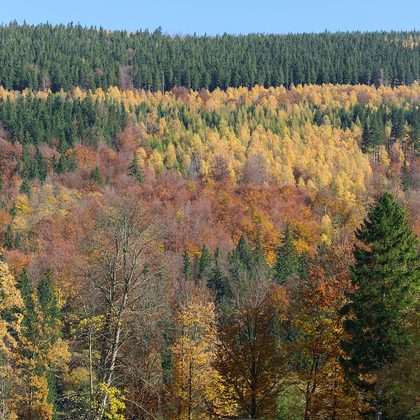
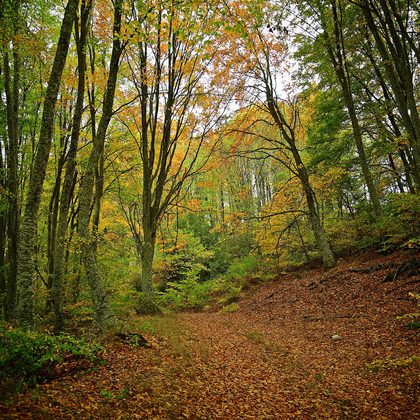
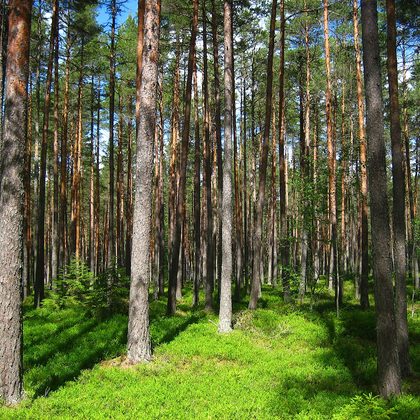
Breeds in the south-eastern taiga: mixed larch, birch and spruce forest with a dense shrub layer, young birch regrowth on old burns, and above all the dense willow and alder thickets of river floodplains and stream valleys, where it feeds low and inconspicuously. Also in oak and lime woodland in Manchuria and the Russian Far East. It winters in the forest edges, bamboo and scrub of southern China, Indochina and Thailand. On this side of the world in autumn it is in coastal copses, sea buckthorn, elder and willow scrub, usually in the company of tits.
Where the bird is most at home, classified with EUNIS — the European standard for habitats.

Range and movements
Breeds from Lake Baikal and Transbaikalia east through Mongolia, Manchuria and north-east China to the coast of the Sea of Okhotsk, and winters in south-east Asia. The entire range therefore lies far outside our map area, and everything that appears here is a lost autumn migrant. Britain's first was on the Isles of Scilly in 1987, and since then a few more have followed at intervals of years, almost always in October on the east coast — Northumberland in 2020, East Yorkshire in 2021, North Yorkshire in 2024. The Netherlands has four accepted records: Castricum in September 1990, Terschelling in October 1996, a bird that wintered near Dronten from late November 2013 into January 2014, and Rotterdam in October 2021. The Terschelling bird was first put down as an Arctic Warbler and only corrected later, which says everything about how hard the species is. In Spain it is an extreme rarity.
Where and when to look
October, after a long spell of easterly wind, in the same coastal copses where you look for Yellow-broweds. The method is that of any eastern vagrant: walk with a tit flock and listen. If you hear something that suggests Yellow-browed but is too full and too rolling, switch on the recorder before you raise the binoculars — with this species the recording is the evidence and the view merely supports it. Once you have the bird, check in this order: size and the absence of a crown stripe, then the broad, evenly wide lower wing bar, then whether the superciliums meet above the bill, and finally the lead-grey legs.
Conservation status
Not globally threatened; the breeding range is vast and numbers are stable. In Europe the bird has only been recognised since the 1980s: until 1990 it was treated as an eastern form of Greenish Warbler and since then as a species in its own right, which keeps the European record series short. The distribution of this group of forms around the Tibetan plateau is the textbook example of a ring pattern: from the Baltic states by way of the Himalaya to eastern Siberia the forms grade gradually into one another, except at the point in central Siberia where the two ends of the ring meet — there Greenish and Two-barred Warbler live side by side without mixing, and there they behave as two separate species.