All species › Divers › Divers › Common loon
Common loon
Gavia immer | IJsduiker | Colimbo grande
The Great Northern Diver is the heaviest diver of the northern hemisphere and in the Netherlands an annual but always notable winter visitor, usually a single bird that stays for weeks in the same harbour or on the same lake. See one beside a Great Crested Grebe or a Cormorant and that massive angular outline stays with you.

Voice
In European winter quarters practically always silent; the famous repertoire belongs to the breeding lakes of Iceland and North America. There you hear a long drawn-out, mournful ah-oo-eee drifting across the water, a yodelling territorial call from the male, and a laughing tremolo hoo-hoo-hoo-hoo when the bird is uneasy. On Icelandic lakes it sounds from May to July, at its best in the stillness just after sunset.
Recording: Jonathon Jongsma — CC BY-SA 3.0 · Wikimedia Commons
Identification
Everything about the bird is heavy: a thick neck, a long low body and a head with a steep forehead, a bump just above the eye and often a second swelling at the rear of the crown. The bill is stout and dagger-shaped, in winter pale grey with a dark ridge along the upper mandible, and is held strictly horizontal. The neck border is the decisive feature: not a straight line but a jagged, notched boundary, with a dark wedge cutting into the white neck like a half collar, plus a pale eye-ring in a dark face. The upperparts are dark brown with pale feather edges, giving a scaled pattern that is clearest on young birds. In summer plumage, as seen in Iceland, the head is jet black with a green gloss, the neck carries a necklace of vertical white stripes and the mantle is a chequerboard.
Confusion species
Black-throated Diver is the main confusion: smaller and finer, with a smooth rounded crown and no bump, a thinner straight bill, a dead straight and sharp neck border and a white flank patch above the waterline. Red-throated Diver is smaller and paler still, with a thin upturned bill carried tilted up and white reaching above the eye. White-billed Diver, a major rarity, is the dangerous one: an ivory to straw-yellow bill whose upper ridge is also pale towards the tip and which appears slightly uptilted, together with a paler, more contrasting face. At long range a Cormorant can mislead, but it sits higher on the water, holds its bill tilted up and has a far thinner neck.
Habitat
It breeds on large, deep, fish-rich lakes with clean shores in Iceland, Greenland and North America; the nest sits right at the water's edge, since the bird can barely walk. It winters at sea over shallow water, in sheltered bays, tidal inlets and harbours, and in Europe regularly on large inland waters too. It dives deep and long for flatfish, crabs and shrimp and is almost always solitary.
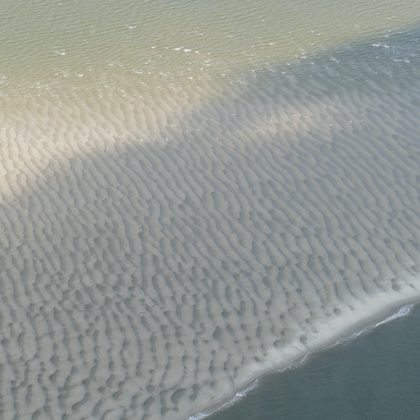
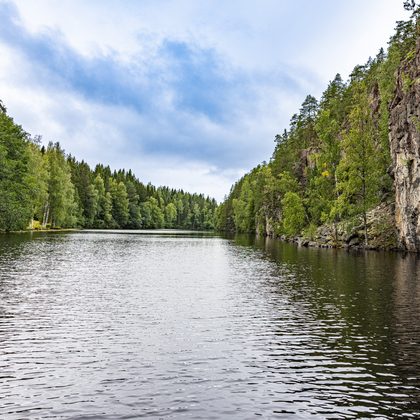
Where the bird is most at home, classified with EUNIS — the European standard for habitats.
Range and movements
A breeding bird of North America and Iceland, where a few hundred pairs nest; the European winter range runs from Norway and Britain to the Bay of Biscay. The Netherlands records a few birds each year, often long-staying in a seaport, on the IJsselmeer, the Grevelingen or a large inland lake, mainly from December to March. In Spain it is a rare winter visitor to Galicia, Asturias and Cantabria, with only sporadic Mediterranean records.
- Resident
- Breeding (summer)
- Winter
- Passage
- Migration direction
- dark = core range, pale = thinly spread
Where and when to look
The practical route is simple: follow the local bird news, because a Great Northern Diver often stays put for weeks and can then be watched at close range from a harbour quay or a dyke. Choose flat water and soft morning light, and work through head shape, bill colour and neck border in that order: the three together rule out both Black-throated and White-billed Diver. On November and December seawatches the species does pass; look for slow deep wingbeats, a drooping neck and clearly projecting feet on a bird that dwarfs every other diver.
Conservation status
Not globally threatened, with a stable to slightly increasing North American population and a small but steady Icelandic breeding population. The main threats are mercury and lead from fishing tackle, oil pollution, acidification of breeding lakes and bycatch in gillnets along the wintering coasts. In Europe the numbers are so small that the species counts mainly as a vagrant and winter visitor, and Dutch records have if anything increased in recent decades as observer numbers have grown.