All species › Divers › Divers › Arctic loon
Arctic loon
Gavia arctica | Parelduiker | Colimbo ártico
The Black-throated Diver is the middle one of the three divers that turn up regularly in the Netherlands, and the hardest to name with confidence. Its Dutch name refers to the rows of white pearl-like blocks on the mantle, which you only see in summer plumage.

Voice
At sea in winter it is almost always mute, so for the voice you have to go to the breeding lakes. There, at dusk, a far-carrying, wailing yodel, kloo-eeee, echoes between the forest edges, plus a short, hard barking kwok-kwok when two birds meet. It sounds from May to July on large clear lakes in Sweden, Finland and northern Russia; the chance of hearing it in the Netherlands is close to nil.
No freely licensed recording is available for this species yet.
Identification
In winter plumage concentrate on head shape and on the border between dark and light. The crown is flat to gently rounded, the forehead slopes evenly and the skull looks neat and smooth without a bump; the straight dagger bill is carried horizontally, never tilted up. The line between the dark grey crown and hindneck and the white chin, cheek and foreneck runs dead straight and sharp, so the bird looks crisply two-toned, with the dark reaching below the eye. On a relaxed bird a small white patch glows on the rear flank just above the waterline, the best feature at distance. The upperparts are plain dark with at most fine pale feather edges. In summer plumage it is unmistakable: a grey crown and nape, a black throat with a purple sheen, vertical white stripes on the neck sides and two large white-chequered panels on the mantle.
Confusion species
Red-throated Diver is the standing winter confusion: paler and whiter, with a thinner, slightly upturned bill carried tilted upwards, white extending above the eye so the eye sits in white, and a back finely speckled with white. Its dark-light border is also ragged and wavy, where Black-throated is straight. Great Northern Diver is far bulkier, with an angular head, a steep forehead, a bump on the crown, a much heavier bill, a pale eye-ring and a jagged neck border with a dark notch cutting into the white. Great Crested Grebe is much slimmer and whiter with a thin bill and a long thin neck, and Cormorant sits higher on the water and holds its bill tilted up.
Habitat
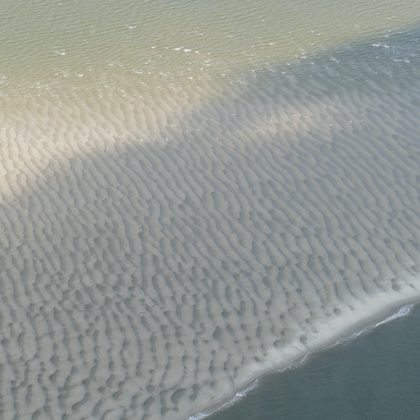
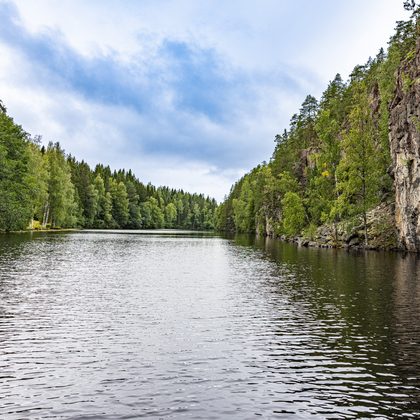
It breeds on large, deep, clear lakes in taiga and tundra, with fish-rich water and a quiet shore or islet for the nest, which sits right at the waterline. Outside the breeding season it stays wholly afloat, usually at sea over shallow banks and in sheltered bays, but in the Netherlands also on large freshwater bodies. It dives at length after small fish and is typically alone or in loose parties of a few birds.
Where the bird is most at home, classified with EUNIS — the European standard for habitats.
Range and movements
A breeding bird of northern Europe and Siberia, with the nearest populations in Sweden, Finland, Norway and the Baltic states; it winters along the North Sea, the Baltic, the Atlantic coast and in the Black Sea. The Netherlands has no breeders, but tens to a few hundred birds winter each year on the North Sea, the Grevelingen, the Veerse Meer and the Veluwe border lakes, with passage in November and again in March and April. In Spain it is a scarce winter visitor to the Cantabrian and Galician coasts and the Bay of Biscay, with scattered records into the Mediterranean.
- Resident
- Breeding (summer)
- Winter
- Passage
- Migration direction
- dark = core range, pale = thinly spread
Where and when to look
Seawatching in October and November and again in March and April produces most birds: watch from an exposed headland or dam and look for hump-backed silhouettes shooting low over the water with a drooping neck and projecting feet. For relaxed viewing the Grevelingen, the Veerse Meer and the border lakes are better, ideally on a windless morning with the sun behind you so that neck border and flank patch show cleanly. Take your time: a diver stays under for minutes on end and often surfaces a hundred metres further on.
Conservation status
Not globally threatened, but the European picture is poor: breeding numbers in Fennoscandia and the Baltic are falling through lake acidification and water-level management, recreation on breeding waters and clutches lost to boat wash. At sea, bycatch in gillnets, oil pollution and disturbance from shipping and wind farms are the main risks. For the Netherlands the numbers involved are modest winter totals, which swing widely from year to year with the severity of the winter in the Baltic.