All species › Divers › Divers › Red-throated loon
Red-throated loon
Gavia stellata | Roodkeelduiker | Colimbo chico
The Red-throated Loon is Europe's smallest and slimmest diver, and the only one that winters in real numbers just off the Dutch coast. See one on a tundra pool in Lapland in June and you would hardly connect it with the grey bird passing the Brouwersdam in January.

Voice
Silent at sea; in Dutch waters you will practically never hear it. At the breeding site it is the opposite: a plaintive, drawn-out wail that rolls across the water and carries far, and a rhythmic barking kwuk-kwuk-kwuk given in flight between the nesting pool and the sea. The wailing comes mostly at dusk and at night, from May to July on tundra and taiga pools in northern Scandinavia, Iceland and Scotland.
Recording: British Library — CC BY-SA 4.0 · Wikimedia Commons
Identification
In flight the best character: a long, low silhouette skimming the waves with a noticeably drooping belly, head and neck carried slightly below the line of the body and the feet projecting as a short point behind the tail. The wings are narrow and set well back; the beat is fast and shallow, with no glides. The thin bill is held distinctly tilted upwards, on the water as well as in the air. In winter plumage paler than any other diver: upperparts grey with fine white speckling, and the white of the throat runs high up above the eye, giving an open, white-faced look. In summer the head and neck are grey, the sides of the neck striped black and white, and the dull red throat patch reads simply as dark at any distance.
Confusion species
Black-throated Diver is the standing confusion species: bulkier, with a thicker bill held level, a darker and more sharply defined hindneck, and usually a white flank patch above the waterline. In Black-throated the border between dark cap and white throat runs as a straight line below the eye; in Red-throated it sweeps high up onto the face. Great Northern and Yellow-billed Divers are far heavier, with an angular head and a partial neck collar. Great Crested Grebe can suggest a diver at range but shows white wing panels and holds the neck straight out; Cormorant flies with a kinked neck and long tail, and higher above the water.
Habitat
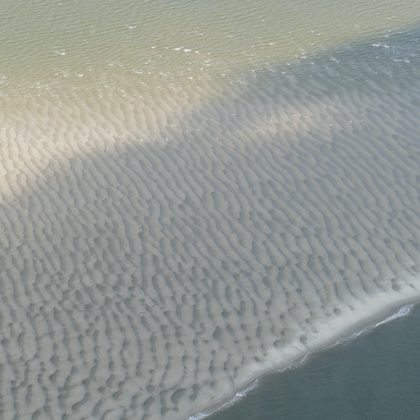
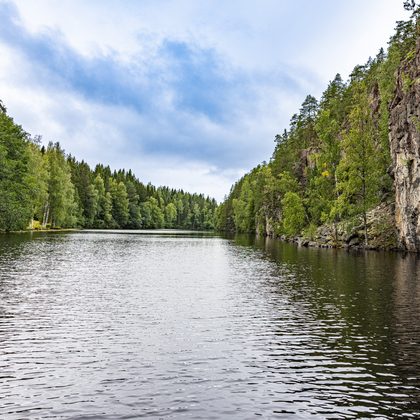
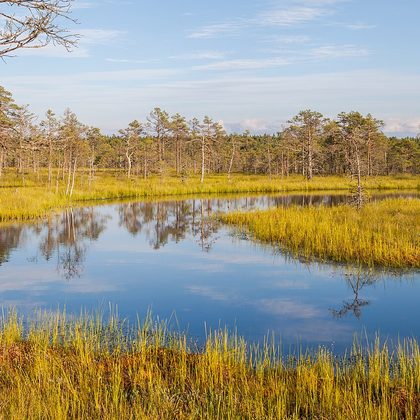
Breeds on small, fish-poor pools and bog lochans in tundra, taiga and Scottish blanket bog, commuting daily from there to the sea or to larger waters to fish. Outside the breeding season entirely marine: shallow coastal waters, tidal inlets, the outer delta and the edges of sandbanks, where it dives for sprat, herring and gobies. Unlike Black-throated Diver it avoids deep water and usually stays within a few kilometres of the shore.
Where the bird is most at home, classified with EUNIS — the European standard for habitats.
Range and movements
Breeds in Iceland, Scotland, Scandinavia, the Baltic states and the Russian north. The Netherlands has no breeding pairs, but thousands winter along the whole coast from the Wadden Sea to the Zeeland Delta, concentrated over the shallow coastal zone and around the Voordelta. In Spain it is a scarce but annual winter visitor along the Cantabrian and Galician coasts, with small numbers reaching Catalonia and very few records in the Mediterranean.
- Resident
- Breeding (summer)
- Winter
- Passage
- Migration direction
- dark = core range, pale = thinly spread
Where and when to look
Seawatching in November and December in a moderate north-westerly produces the most birds; from Camperduin, IJmuiden or the Brouwersdam scan the first two hours after sunrise and watch for the low, sagging silhouette and the upward-tilted bill. During frost spells birds move into the tidal inlets and can be studied at close range from the dyke. In Spain the Ría de Ferrol or the bay of Santander in January is the best bet; calm weather actually helps there, because the birds then sit inside the bay rather than far offshore.
Conservation status
Not threatened; the world population is large and spread across the entire Arctic. In Europe the southern breeding populations in Scotland and southern Scandinavia are declining locally through disturbance at nesting pools and through breeding failure when small fish are scarce. At sea the main risks are oil pollution, bycatch in gillnets and disturbance from shipping and offshore wind construction; the species is unusually sensitive to disturbance and avoids wind farms over considerable distances.