All species › Passerines › Crows and jays › Carrion crow
Carrion crow
Corvus corone | Zwarte kraai | Corneja negra
The Carrion Crow is one species in two suits. From Ireland and western Britain across to the Balkans it is the same bird, but the plumage changes: wholly black in western and southern Europe, and in northern, central and eastern Europe ash-grey on mantle and belly against a black head, black wings and a black tail — the bird long called Hooded Crow, and the everyday crow of Dublin, Inverness, Vienna and Helsinki. AviList 2025 treats both forms as one species, Corvus corone; other checklists carry them as two, Corvus corone and Corvus cornix. In the field the label matters little: size, build, behaviour and voice are the same, only the plumage differs.

Voice
A hard, grating kraaa kraaa kraaa, usually in series of three or four with even gaps, often delivered with a deep bow of the whole front of the body. Also a hollow klok-klok between mates, a short rattling alarm and, in spring, a soft and surprisingly varied muttering near the nest tree. Heard all year, loudest during territorial disputes in March and April. The black and grey forms sound alike: voice will not tell you which of the two is in front of you.
Recording: Sander Pieterse — CC BY-SA 4.0 · Wikimedia Commons
Identification
Both forms are the same heavy, compact crow of 44–51 cm, with a stout, slightly curved bill whose base is obviously feathered — the nasal bristles run well out along the upper mandible — a dark eye and a flat crown without a peak. In flight both show steady, shallow wingbeats, a nearly straight trailing edge to the wing and a short, square-cut tail. The black form is wholly black, with a green-blue gloss that shows only in full light. The grey form has head, throat, wings, tail and thighs glossy black and the rest of the body — mantle, back, breast and belly — pale ash-grey, with a sharp boundary along the black breast bib; in flight the grey reads as a pale saddle between two black wings. Juveniles of both are duller, washed brownish, with a blue-grey eye that darkens through the first autumn; young grey-form birds have dirtier, browner grey and at first a pale bill base. Where the two forms meet — a narrow belt running from the Scottish Highlands through Denmark and along the Elbe in Germany down to northern Italy — intermediates are the rule rather than the exception: black birds with a faint grey wash over flanks or mantle, grey birds with black flecking and uneven blotching through the grey, and everything between. Muddy or patchy grey is normal within that belt; well outside it, it is worth a longer look.
Confusion species
Rook is slimmer, with a more pointed, straighter bill and, in adults, a bare greyish-white face; it looks long-legged, with a peaked rear crown and baggy thigh feathering. Beware: young Rooks have no bare face yet and remain the real pitfall well into their first winter — then go by the pointed bill, the steeper forehead and the company the bird keeps. Jackdaw is far smaller, with a grey nape and a pale grey eye. At range it is Jackdaw that trips people up on the grey form, since both are two-toned — but the pale part sits at the wrong end: on Jackdaw the nape and hind-head are grey and the body dark, while on the grey crow the head is black and the mantle and belly pale. Add that Jackdaw is a third smaller and shorter-billed, beats its wings faster and deeper, walks briskly with a trot, and calls a clear kya against the crow's unhurried gait and grating caw. Raven is much bigger, with a wedge-shaped tail and a deep cronk.
Habitat
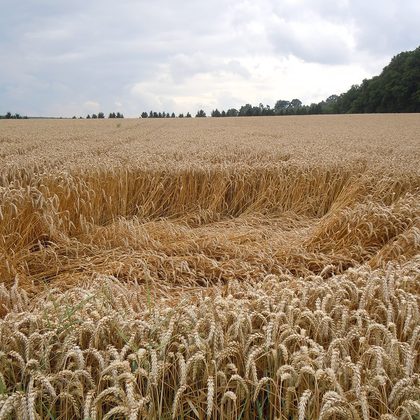
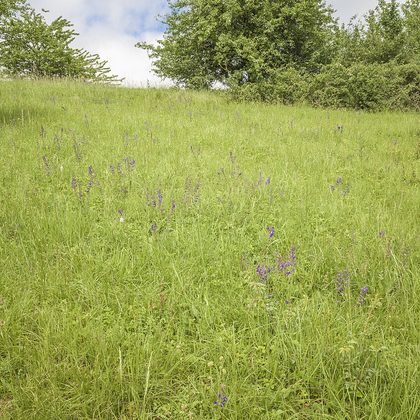
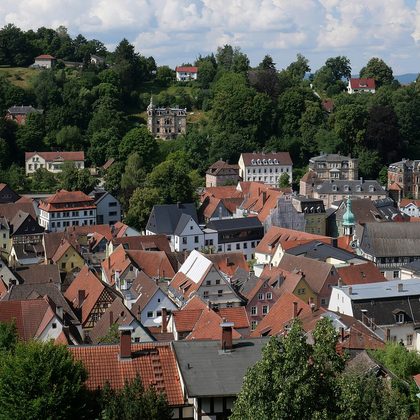
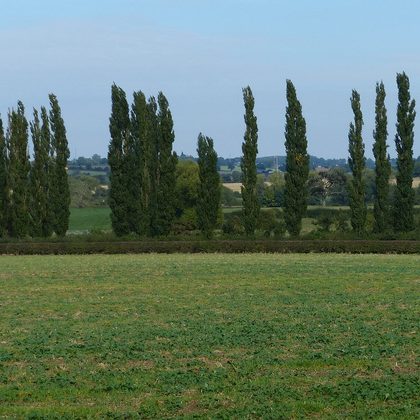
Almost any open or half-open country with trees: arable land, pasture, hedge banks, river floodplains, dunes, landfills, motorway verges, city parks and housing estates. Nests singly in a bulky stick basket high in a tree or pylon, always well spaced from the next pair. Feeds on anything: worms, insects, eggs and nestlings, carrion, nuts, grain and human refuse. Across the north and east, where the grey form is the ordinary crow, the coast belongs firmly in that list: tidal flats and strandlines, where shells and crabs are dropped from height to break them, plus harbours, fish quays and muck heaps. In winter both forms readily follow the plough.
Where the bird is most at home, classified with EUNIS — the European standard for habitats.
Range and movements
The black form breeds in western and southern Europe: Britain south of the Highlands, France, the Low Countries, Germany west of the Elbe, Switzerland, western Austria, north-west Italy and northern Spain. The grey form breeds in Ireland, northern and western Scotland, Denmark, Germany east of the Elbe, Scandinavia, Poland, the Baltic states, Russia, most of Italy and the Balkans, and eastwards to the Middle East. Between them lies a narrow belt — from the Scottish Highlands through Jutland and the Elbe valley to the Alpine fringe of northern Italy — where both forms breed together and most birds are intermediates. In the Netherlands the black form is very common all year, from the Wadden Sea to city centres, while the grey form was a routine winter visitor from the Baltic until the 1980s, in thousands; milder winters and shorter migrations have left tens to a few hundred, chiefly along the Wadden coast and in the north and east. In Spain the species is confined to the northern strip — the Cantabrian coast, Galicia, the Pyrenees and the northern Meseta — and the grey form is a vagrant.
- Resident
- Breeding (summer)
- Winter
- Passage
- dark = core range, pale = thinly spread
Where and when to look
In March find a breeding pair in a row of poplars along a dyke and watch how the bird drops its head and chest deeply as it calls. To see the corvids side by side, visit a freshly ploughed field in winter with a mixed flock: Jackdaws walk small and briskly among the Rooks, while Carrion Crows usually stand apart in twos. For the grey form in the Low Countries, November to March along the Wadden coast is the best chance — scan crow and Jackdaw flocks on saltmarsh and strandline for a pale saddle. To see it in numbers, take a winter city park in Ireland, Scotland or central Europe: in Dublin, Vienna or Helsinki it simply walks between the strollers.
Conservation status
Not threatened (IUCN: Least Concern), and stable to increasing across most of Europe, helped by its move into towns and villages. In the Netherlands and Flanders the black form is an ordinary breeding bird, though still shot under wildlife management schemes, and local swings track that management and the supply of carrion and waste. The grey form has declined locally in Ireland and north-west Scotland, and in places the belt of intermediates is shifting. For birders in the Low Countries the biggest change is that the winter influx of grey birds from the east has largely fallen away, turning a matter-of-course sight into a bird worth going out for.