All species › Passerines › Penduline tits › Eurasian penduline-tit
Eurasian penduline-tit
Remiz pendulinus | Buidelmees | Pájaro moscón europeo
The Penduline Tit is not a true tit but a weaver: the male builds a felted purse of willow down and nettle fibre, with a spout, hung from a thin twig over water. For twenty years it was the star of every Dutch reedbed; now you have to drive a long way for one.

Voice
The call is the most useful field mark of all: a high, thin, drawn-out and slightly descending tseeeoo, as fine as a whistle and easily lost among Reed and Sedge Warblers. Often you hear it only as the bird passes overhead. There is also a short tsee-tsee in contact and a soft, hissing little song from the male at the nest. Most vocal from late March to June, and again on passage in September and October.
No freely licensed recording is available for this species yet.
Identification
Tiny and finely built, with a short, awl-shaped bill and a proportionally long tail. The adult male has a pale grey head with a broad, jet-black mask running through the eye to behind the cheek, a chestnut mantle and pale sandy underparts. The female's mask is narrower and browner-black and the mantle duller. Juveniles lack the mask entirely and are plain sandy brown with a pale head — a genuine pitfall in July and August. The nest is a field mark in itself: a grey, felted, pear-shaped bag of fifteen to twenty centimetres with a short entrance spout at one side, slung from a willow, poplar or tamarisk over water.
Confusion species
Little. Size and behaviour suggest Bearded Reedling, but that has a long narrow tail, an orange-brown body and, in the male, a grey head with a drooping black moustache rather than a mask. Red-backed Shrike also has a black eye mask, but is three times the size and sits on scrub lookouts. Maskless juvenile Penduline Tits can look like a washed-out small warbler; then note the awl-shaped bill, the sandy tone and the way the bird hangs upside down from a reed head like a tit.
Habitat
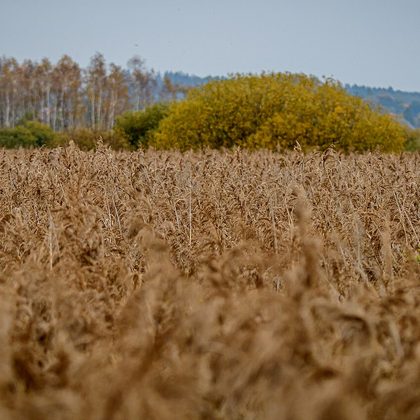
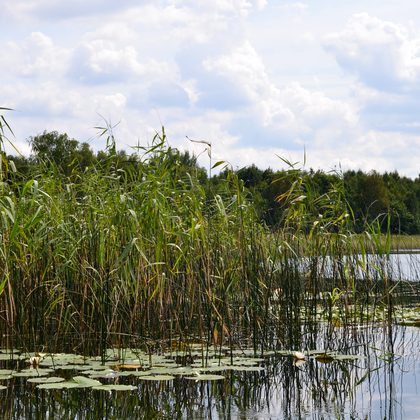
Reed fringes, willow scrub and young poplars along rivers, oxbows, clay pits, lakes and canals; always where reed and soft, downy trees stand together. The male starts several nests at once to attract different females; the breeding system is loose and either parent may desert the clutch. Feeds on insects, and later in the year on reed seed and willow down.
Where the bird is most at home, classified with EUNIS — the European standard for habitats.

Range and movements
Central, eastern and southern Europe, with a distribution that follows the great river valleys. In the Netherlands the species settled in the 1980s, grew to a peak of some 250 pairs in the 1990s and then fell away sharply: by around 2019 only fifteen to thirty pairs remained, and it was added to the national Red List in 2017. In Spain it is far more ordinary: it breeds in the willow and reed zones of the Ebro and other big rivers, and winters in numbers in the reedbeds of the east coast, the rice fields and the Guadalquivir marismas.
- Resident
- Breeding (summer)
- Winter
- Passage
- Migration direction
- dark = core range, pale = thinly spread
Where and when to look
Walk a reed fringe with willows along a river, oxbow or clay pit in April and May — the Gelderse Poort, the Biesbosch and the Dutch river country are the classic sites — and listen for the thin tseeeoo over the reeds. Then scan the slender overhanging willow twigs above water for the grey purse: an abandoned nest from a previous year can hang on for months and betray the place. In Spain a winter reedbed in the Ebro delta or Doñana is far more productive.
Conservation status
Not globally threatened and numerous in southern and eastern Europe, but in retreat at the north-western edge of the range. In the Netherlands it has all but vanished as a breeding bird after a brief flowering, without anyone being sure why; rank and drying reed fringes, the loss of young willow growth and conditions in the wintering areas are all cited. Belgium and Germany show much the same picture.