All species › Waders, gulls and terns › Plovers and lapwings › American golden-plover
American golden-plover
Pluvialis dominica | Amerikaanse goudplevier | Chorlito dorado americano
The Nearctic golden plover, and the American wader most often picked out of a European Golden Plover flock. Ireland and western Britain take the great majority of records, and almost every bird is found on shape and stance before a single feather has been examined.

Voice
A flat, slightly harsh kleep or drawn-out queedle, lower and more clipped than the clear, plaintive tloo of European Golden Plover and without the rising second note of Pacific Golden-Plover. Vagrants call mainly on taking off with the flock, so the moment a golden plover flock lifts is worth listening to as carefully as it is worth watching.
No freely licensed recording is available for this species yet.
Identification
Smaller and slimmer than European Golden Plover, longer-legged and with a noticeably long rear end. Breeding adults are black from chin to undertail, the black unbroken along the flanks, with a broad white band running from the forehead over the eye and down the side of the neck, ending in a square block on the breast side. The upperparts are spangled white and pale buff rather than deep gold. Juveniles and winter birds are cold grey-brown with a bold whitish supercilium, a dark cap and a plain grey wash across the breast. At rest four or five primary tips fall beyond the short tertials and the wingtip projects well past the tail.
Confusion species
The axillaries settle it. European Golden Plover has pure white axillaries and a white underwing; American Golden-Plover has smoky grey axillaries; Pacific Golden-Plover grey-brown ones. In flight, against the light, that patch under the wing is the one character that never lies, and a resting bird with the wings folded often cannot be named at all until it lifts them. Against Pacific Golden-Plover, this species has the longer primary projection, with four or five primary tips clear of the tertials and the wingtip standing well beyond the tail; Pacific shows two or three tips and a wingtip roughly level with the tail. Pacific has short-looking wings because its tertials are long, almost reaching the wingtip, while on American the tertials are short and the wing looks stretched. Pacific is longer in the tibia and stands higher on the leg; American looks bigger-headed, with a steeper forehead and a bolder supercilium. In breeding plumage American is solidly black to the undertail, while Pacific shows white mottling along the flanks and vent and a white neck stripe that continues down the flank instead of stopping at the breast. Against European Golden Plover, both American species are slimmer, greyer and longer-legged, and neither shows the white axillary flash.
Habitat
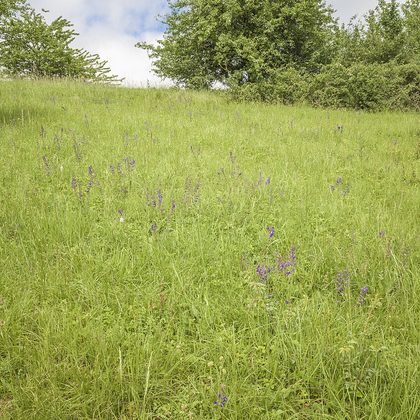
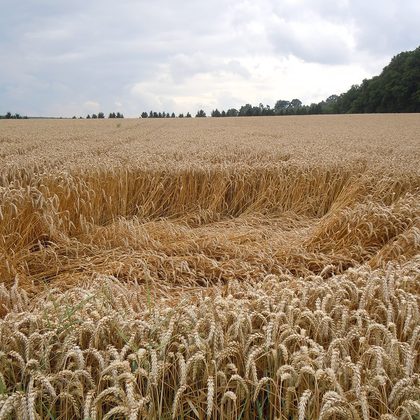
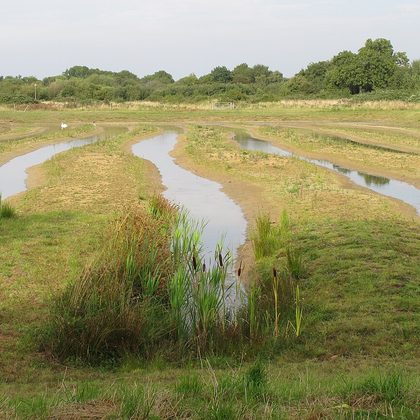
Short coastal grassland is the classic setting: machair, cropped pasture, golf links and airfields, with stubbles and ploughed fields inland. Birds roost on estuarine mud and saltmarsh and feed on the grass, and they are almost always inside a flock of European Golden Plovers and Lapwings rather than alone.
Where the bird is most at home, classified with EUNIS — the European standard for habitats.

Range and movements
Breeds on Arctic tundra from western Alaska across northern Canada and winters on the grasslands of southern South America, crossing the western Atlantic in autumn. A near-annual vagrant to Ireland, the Hebrides, western Britain and the Azores, chiefly from late August to early November, with juveniles predominating; records thin out sharply eastwards across the North Sea and the Mediterranean.
Where and when to look
Work coastal grassland in the west of Ireland or the Outer Hebrides in the last week of September and the first half of October, after a run of deep Atlantic lows. Scan the flock for the bird that stands taller, greyer and longer-winged than its neighbours, then be patient: the flock will eventually fly, and the grey armpit against a white one settles the record in a second.
Conservation status
Not of conservation concern, with a large and apparently stable population across the Arctic. The main pressures fall on migration, where the species depends on a small number of grassland and wetland staging areas in the Great Plains and in South America that are steadily being ploughed or drained.