All species › Waterfowl › Ducks, geese and swans › White-winged scoter
White-winged scoter
Melanitta deglandi | Witvleugelzee-eend | Negrón aliblanco
The bulkiest of the scoters and one of the harder ducks to get on a British or Irish list. Since 2011 the east coast of Scotland has produced a small run of returning drakes, and working through the winter scoter rafts there is now a recognised way to catch up with one. At close range the angular head and the heavy, knobbed bill make it an impressive bird.

Voice
Effectively silent in Europe. What carries is the heavy clatter of wings on take-off and the splash of diving birds. On the breeding grounds the drake gives a thin high whistle, fee-fiew, and the female a hoarse low krer-krer; from a winter raft off a Scottish beach you will hear neither.
No freely licensed recording is available for this species yet.
Identification
The drake is sooty black with brown-washed flanks and a small white hook curling upwards from behind the eye, like a comma set on its side. The bill is orange-red with a black knob at the base and a black cutting edge, and the feathering on the bill base runs forward past the nostrils. The female is dark sooty brown with two dull pale patches on the face, a steep forehead and the same heavy bill. On the water both sexes often show a sliver of white secondaries above the flank; in flight the white speculum is broad and cleanly cut.
Confusion species
It all comes down to Velvet Scoter. Take the head profile first: on White-winged the forehead rises steeply and the bill base carries a distinct bulge, so the head looks angular, where Velvet is smoother and more evenly rounded. Take bill structure second: on deglandi the feathering of the lores runs well forward, past the nostrils, and the bill is orange with a lot of black; on fusca the feathering stops shorter and the bill is yellow with a small black saddle. Take the shape of the white eye mark third: on deglandi a short hook curling upwards behind the eye, on Velvet a longer, flat white line running below and behind the eye. The brown-washed flanks of the drake are a useful extra. Surf Scoter shows white patches on forehead and nape and no white in the wing at all; Common and Black Scoter are smaller, round-headed and lack the speculum entirely. Females have to be done on bill structure and head profile, because the face patches overlap badly with Velvet.
Habitat
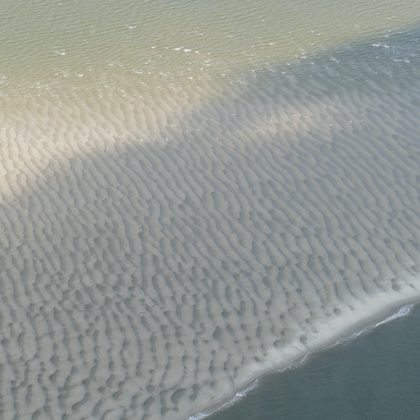
Shallow inshore sea over sand, shell and gravel, usually within a mile or two of the beach and often in the surf line off river mouths and sandbars, where the birds dive for mussels and other shellfish. In Europe almost always among Velvet and Common Scoters. Very occasionally one turns up on a large inland lake or reservoir.
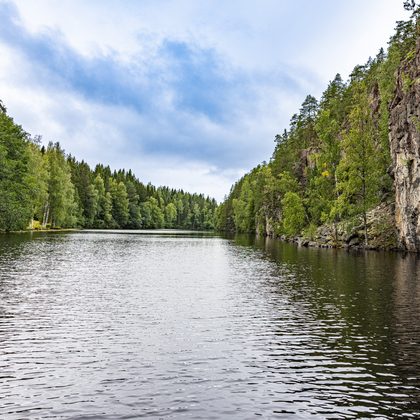
Where the bird is most at home, classified with EUNIS — the European standard for habitats.
Range and movements
Breeds beside shallow lakes and river flats in Alaska and Canada and winters on both North American coasts and the Great Lakes. In Europe it is a rare vagrant heavily concentrated in Scotland: since the first at Murcar, north of Aberdeen, in 2011 there have been around twenty records, several of them drakes returning year after year off North-East Scotland, Lothian, Fife, Angus and Shetland. Iceland has records too, and Ireland remains a realistic prospect for a first. The Siberian sister species, Stejneger's Scoter, arrives in northern Europe by a different route and has to be excluded on every claim.
Where and when to look
Pick a winter day with an offshore wind and the sun behind you, and scan from the dunes at Murcar or Blackdog just north of Aberdeen. Put the scope on the edge of the raft and wait: preening, wing-flapping or a flush will expose the white speculum. Then confirm on head profile and bill, because Velvet Scoters show white in the wing as well and at range that alone proves nothing.
Conservation status
Not globally threatened, but North American midwinter counts have been falling for decades. The pressures are drowning in gill nets, oil and disturbance on the wintering grounds, shellfish dredging on the feeding banks, and degradation of the shallow boreal lakes where the birds breed. None of that bears on the European picture, where the species occurs only as a scattering of vagrants.