All species › Swifts › Swifts › White-throated needletail
White-throated needletail
Hirundapus caudacutus | Stekelstaartgierzwaluw | Vencejo mongol
The White-throated Needletail is the largest and heaviest swift ever to have reached western Europe, a barrel-bodied bird with a clean white throat and a white horseshoe wrapped around its stern. It breeds in the forests of Siberia and East Asia and winters in Australia, and the few that have appeared here arrive in late spring, most of them far to the north.

Voice
Largely silent away from the breeding forest, and vagrants have been watched for hours without a sound. Where it does call, it gives a rapid, thin, insect-like trill, trrit-trrit-trrit, and a chattering chirrip from birds chasing each other over the canopy. The voice is no help on a vagrant and should not be waited for.
No freely licensed recording is available for this species yet.
Identification
A very large, heavy swift, clearly longer than a Common Swift and with a wingspan half as wide again, built like a barrel and carried on long, sabre-shaped wings. The tail is short and square and ends in the bare needle-like shafts that give the bird its name; they show only at close range. The throat is white and sharply cut off, the forehead and lores are pale grey-white, and the mantle and back carry a pale grey-brown saddle that contrasts with the darker crown, wings and tail. The white undertail coverts continue forward along the flanks, so that the rear of the bird is ringed by a white horseshoe that is visible from below, from the side and even from above. The flight settles it: long, powerful, deliberate beats and enormously long glides, at a speed no other swift in the region approaches, so that a bird can appear at one edge of the sky and be gone at the other in seconds.
Confusion species
Common Swift is what a distant needletail is usually taken for, but it is far smaller, uniform sooty brown, with stiff, scythe-shaped wings, a short forked tail and no white at all beyond a vague pale throat patch; the sharp white throat, the white horseshoe and the pale saddle are all missing. Pallid Swift is browner, with a stronger head and throat pattern and broader-based wings, and is again a much smaller bird. Alpine Swift is the closest in bulk and also shows white below, but its white is a long white belly panel cut off from a white throat by a dark breast band, its tail is forked, and it has neither the saddle nor white along the flanks. Hobby is occasionally claimed as a needletail and the reverse happens too, but it has a barred tail, rufous trousers and a dark moustache. Size and structure are hard to judge on a lone bird in an empty sky, so work the pattern first: white throat, white horseshoe, pale saddle.
Habitat
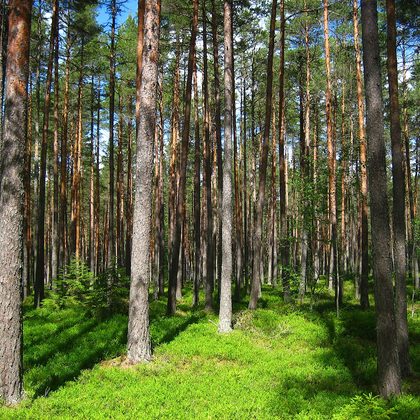
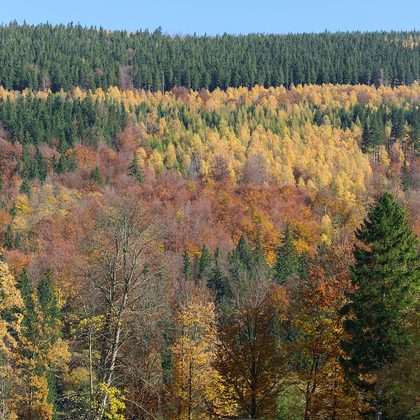
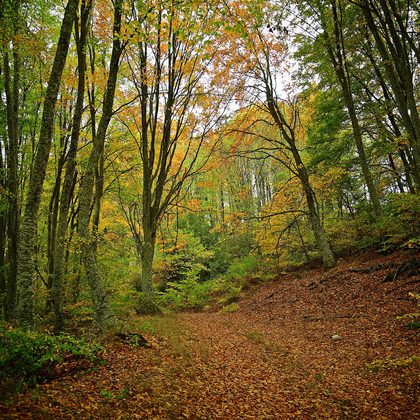
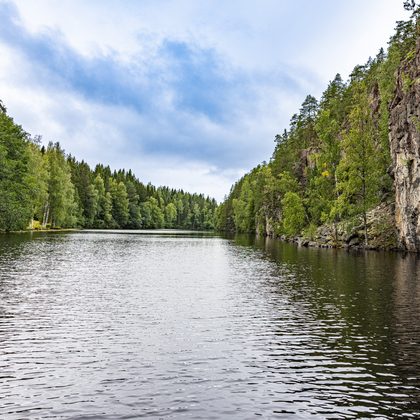
It breeds in taiga and mixed mountain forest in southern Siberia, the Russian Far East, Sakhalin, Japan and the Himalaya, nesting in hollow trees and rock crevices and hunting high over the canopy, along wooded ridges and above forest rivers and lakes. In the southern summer in Australia it ranges over forest, farmland and towns, often working ahead of thunderstorms. Birds that stray to western Europe have been found over open moorland, coastal grazing and island crofts, over lochs and reservoirs and once over a Dutch town, feeding wherever warm air has lifted insects off the ground.
Where the bird is most at home, classified with EUNIS — the European standard for habitats.
Range and movements
Breeds from the Altai and Lake Baikal east to Kamchatka, Sakhalin and Japan, with a separate population in the Himalaya, and winters mainly in eastern Australia. Records in the west are very few. Britain has around ten accepted, most of them in Shetland, Orkney and the Outer Hebrides, beginning with nineteenth-century birds in Essex in 1846 and Hampshire in 1879, and including a much-watched bird on Harris in June 2013 and a juvenile in October 2025 that fell outside the usual dates. Ireland has one, on Cape Clear in June 1964. The Netherlands has a single accepted record, at Middelburg and Veere in Zeeland on 22 May 1996. Norway, Sweden and Finland have added a handful more; there appears to be no Spanish record.
Where and when to look
Late May to early July is the window, and nearly every record has come in warm southerly or south-easterly air pushing north over Britain and the North Sea, often at the end of a spell of easterlies. Watch large empty skies over moorland, islands and big waters at those times rather than over towns, and be ready for a bird that crosses the whole field of view in seconds. If you can, photograph first and identify afterwards: on something moving that fast a single frame showing the white throat and the horseshoe under the tail is worth more than any impression of size.
Conservation status
The IUCN category is Least Concern. The breeding range across northern Asia is enormous and the world population large, and there is no evidence of a rapid overall decline. Numbers arriving in Australia in the southern summer are reported to be lower than they once were, and the felling of old forest with suitable hollow trees is the threat most often named on the breeding grounds. In Europe the species is a vagrant and nothing else, so no European conservation measure applies to it.