All species › Waders, gulls and terns › Auks › Thick-billed murre
Thick-billed murre
Uria lomvia | Kortbekzeekoet | Arao de Brünnich
The auk of the high Arctic: a heavy, short-billed guillemot of cliffs at the edge of the pack ice, from Svalbard to Greenland. In western Europe it is a winter bird, and it rarely arrives under its own steam but on the back of a north-westerly gale.

Voice
At the colony a low, guttural growling and croaking, arrr and orrr, coming off the cliff face as a continuous murmur and deeper in tone than Common Guillemot. Silent away from the colony; birds passing on a seawatch effectively never call, so voice plays no part in British records.
No freely licensed recording is available for this species yet.
Identification
More compact and heavier-built than Common Guillemot, with a thick neck and a short, deep bill. The upperparts are jet black rather than chocolate-brown and the flanks are unstreaked. A narrow pale stripe runs along the cutting edge of the upper mandible and can be seen through a telescope on a settled bird. On the breast the black of the throat runs down onto the white in a sharp point. In winter the face stays largely dark, with the black extending below the eye and no line across the cheek.
Confusion species
Against Common Guillemot (Uria aalge) there are three points. The bill is shorter and deeper with a more curved culmen, and carries that pale line along the cutting edge, which Common lacks. The head is rounder and the neck thicker, where Common looks slimmer and longer with a straight dagger of a bill. And the border between black and white on the neck is clean and runs down in a point on Brünnich's, while on Common it is rounder and less defined. In winter add the face: Common shows a dark line running back across the white cheek, Brünnich's keeps a dark face down to below the eye. Razorbill is blacker still but has a deep blunt bill crossed by a white band and a longer, pointed tail.
Habitat
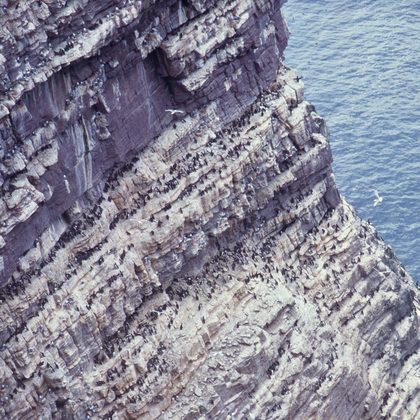
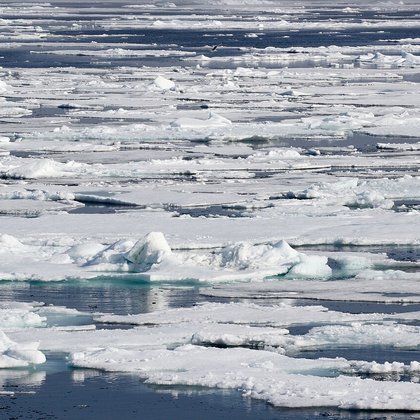
Breeds in dense colonies on narrow ledges of steep sea cliffs in the high Arctic, often where pack ice reaches close in to the wall. For the rest of the year it lives on the open sea, favouring the ice edge and the continental slope, diving to a hundred metres for polar cod, capelin and pelagic crustaceans.
Where the bird is most at home, classified with EUNIS — the European standard for habitats.

Range and movements
A circumpolar breeder: Svalbard, Franz Josef Land, Novaya Zemlya, Iceland, northern Norway, Greenland and Arctic Canada. It winters on open water north of Britain and in the Barents Sea, becoming rapidly scarce further south. British records are few and scattered, mostly Shetland, Orkney and the northern isles, and a fair proportion are tideline corpses or exhausted birds found in harbours after severe weather.
- Resident
- Breeding (summer)
- dark = core range, pale = thinly spread
Where and when to look
For a comfortable view of the species, go north: Svalbard or northern Iceland in summer, with Alkefjellet on the Hinlopen Strait the best-known cliff of all. In Britain it is a winter seawatching job. Work the northern isles in strong north-westerlies and look through the Common Guillemots for a bulkier, blacker bird with a short bill and a dark face. Photograph everything, because the identification rests on head shape and bill profile, which are hard to nail with the eye alone.
Conservation status
Not globally threatened, but many millions of birds sit in a small number of enormous colonies, which leaves the species exposed to local disasters. Numbers are falling at several North Atlantic colonies; the retreating ice edge and its effect on food supply, hunting in Greenland waters and drowning in gillnets are all cited, with oil pollution along the migration routes on top of that.