All species › Parrots › Old World parakeets › Rose-ringed parakeet
Rose-ringed parakeet
Psittacula krameri | Halsbandparkiet | Cotorra de Kramer
You almost always hear the Rose-ringed Parakeet before you see it: a shrill, piercing screech that cuts straight through the background noise of a city park. Since the 1970s this parrot of the Sahel and the Indian subcontinent has been a fixture of the Dutch Randstad, Brussels, the Rhineland and Greater London.

Voice
A hard, shrill kee-ak or kee-yak, usually in short runs of two to four notes and almost always given in flight; it is the sound that gives the species away before anything green flashes past. At a roost it swells into a deafening, sustained chorus of hundreds of birds. In and around the nest hole a softer, yapping kek-kek-kek. Heard year round, loudest in the last quarter of an hour before sunset.
Recording: Marie-Lan Taÿ Pamart — CC BY-SA 4.0 · Wikimedia Commons
Identification
Slim, grass-green parakeet with a very long, sharply tapering tail that makes up more than half the total length. Red upper mandible with a black tip, yellow eye with a red orbital ring, a bluish wash over the hindcrown. The flight silhouette is unmistakable: dead straight and fast, on short, shallow beats that barely rise above the line of the back, with the tail streaming behind like a pennant — more dart than bird. The adult male has a black chin and throat running into a thin black collar edged behind with pink; females and young birds lack the collar entirely, or show no more than a faint green shadow of it, and have a slightly shorter tail.
Confusion species
The Alexandrine Parakeet also flies free locally in the Netherlands, Germany and England and is the only real confusion species. It is considerably larger (55–62 cm), has a heavier, deeper blood-red bill, and in every plumage — female and juvenile included — carries a maroon shoulder patch on the wing coverts; its wingbeat is slower and heavier and its call deeper and harsher. The Monk Parakeet is much stockier and shorter-tailed, with a grey forehead, grey throat and grey-scalloped breast, and builds bulky stick nests instead of nesting in holes.
Habitat
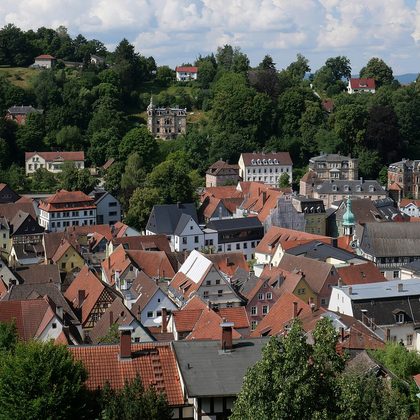
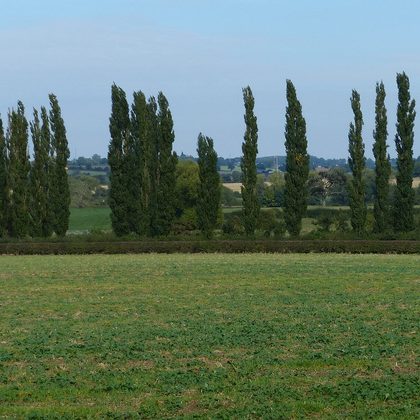
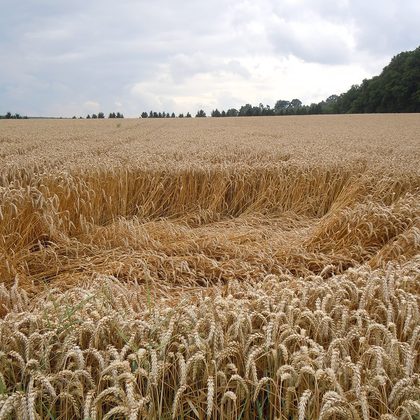
Almost entirely tied to built-up areas with old, thick trees: city parks, cemeteries, mature suburbs, avenues, estate woodland on the urban fringe and allotment complexes. Nests from January to June in large cavities in plane, beech, poplar and lime, often in enlarged old woodpecker holes. Feeds on buds, blossom, seeds, nuts and fruit, and in winter heavily at garden feeders — that winter supplement is one of the reasons the species survives at these northern latitudes at all.
Where the bird is most at home, classified with EUNIS — the European standard for habitats.


Range and movements
Established in the Dutch Randstad (The Hague, Amsterdam, Rotterdam, Utrecht, Leiden), in Brussels and several Flemish cities, in the German Rhine-Main region (Cologne, Düsseldorf, Wiesbaden, Heidelberg) and across Greater London with Surrey and Kent. The Netherlands hold an estimated 2,500–3,000 breeding pairs, with winter roosts totalling 10,000–12,000 birds. Further colonies exist in Paris, Barcelona, Seville, Madrid, Rome and Athens. The native range runs from Senegal and the Sahel through Sudan and Ethiopia to Pakistan, India and Nepal.
- Resident
- Winter
- Passage
- dark = core range, pale = thinly spread
Where and when to look
Go to a known roost half an hour before sunset in November or December — in The Hague the Haagse Bos and the trees around the Nieuwe Uitleg, in Amsterdam the Vondelpark and Oosterpark — and stand with your back to the last light in the sky. The birds arrive in waves of tens at a time, circle screeching, then drop into the crowns like green leaves. In the breeding season it is easier: find thick planes with a round, gnawed-out cavity and wait for the yapping call.
Conservation status
Not globally threatened (IUCN: Least Concern); across its native range the species is common and locally an agricultural pest. In Europe it is a naturalised introduction, founded on cage birds that escaped or were released from the 1960s and 1970s onward and growing steadily ever since. Whether it displaces native hole-nesters is still not settled. Experimental work in Brussels showed that parakeets actively evict Nuthatches from suitable cavities and that Nuthatch density is lower around large parakeet concentrations; an analysis of British monitoring data, by contrast, found scarcely any detectable population-level effect on Starling, Jackdaw or woodpeckers. The clearest case is in Seville, where parakeets have displaced the rare Greater Noctule bat from its tree holes. Local damage to fruit crops and noise at roosts add to the picture. The species is not on the EU list of invasive alien species of Union concern, but is monitored in several countries.