All species › Waterfowl › Ducks, geese and swans › Redhead
Redhead
Aythya americana | Amerikaanse tafeleend | Porrón americano
The Nearctic counterpart of Common Pochard, and one of the hardest ducks in Europe to get accepted. A drake shows a high domed forehead, a yellow eye and a blue-grey bill with a broad black tip. Finding one leaves you with two questions at once: is it really one, and where has it come from.

Voice
Silent here. On the breeding grounds a displaying drake gives a curiously cat-like rising wee-ough with the head thrown back, and the female a hard low krrr when flushed or calling young. A vagrant sitting among Pochard says nothing, so voice plays no part in identification in Europe.
No freely licensed recording is available for this species yet.
Identification
The size of a Pochard but built round a different head: high, rounded and domed, with a steep forehead running abruptly into a short bill. The drake has an orange-chestnut head, a yellow to orange-yellow iris, a black breast, and mid-grey finely vermiculated back and flanks that contrast only moderately with the breast. The bill is pale blue-grey with a narrow white band immediately before a broad black tip. The female is evenly warm brown with a paler face around the bill base and throat, a dark eye with a faint pale eye-ring and the start of a pale line behind it, and the same bill pattern as the drake. In flight the wing bar is grey and shows little contrast.
Confusion species
Common Pochard sets the standard. It has an angular head with a concave forehead and a peaked crown, a red iris in the drake, and a paler, almost whitish-grey back that throws the black breast into much sharper relief; its bill carries a broad grey band between a black base and a black tip, not a single narrow white band before the tip. Females are where it gets hard: a female Pochard has a patterned face with a pale line behind the eye and the same broad bill band, while a female Redhead is plainer brown, rounder-headed, and shows the narrow white band before a black bill tip. In practice such a bird stalls without photographs of head and bill. Then there are hybrids: Pochard crossed with Ferruginous Duck produces birds with a domed head and a yellowish iris that mimic this species closely, and in Europe those have been found more often than the real thing.
Habitat
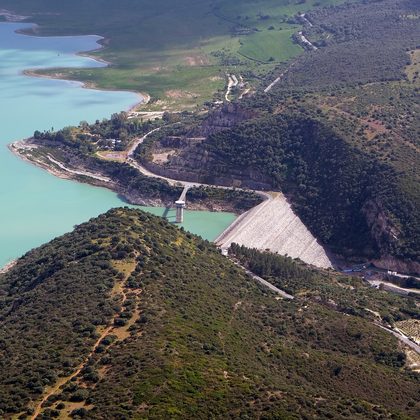
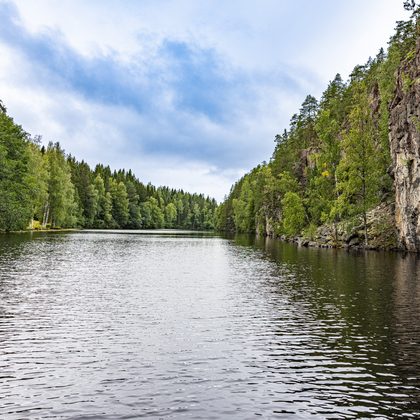
In Britain only on large open fresh water where diving ducks are already gathered: reservoirs, deep gravel pits and big lakes, almost always in the middle of a Pochard or Tufted Duck flock. In North America it breeds on shallow prairie sloughs with dense fringing vegetation and winters in enormous rafts on shallow coastal lagoons, but none of that behaviour is on show here.
Where the bird is most at home, classified with EUNIS — the European standard for habitats.
Range and movements
Breeds across the prairie states and western Canada and winters from the Great Lakes to the Gulf of Mexico. For Europe this is one of the scarcest Nearctic ducks, with a handful of records spread over Britain, Ireland, Iceland, the Netherlands and the Azores. A BBRC review left Britain with a single acceptable record: a drake at Bleasby gravel pits, Nottinghamshire, from 8 to 27 March 1996, taken to be the same bird at Rutland Water from 4 to 24 February 1997. A long-staying bird at Kenfig Pool, East Glamorgan, once accepted, is no longer regarded as proven. The Netherlands has one accepted record, in the Westerkwartier in Groningen from 19 January to 13 March 2016, admitted on the benefit of the doubt because nothing pointed to an escape. That is the heart of the matter: the species is widely kept in wildfowl collections and gets out of them regularly, so provenance sinks most claims.
Where and when to look
Work through big Pochard flocks on reservoirs and deep pits from midwinter into spring, best in February and March when the drakes display and the heads come up. Look for a head that is too high and too domed, and for an iris burning yellow rather than red. Photograph head, bill and flank in profile on any candidate, and check for leg rings, worn primaries and tameness, because here provenance decides more cases than identification does.
Conservation status
A numerous quarry species in North America, listed as Least Concern, with numbers slowly rising in recent decades. The pressures there are the draining of prairie wetlands and the decline of the seagrass beds in the Texan and Mexican coastal lagoons where much of the population winters. In Europe the species has no conservation status, and the only practical problem it causes is the steady trickle of escaped collection birds that muddies the assessment of genuine vagrants.