All species › Cranes, rails and allies › Rails and crakes › Red-knobbed coot
Red-knobbed coot
Fulica cristata | Knobbelmeerkoet | Focha moruna
An African coot with a small European outpost in southern Spain, Mallorca and Morocco. For a northern birder this is mainly an exercise in patience: a black blob among hundreds of Coots that you may only write down once you have the head shape, the bill colour and, ideally, the trailing edge of the wing.

Voice
Deeper and more nasal than Coot, which gives a sharp metallic kek. Red-knobbed Coot gives a disyllabic kloo-kuk and a rolling metallic krrook, plus a low grunting oot oot from the reed edge. Anyone who knows Coot well hears the difference before seeing it.
Recording: Joost van Bruggen — CC BY-SA 4.0 · Wikimedia Commons
Identification
Uniform slate-blue black, slightly larger and longer-necked than Coot and without the brownish cast Coot shows on mantle and scapulars in good light. The frontal shield is broad, tall and rounded on top, running into a bluish-white bill that is colder in tone than the creamy bill of Coot. Two dark red knobs the size of a pea sit on top of the shield in the breeding season; the iris is dark red, the legs grey-blue with broad lobes.
Confusion species
Everything turns on separating it from Coot. The two red knobs are only reliable from January to about June: outside the breeding season they shrink to two vague brown smudges invisible at a hundred metres, and juveniles have none at all. Start with head shape instead. Red-knobbed Coot has a distinctly domed crown and a shield that ends in a rounded, blunt upper edge, where Coot has a flat forehead in which shield and culmen form almost one straight line ending in a point. Then check the bill, bluish-white against Coot's cream with a pink flush. The clinching feature only comes when the bird flaps or flies: Coot shows a thin white line along the trailing edge of the wing, formed by the white tips of the secondaries, and Red-knobbed Coot lacks it entirely, the wing being uniformly dark. The undertail is solidly black too. One warning outweighs all the features together: outside southern Spain, Mallorca and Morocco, almost every claim proves to be a Coot with a swollen shield in breeding condition, or a bird out of a collection.
Habitat
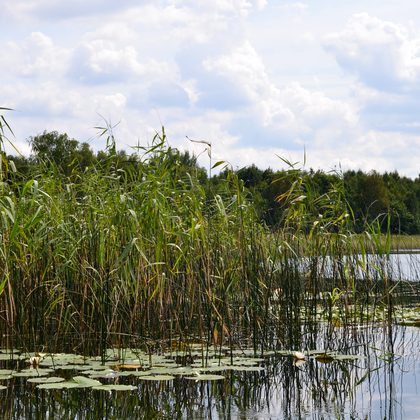
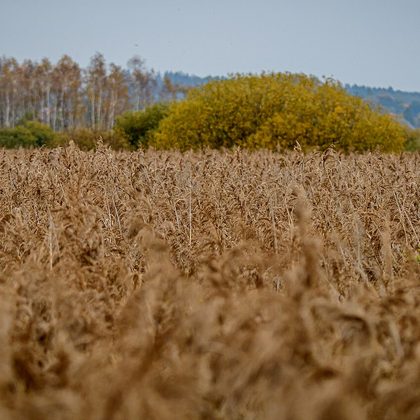
Shallow, nutrient-rich fresh waters and lagoons with abundant floating and submerged vegetation and broad fringes of reed, reedmace and club-rush. Unlike Coot it avoids deep, bare open water, feeding by grazing in the marginal zone and over weed mats. Reservoirs, worked-out pits and restored marshes are used once the vegetation has come on.
Where the bird is most at home, classified with EUNIS — the European standard for habitats.


Range and movements
The species is mainly sub-Saharan African, and the European and North African population is small and fragmented. In Spain it occurs in Andalucía, the Valencian Community and on Mallorca, with a scattered Moroccan population. There is no accepted British or northern European record, and birds seen north of the Pyrenees come out of wildfowl collections.
- Resident
- Winter
- Passage
- Migration direction
- dark = core range, pale = thinly spread
Where and when to look
Plan a trip rather than hope for a vagrant. S'Albufera on Mallorca is the easiest site in Europe, and February and March give the biggest knobs and displaying birds. Scan the vegetated edges from a hide rather than the open middle, and wait for any candidate to flap or fly so you can settle the trailing edge of the wing.
Conservation status
Not globally threatened thanks to the large African population, but listed as endangered nationally in Spain and as critically endangered in the Spanish red data book. The Spanish nucleus now goes back largely on released birds from a captive breeding and reintroduction programme. Threats are lagoons drying out, water abstraction, shooting through confusion with Coot, lead shot and the loss of fringing vegetation.