All species › Pelicans, herons and ibises › Herons and bitterns › Purple heron
Purple heron
Ardea purpurea | Purperreiger | Garza imperial
The Purple Heron is the slim, dark counterpart of the Grey Heron, tied to old standing reed and present only in summer. Almost every sighting is a bird in flight, so the flight profile matters more than the plumage.

Voice
Calls less often and higher than Grey Heron: a short, hoarse, slightly squeezed krek or kreek, usually on take-off or over the colony. At the nest a series of grunting, clucking notes and the rattling begging of young. Most often heard over large reedbeds in May and June, early in the morning and as birds come in to roost.
Recording: Joost van Bruggen — CC BY-SA 4.0 · Wikimedia Commons
Identification
Clearly slimmer and darker than a Grey Heron, with a thin, snaky neck and a long, sharply pointed yellow-brown dagger of a bill. Adults show a rufous neck with crisp black lines, a black crown with long plumes, slate-grey upperparts with purple-brown scapulars, and very long toes. In flight the far deeper, bulging neck keel stands out — it hangs visibly below the body — as do the huge feet trailing like loose paddles behind the tail. The wings look narrower and more angled than a Grey Heron's. Juveniles are warm ochre-brown without the black head pattern and look strikingly uniform buff in flight.
Confusion species
Grey Heron is the only real confusion species: paler and colder grey, with a thicker neck and shallower keel, broader-looking wings with a paler forewing panel, and much smaller feet that hardly register. The deep, low-hanging neck keel plus the obvious toes settle it, even on a distant silhouette. A juvenile Purple Heron in poor light can suggest a Bittern, but that bird is shorter and broader winged, heavier, and shows black-and-buff barred primaries.
Habitat
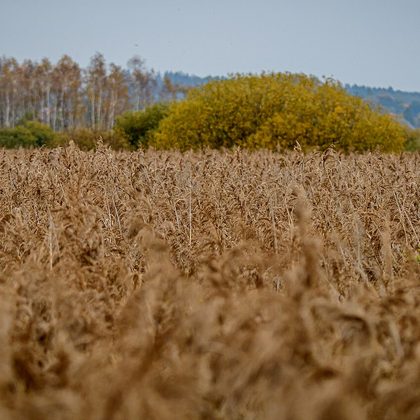
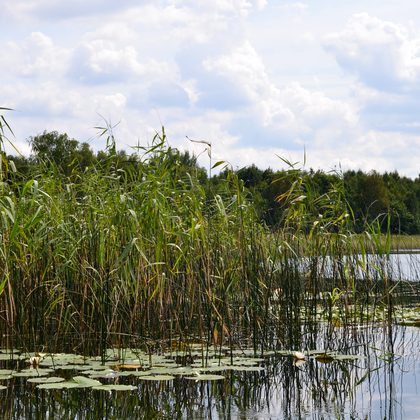
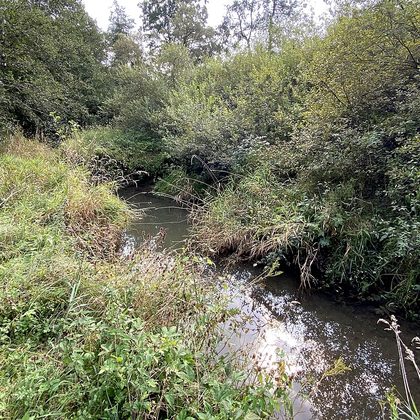
Extensive, wet, standing reed with open channels and shallow, fish-rich water; nests low in the reed or in marsh scrub, sometimes in willows. Hunts in narrow channels, along reed edges, in ditches and, in southern Europe, extensively in rice fields. What it needs above all is edge between reed and open water.
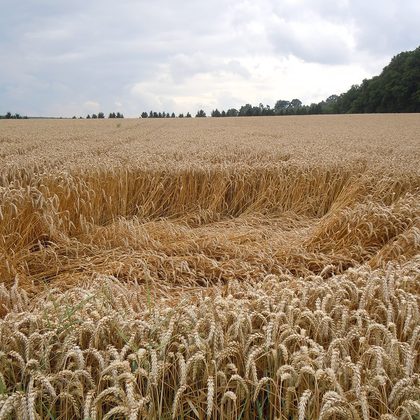
Where the bird is most at home, classified with EUNIS — the European standard for habitats.
Range and movements
A scarce Dutch breeder confined to a handful of large marshes: the Zouweboezem is the best-known stronghold, alongside the Nieuwkoopse Plassen, Botshol, the Vecht lakes and parts of the Delta. In Spain it is far more numerous, with colonies in Doñana, the Ebro Delta, the Albufera of Valencia and the Guadalquivir rice country. All European birds winter in the Sahel, which makes the population sensitive to drought there.
- Resident
- Breeding (summer)
- Winter
- Passage
- Migration direction
- dark = core range, pale = thinly spread
Where and when to look
In May or June take a dyke or viewpoint over a large reed marsh in the first hour of light and watch for herons coming in low over the reed; that is when birds shuttle between colony and feeding grounds. In Spain an evening along the rice fields in July is the easiest option, when immatures also feed in the open.
Conservation status
Not globally threatened (IUCN: Least Concern), but the European population has declined over the long term through loss of reed marsh and drainage. Dutch numbers crashed after the Sahel droughts of the 1970s and 1980s and have since partly recovered; the species still depends on active marsh management with high water levels and standing old reed.