All species › Birds of prey › Hawks, eagles and kites › Pallid harrier
Pallid harrier
Circus macrourus | Steppekiekendief | Aguilucho papialbo
Into the 1990s the Pallid Harrier was a major rarity in western Europe. Since then it has pushed west at remarkable speed, and a handful of birds is now expected in the Netherlands each spring and autumn — often among the Montagu's Harriers.

Voice
Silent on migration; in the Netherlands you will almost never hear this species. On the steppe breeding grounds the male gives a fast, high kee-kee-kee-kee in display, thinner and quicker than the Hen Harrier's, and the female begs with a shrill, insistent peeh-peeh at food passes.
No freely licensed recording is available for this species yet.
Identification
The slimmest and lightest of the three grey harriers: narrow, pointed wings, a small head, a long slender tail and a flight that looks more tern-like than sailing, wings held in a shallow V. Male: almost pure white below and very pale silver-grey above, with a black wedge confined to the outer four primaries that tapers into the wingtip like a thin pen stroke — not the broad black hand of a Hen Harrier. The grey of the breast fades into the white without a border, and the rump is dull greyish-white. Female: brown and streaked, but with a sharply drawn head: a dark mask across the ear coverts, a narrow pale collar closing right round the neck, a pale line above and below the eye and often a small white spot immediately above the eye. Juvenile: unmistakably orange-buff and unstreaked below, with the same dark mask and complete collar, and a strikingly pale, unbarred central panel on the inner underwing set against a dark trailing edge.
Confusion species
The comparison with the other two grey harriers is the whole story. A male Pallid looks whiter and sharper-winged than a Montagu's and lacks its black bar across the upperwing secondaries, its two dark underwing bars and its rusty flank streaks; it equally lacks the broad black hand of a Hen Harrier. Count the fingered primaries: four in Pallid and Montagu's, five in Hen Harrier. On females and juveniles — the ringtails — the head decides it. A juvenile Pallid has plain orange-brown, unstreaked underparts, a fully closed pale collar and a dark hooded mask; a juvenile Montagu's is redder with fine flank streaks, an incomplete collar and a darker inner underwing with two narrow bars; a juvenile Hen Harrier is bulkier, heavily streaked on breast and belly and shows a far larger white rump. The pale, almost unmarked base of the primaries on the underwing, sharply bounded by a dark trailing edge, is the most reliable long-range mark for Pallid.
Habitat
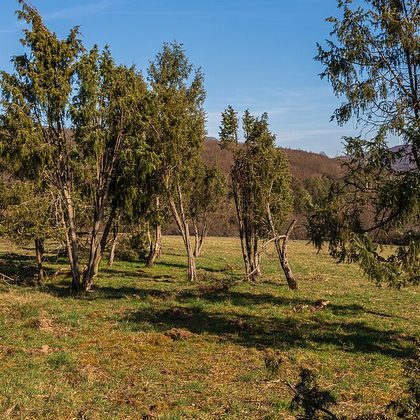
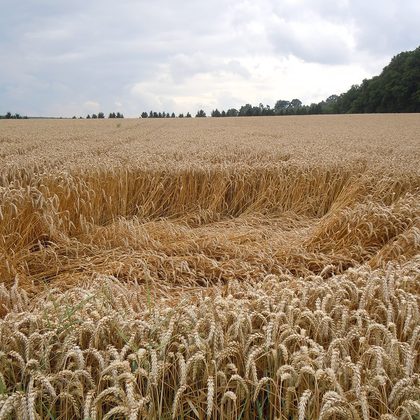
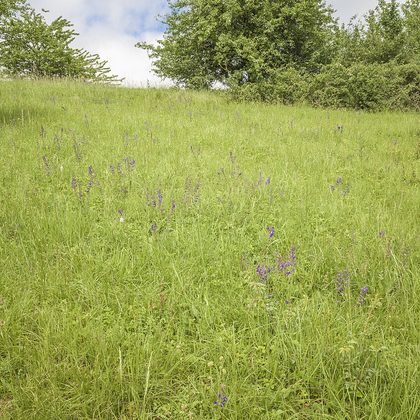
Breeds in open steppe, grassland and extensively farmed cereal country from eastern Europe to Central Asia, nesting on the ground among tall herbs. On migration and in the African and Indian winter quarters it hunts over dry grassland, savanna, rice fields and arable land. In the Netherlands birds turn up over saltmarsh, polders, rough field margins and heathland, often where Montagu's Harriers are also hunting.
Where the bird is most at home, classified with EUNIS — the European standard for habitats.

Range and movements
Core range from Ukraine and southern Russia to Kazakhstan and western China, with a marked recent push to the north-west and breeding records in Finland, the Baltic states, Poland, Germany and even the Netherlands. In the Netherlands it is a scarce but now near-annual migrant, most often in Groningen, Friesland, Flevoland and the Delta. In Spain it is a rare visitor, mainly in autumn on the southern coast and the Canary Islands, although the first south-west European breeding records are now a fact.
- Breeding (summer)
- Winter
- Passage
- Migration direction
- dark = core range, pale = thinly spread
Where and when to look
Look for it where you look for Montagu's: in May over freshly drilled fields and saltmarsh, and from late August to early October over the northern polders. Give every pale or unstreaked ringtail your time — it is all about the head. Check whether the pale collar runs right round the neck and whether the underparts are plain orange without streaking; those are the marks that still work at range. Coastal watchpoints and migration counts produce most records.
Conservation status
IUCN: Near Threatened. The core range in the steppes of southern Russia and Kazakhstan is under pressure from steppe conversion to arable, fires and the loss of rodent prey, and the world population is put at a few tens of thousands of pairs. At the same time the species is expanding to the north-west — probably a response to drought and habitat loss in the core range — which is precisely why western European birders now see it more and more often.