All species › Passerines › Leaf warblers › Pallas's leaf warbler
Pallas's leaf warbler
Phylloscopus proregulus | Pallas' boszanger | Mosquitero de Pallas
Pallas's Leaf Warbler is barely bigger than a Goldcrest and weighs less than six grams, yet in autumn it crosses thousands of kilometres from the Siberian taiga to the North Sea coast. Finding one in a coastal copse means watching a bird that seems to be made of seven stripes and that hovers at the twig tips like a hummingbird.

Voice
In western Europe the call is all you get, and it is surprisingly soft for so gaudy a bird: a short, slightly nasal, gently rising chu-wee or dju-ee that recalls a young House Sparrow and is easily lost in the babble of a tit flock. It is markedly quieter, lower and less piercing than the loud, penetrating tswee-eest of Yellow-browed Warbler, and that difference is the key in a coastal copse: something soft and nasal among the tits is worth chasing. The song, almost never heard here but delivered in the taiga from May to July, is an astonishingly loud and varied canary-like performance of high trills, descending glissandi and rapid rolls, produced by a six-gram bird and audible for hundreds of metres. Very occasionally an autumn bird gives a short, subdued version on a warm October day.
No freely licensed recording is available for this species yet.
Identification
Tiny, round and short-tailed, with a strikingly striped head. A broad sulphur-yellow central stripe runs over the dark crown right onto the forehead; below it a long, broadly flared yellow supercilium and a dark eye-stripe. The wing carries two yellow wing bars, the front one short and often inconspicuous, plus pale tertial fringes. The clinching feature is the lemon-yellow rump patch, visible only when the bird hovers or stretches — and it does so constantly, feeding on the wing at the tips of branches with quivering wings like a small hummingbird. Legs dark, bill small and dark with a pale base.
Confusion species
Yellow-browed Warbler is the species to rule out, and there are three benchmarks: the crown stripe (broad and bright yellow in Pallas's, absent or at most a vague pale line in Yellow-browed), the rump (a clear lemon patch in Pallas's, uniform green in Yellow-browed) and size and tone (Pallas's smaller, rounder and far yellower; Yellow-browed larger, longer, with a whiter supercilium and wing bars). The call helps too: Yellow-browed gives a loud, upslurred, penetrating tswee-eest, Pallas's something softer and more nasal. Goldcrest is the same size and hovers in the same way, but lacks any supercilium and has a plain, expressionless face with a black-bordered crown. Hume's Leaf Warbler is greyer with only one clear wing bar and dark legs.
Habitat
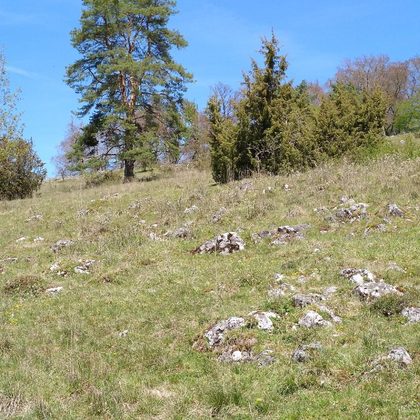
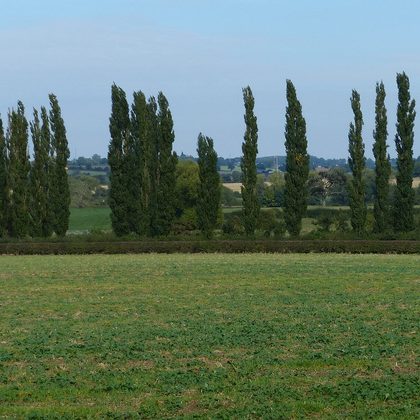
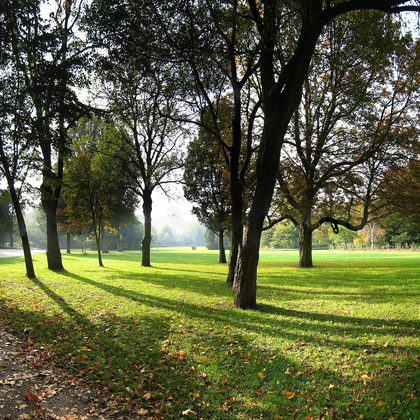
Breeds in dark coniferous forest of the Siberian taiga, in larch, spruce and birch regrowth, up into the mountain forests of southern Siberia and Mongolia. Here in autumn it is instead in low, dense scrub close to the sea: sea-buckthorn thickets, willow scrub in dune slacks, elder and hawthorn in coastal copses, and gardens and shelterbelts by lighthouses and on the Wadden islands. It normally feeds in the outer branches of bushes and low trees, where the light is and the insects are.
Where the bird is most at home, classified with EUNIS — the European standard for habitats.

Range and movements
Breeds from the Urals to the Sea of Okhotsk and normally winters in south-east Asia, but since the 1970s it has become an annual autumn visitor to north-west Europe, with tens to hundreds of birds each year. In the Netherlands it appears almost exclusively between mid-October and late November, peaking in the last ten days of October, and almost always along the coast: the Wadden islands, the Holland dunes and the Maasvlakte. In Spain it is a distinct rarity, with a small number of records, mainly in the north and on the Balearics.
Where and when to look
The last week of October, in a small coastal copse or a sea-buckthorn thicket on a Wadden island, after a few days of easterly or south-easterly wind and preferably in the morning after a clear night. Find a party of Blue Tits and Long-tailed Tits first, because eastern vagrants almost always travel with such a flock; walk along with it and listen for a soft, nasal note among the chatter. Then watch the twig tips for a bird that hovers: that hovering moment reveals the yellow rump, and with it the identification is settled.
Conservation status
Not threatened; the Siberian breeding population is huge and stable to increasing. Records in Europe have risen sharply over the past half century, partly because there are more and better observers on the coast, but probably also through a genuine increase and a shift in migration direction. From a sensation in the 1960s, Pallas's Leaf Warbler has become an annual visitor of which, in good years, dozens are seen on a single island.