All species › Pelicans, herons and ibises › Ibises and spoonbills › Northern bald ibis
Northern bald ibis
Geronticus eremita | Heremietibis | Ibis eremita
A black, metallically glossed ibis with a bare red head and a shaggy neck ruff that breeds not in a marsh but on a cliff face. It vanished from the Alps around 1600 and became one of the rarest birds on earth in the twentieth century; every Northern Bald Ibis you see in Europe today is the product of a reintroduction project.

Voice
At the colony a hoarse, guttural chrup or hroomp and a higher, husky hyoh, often in greeting at the nest changeover, with the head bobbing and the ruff raised. Away from the colony the species is virtually silent; feeding flocks are quiet. The sound does not carry far — a breeding cliff gives itself away by its white droppings and the flapping rather than by voice.
No freely licensed recording is available for this species yet.
Identification
Medium-sized, stocky ibis with a short tail and long legs. Uniformly black at range, at close quarters strongly glossed green, bronze and purple across mantle and wing coverts. Head and foreneck are unfeathered: dull crimson on face and throat, slate grey on the crown, with an orange-red eye. Long, narrow feathers on the hindcrown hang over the neck like a windblown ruff — the feature that identifies the species in any posture. The long, sickle-shaped bill and the legs are red. In flight: broad, square-ended wings, extended neck, short tail and fast, fairly shallow beats broken by short glides. Juveniles have a grey-feathered head, a duller bill and almost no ruff.
Confusion species
Glossy Ibis is the only real confusion species and differs on every point. It is clearly slimmer and much longer-legged, in breeding plumage deep chestnut with a green gloss on wing and back rather than uniform black, and has a feathered head with only a narrow bare line and a white border around the bill base, and no ruff. In flight the leg projection settles it: on Glossy Ibis the whole lower leg trails well beyond the tail, on Northern Bald Ibis the toes barely clear it, which makes the bird look shorter and more compact. A distant flock can suggest crows or even Black Storks, until the long decurved bill comes into view.
Habitat
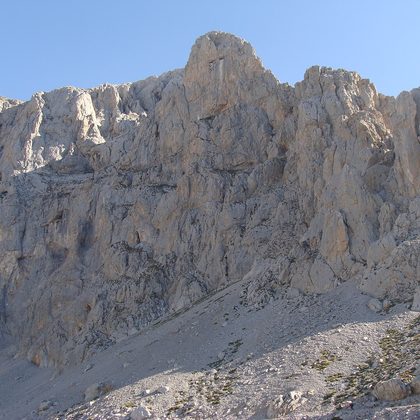
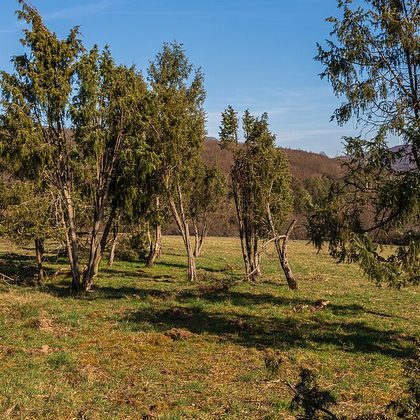
Steep rock faces with broad ledges, niches and overhangs — sea cliffs as readily as inland crags — close to open, short-grazed or stony ground. Feeds by walking and probing in dry steppe, extensively grazed pasture, fallow, stubble and coastal sand flats, using the curved bill to take beetles, grasshoppers, larvae, lizards and worms. Unlike most ibises it needs no water; drought and the loss of extensive grazing are what threaten it instead.
Where the bird is most at home, classified with EUNIS — the European standard for habitats.



Range and movements
The only continuously wild population is on the Atlantic coast of Morocco, in and around Souss-Massa National Park and at Tamri, and numbers more than seven hundred birds. Europe has two focal points, both reintroductions: the resident colonies in the province of Cádiz — La Barca de Vejer, Castilnovo and San Ambrosio — built up since 2004, and the migratory Alpine population of the Waldrappteam, breeding in Austria and southern Germany and wintering in Tuscany, a route redirected towards Spain in recent years. In Turkey a semi-wild colony survives at Birecik on the Euphrates, kept in captivity outside the breeding season. Historically the species bred from Morocco and Spain through the Alps and the Balkans to Syria.
- Resident
- Breeding (summer)
- Winter
- Passage
- Migration direction
- dark = core range, pale = thinly spread
Where and when to look
In Andalusia the colony on the cliff at La Barca de Vejer (Cádiz) is by far the easiest: look up at the ledges from the far bank of the river and count the ruffed heads; in spring the birds are active all day and cross low over the road. Outside the breeding season they feed in small parties on the surrounding pasture and stubble, where at range they pass for carrion crows until you see the bill. In Morocco the coastal plain at Tamri, north of Agadir, is the classic address, best in early morning. Nearly all European birds carry colour rings and often a transmitter — note the codes, the projects value them.
Conservation status
IUCN: Endangered. In 2018 the species was moved down from Critically Endangered after the Moroccan population more than trebled in two decades; before that it ranked among the rarest birds in the world. That you can see it in Europe at all is entirely the work of reintroduction. Proyecto Eremita has raised and fledged captive-bred young in Cádiz since 2004; in 2008 a pair bred in the wild on Spanish soil for the first time in over five centuries, and in recent seasons more than fifty chicks a year have been ringed — the colony is now resident and approaching self-sufficiency. The Waldrappteam has since 2004 taught hand-raised young the migration route across the Alps behind an ultralight aircraft; those birds now breed on their own, but a warming climate has made the autumn crossing of the Alps so difficult that the route has been shifted to the south-west. It remains precarious: illegal shooting along the flyway, collisions with power lines, loss of feeding habitat to intensification and drought, and a narrow genetic base.