All species › Passerines › Long-tailed tits › Long-tailed tit
Long-tailed tit
Aegithalos caudatus | Staartmees | Mito común
The Long-tailed Tit is not a true tit at all but a fluffy ball of eight grams with a tail longer than the rest of the bird. It travels in family parties that work through the bushes on a stream of chatter; you always hear them before you see them.

Voice
The Long-tailed Tit has hardly any true song; what it has is a continuous contact chatter that keeps the party together, and that is the sound by which you know it. Three elements alternate: a thin, high, rapid see-see-see, like a Goldcrest but slightly fuller; a short, hard pt or tup; and above all a dry, rattling, chirring tserrrp or tserr-r-r, as if a tiny rasp were being drawn across wood. That rattle is the decisive sound and carries surprisingly far. A party therefore sounds like a restless, unbroken squeaking and rattling that drifts slowly along the wood edge, with new birds joining all the time. Audible all year, but clearest from October to March when family groups roam; in the breeding season the birds go quiet and inconspicuous. Early in spring the male sometimes delivers a soft, jangling little song that is little more than its calls strung together.
Recording: Jochem Verweij — CC BY-SA 4.0 · Wikimedia Commons
Identification
Unmistakable in shape: a round little body with a tiny round head, a minute stubby bill and a very long, black-and-white, graduated tail making up well over half the total length. Upperparts black with a pink-brown scapular patch, underparts off-white washed pink on flanks and belly. In our breeding subspecies europaeus a broad black band runs from the bill over the eye to the nape, with a dirty white central crown between. The bare orbital ring is yellow to orange-red in adults. Flight is weak and undulating, tail streaming behind, and parties almost always cross an opening one bird at a time.
Confusion species
Confusion is barely possible, but note two things. In reedbeds, Bearded Reedling also has a long tail, but it is warm orange-brown, with a blue-grey head and black moustache in the male, and it never leaves the reeds. And in some autumns northern Long-tailed Tits of the form caudatus reach us, with a wholly white head and no black head band; that white-headed bird is the same species but stands out at once in a party. In Spain the resident form is irbii, which conversely has a dark grey-black head. By ear: the thin see-see-see resembles Goldcrest and Blue Tit, but the dry rattle tserrp woven through it is unique.
Habitat
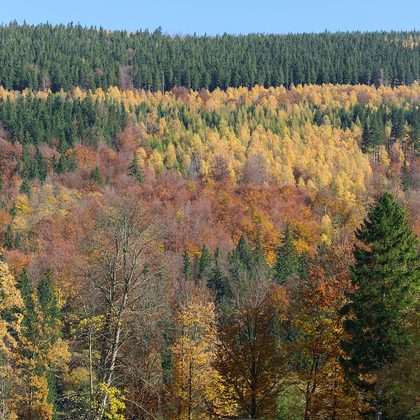
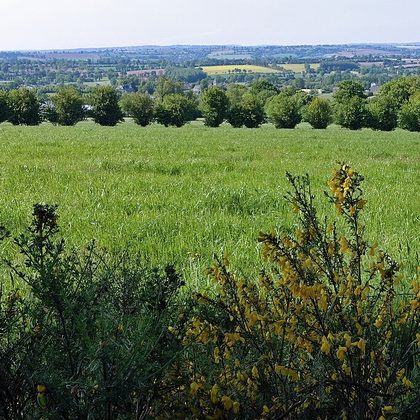
Broadleaved and mixed woodland with a dense shrub layer, wood edges, hedgebanks, overgrown hedges, marshy willow and birch carr, streamside scrub, parks, cemeteries and large gardens. The nest is one of the finest structures built in Europe: a closed, egg-shaped ball of moss and spider silk, camouflaged outside with lichen and lined inside with sometimes more than a thousand feathers, set in a bramble or the fork of a thorn bush. In Spain also in holm oak and pine woods and in riverside poplar and willow groves.
Where the bird is most at home, classified with EUNIS — the European standard for habitats.



Range and movements
From Ireland to Japan, in a long series of subspecies that grow whiter-headed from west to east. In the Netherlands it is a common and in recent decades increasing breeder of woodland, scrub and garden, present all year and essentially non-migratory; in invasion years northern white-headed birds arrive in October and turn up in the dunes and on the Wadden islands. In Spain it is widespread in the north and centre and scarcer in the dry south-east.
- Resident
- Breeding (summer)
- Winter
- Passage
- Migration direction
- dark = core range, pale = thinly spread
Where and when to look
The best months are November to February: walk a wood edge or a hedgebank and listen for the rattle. As soon as you hear it, stand still and wait; the party often comes straight at you and passes within a few metres, because Long-tailed Tits are strikingly unshy. Follow such a group for a while, because other species almost always travel with it: Blue Tits, Marsh Tits, Treecreepers, Goldcrests and, in autumn, sometimes a Yellow-browed Warbler. To see the nest, visit a bramble or gorse thicket in mid-March, when building starts and the leaves are not yet in the way.
Conservation status
Not threatened and increasing across much of Europe, mainly thanks to a run of mild winters and the growth of scrub in woods and urban fringes. Hard frost is the great threat: a winter of prolonged snow and ice can cost more than half the local birds. Because a pair raises ten or more young and is often assisted by helpers from the family group, recovery is usually complete within two or three years.