All species › Passerines › Swallows and martins › Common house-martin
Common house-martin
Delichon urbicum | Huiszwaluw | Avión común
The swallow of the gutter: blue-black above, brilliant white below, with a rump that lights up like a lamp the moment it turns. It builds a nest of mud pellets against the wall and breeds in colonies, but in north-west Europe those colonies are slowly emptying.

Voice
A dry, short, slightly grating prrit or chirrp, given constantly in flight and merging over a colony into a continuous murmur. The song is a soft, muttering, drawn-out twitter without the rattling ending of the Barn Swallow, usually delivered from or beside the nest. A passing Hobby or Sparrowhawk brings a sharp, high tseer, after which the whole colony takes to the air at once.
Recording: Victor C. Lewis / British Library — CC BY 4.0 · Wikimedia Commons
Identification
Compact and broad-winged, glossy blue-black on head, back and wings, with a large, pure white rump that is the clinching feature at range. The underparts are entirely white, throat and undertail included. The tail is short and shallowly forked, with no streamers. Legs and toes are covered in white feathering, which no other European hirundine has. The flight is higher, more fluttering and with more gliding than a Barn Swallow's.
Confusion species
Barn Swallow has a rusty forehead and throat, a blue breast band, creamy underparts and a deeply forked tail with long streamers, and shows no white rump at all. Sand Martin is smaller and dull brown with a brown breast band and likewise no white rump. Swift is bigger, wholly dark and scythe-winged. In Spain the trap is Crag Martin: brown-grey, no white rump, white spots in the tail and a slower, more gliding flight.
Habitat
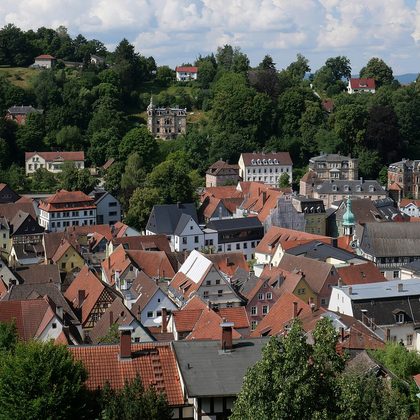
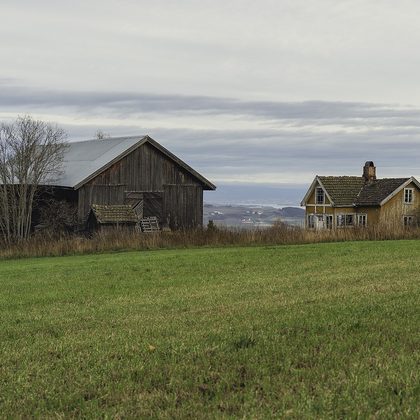
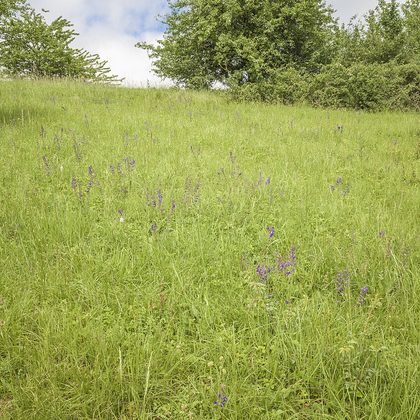
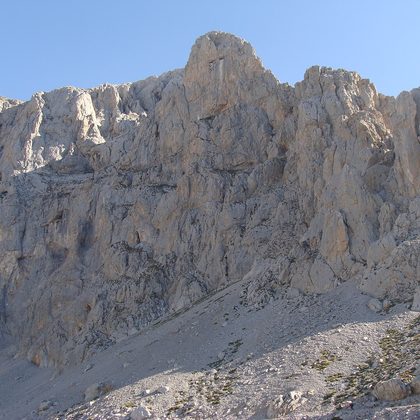
Villages, farms, town edges, bridges and viaducts, with the nests set against an overhang, a gutter or a balcony ceiling on the outside of the building. It also needs two things within a few hundred metres: open air over pasture or water for catching insects, and a source of wet, clayey mud for nest material. In southern Europe it also breeds on natural cliffs.
Where the bird is most at home, classified with EUNIS — the European standard for habitats.
Range and movements
Breeds throughout Europe to northern Scandinavia and far east into Asia. In the Netherlands spread across the whole country, with the largest colonies in the countryside and along the coast, but clearly declining. In Spain it is common in villages, cities and on cliffs, up into the high mountains. It leaves in September and October for Africa, where it winters high above rainforest and savanna and rarely comes to the ground.
- Resident
- Breeding (summer)
- Passage
- Migration direction
- dark = core range, pale = thinly spread
Where and when to look
June and July at a village with an occupied colony: stand under the eaves and watch the comings and goings at the mud cups. After rain, a muddy patch on a farm track or a shoreline repays a visit, with dozens landing at once to gather pellets of clay — the best chance to see the white-feathered legs. In late summer they hunt high over the village alongside Swifts.
Conservation status
Not globally threatened, but clearly declining in north-west Europe and in the Netherlands for decades. The causes stack up: fewer flying insects under intensive land use, smooth insulated modern facades that mud will not stick to, the disappearance of unsurfaced wet places with clay, and the deliberate removal of nests because of the mess. Artificial cups under an overhang, a maintained mud puddle and simply leaving existing nests in place all help at once.