All species › Pelicans, herons and ibises › Herons and bitterns › Little bittern
Little bittern
Botaurus minutus | Woudaapje | Avetorillo común
The Little Bittern is by far the smallest European heron, barely bigger than a Moorhen and almost always hidden in dense reed. In practice you find it on voice, and confirm it on one brief, low flight.

Voice
The male's advertising call is a short, deep, barking hooch — a dog-like woof repeated at a steady interval of two or three seconds, sometimes for half an hour. It does not carry far, so you need to be within a few hundred metres of the reed. Mostly at dusk and in the early morning, from mid-May to early July. The flight call is a sharp, short kek or krek.
Recording: Joost van Bruggen — CC BY-SA 4.0 · Wikimedia Commons
Identification
Small and compact, short legged, with a long pointed bill and a thick neck. The male has a glossy green-black crown and mantle and a very conspicuous large buff-ochre wing panel on the coverts that in flight contrasts sharply with the black flight feathers — this two-toned wing is what the identification turns on. Neck and underparts are warm sandy, the bill yellow with a dark ridge, the legs yellow-green. The female is duller, browner than black above, with fine dark streaking below and a less clean panel; juveniles are brown across the upperparts with pale feather fringes and are heavily streaked. It flies low, fast and slightly jerkily over the reed and drops in abruptly.
Confusion species
Night Heron is the key confusion species, particularly in flight and particularly as a juvenile: it is nearly twice as large, broader and rounder winged, and juveniles are plain dark brown with fine white droplet spots above — never with a pale wing panel. A Little Bittern always shows the sharp contrast between pale panel and black flight feathers, the female included. A Bittern is far bulkier, buff with black barring, and looks owl-like. A Little Bittern crossing the reed low can suggest a Water Rail or a small crake; then look for the outstretched bill and the wing panel.
Habitat
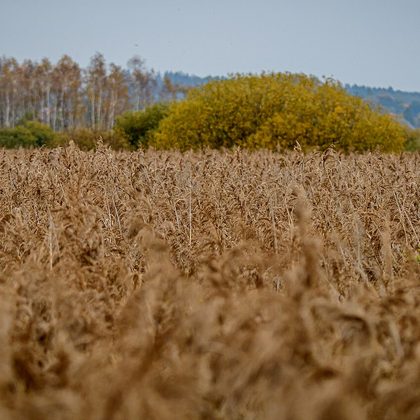
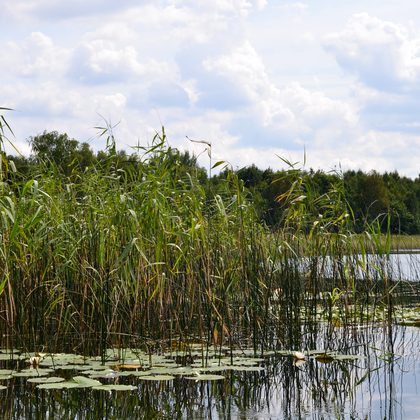
Reed with scrub in or beside it: reed fringes along drains, old clay pits, silting-up sand pits, patches of willow and alder carr at the edge. Unlike the Bittern it makes do with a small area, provided the reed stands in water and there are willows or branches to clamber through. Hunts by climbing among the reed stems for small fish, tadpoles and dragonflies.
Where the bird is most at home, classified with EUNIS — the European standard for habitats.

Range and movements
A very scarce Dutch breeder, with a few dozen pairs at the Zouweboezem, the Nieuwkoopse Plassen, parts of Limburg and the Gelderse Poort. In Spain it is widespread and considerably more numerous, with good numbers in the Ebro Delta, the Albufera of Valencia, the Guadalquivir rice fields and along many inland rivers. Winters in tropical Africa.
- Resident
- Breeding (summer)
- Winter
- Passage
- Migration direction
- dark = core range, pale = thinly spread
Where and when to look
Pick a warm, windless evening in the second half of May or in June and stand close to a reed fringe with willow growth for the last hour before dark. Listen for the barking call first and then follow it: around that time the birds shuttle low from one reed patch to another, giving you a few seconds to catch the wing panel.
Conservation status
Not globally threatened (IUCN: Least Concern), but sharply reduced in north-west Europe. The Dutch population collapsed in the 1970s and 1980s through Sahel drought and the loss of wet reed fringes, and has recovered only slowly since. Restoring wet margins and leaving old reed standing are the measures that matter most.