All species › Passerines › Sylvia warblers › Lesser whitethroat
Lesser whitethroat
Curruca curruca | Braamsluiper | Curruca zarcerilla
Lesser Whitethroat is the Whitethroat's invisible neighbour: just as common in hedges and overgrown gardens, but without ever showing itself. Its dry rattle comes from deep inside a hawthorn, and by the time you have found the bird it is already rattling two bushes further on.

Voice
The song has two parts and the second is the famous one. First comes a soft, hurried, mumbling throaty warble that carries only ten or fifteen metres. Then comes the rattle: a series of eight to fifteen identical, hard, dry, wooden notes on exactly the same pitch, tell-tell-tell-tell-tell-tell-tell, like a small hammer tapping on a plank. The rattle is completely flat — no rise, no fall, no acceleration — and that is precisely what separates it from every other European songbird. It carries for hundreds of metres, while the soft preamble is lost at ten; anyone who hears only the rattle should know a quieter passage came first. The call is a hard, dry tek, like two pebbles knocked together, often in series. Song runs from late April into early July, almost always from cover inside a bush, all day, peaking in the first half of May.
Recording: SanoAK: Alexander Kürthy — CC BY-SA 4.0 · Wikimedia Commons
Identification
Smaller and more compact than Whitethroat, with a shorter tail and a stockier outline. Upperparts plain grey-brown with no warm or rusty tone in the wing at all — that absence of a wing panel is itself the feature. The crown is grey and below it lies a dark, grey-black ear-covert mask that stands out like a small bandit's mask against the white throat. The legs are dark: lead-grey to almost black. Underparts white with a faint cream wash on the flanks; the outer tail feathers are white. Sexes alike. In autumn, eastern birds occasionally appear that are greyer and paler, with a lighter crown and a finer bill.
Confusion species
Whitethroat is the main confusion species, and it comes down to three things: legs (lead-grey to black in Lesser, pale straw in Whitethroat), wing (plain grey-brown in Lesser, a broad rusty panel in Whitethroat) and face (a dark ear-covert mask in Lesser, a plain grey or brown head in Whitethroat). Song settles it immediately too: Lesser rattles dryly and flatly on one pitch, Whitethroat scratches out a hurried chatter. A large, bulky Lesser Whitethroat can also suggest Barred Warbler; then look for the heavy bill, the two white wing bars, the long primary projection and the pale iris of Barred Warbler, all four of which Lesser lacks. East of Europe there are forms that are harder to place. The Central Asian form formerly called Curruca althaea is larger, with a longer bill, a darker and browner plumage and a greyer head. In western Europe such eastern birds are rarely named with certainty, because the plumage characters overlap too widely; call and song are what help most. AviList 2025 treats that form as part of Lesser Whitethroat, while other lists carry it as a separate species.
Habitat
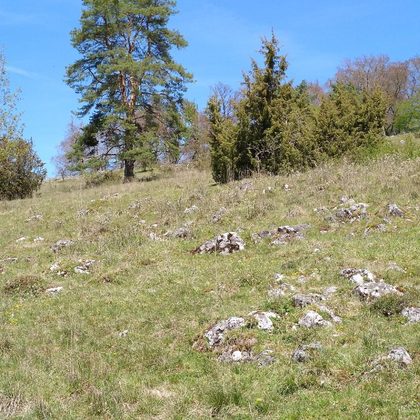
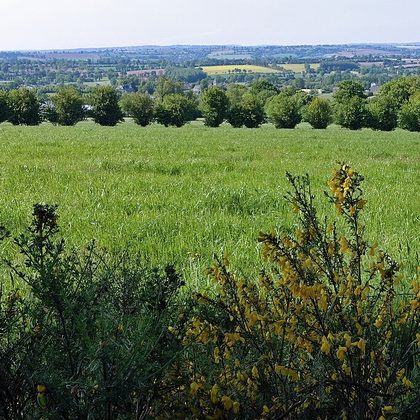
Dense, thorny, tall scrub: hawthorn and blackthorn hedges, overgrown gardens, cemeteries, parks with thick hedges, young conifer plantations, sea-buckthorn thickets in the dunes, hedgebanks and orchard edges. Unlike Whitethroat it wants height and density rather than low rank growth, and accordingly it sings from inside the bush rather than on top of it.
Where the bird is most at home, classified with EUNIS — the European standard for habitats.


Range and movements
Breeds from north-west Europe to Central Asia. The migration route is remarkable: Lesser Whitethroats head not south-west but south-east, through Italy, the Balkans and the eastern Mediterranean to north-east Africa and Arabia — which is why they are so rarely seen in Spain. In the Netherlands it is a common but thinly spread breeder of hedges, dunes and town fringes, arriving late, usually not before the last week of April. In Spain it breeds only very locally in the north-east and is otherwise a scarce passage migrant.
- Breeding (summer)
- Winter
- Passage
- Migration direction
- dark = core range, pale = thinly spread
Where and when to look
Early May, along a hawthorn hedge, an overgrown cemetery or an old orchard edge, at any hour of the day. Walk slowly and wait for the rattle; then do not go searching but stand still and scan the edges of the bush, because sooner or later the bird comes into view for a few seconds to fly to the next one. That is your chance to fix the dark legs and the ear-covert mask. In the dunes, sea-buckthorn thickets are the best bet, and in autumn the same thickets produce migrants.
Conservation status
Not threatened, with a large population that is stable to slightly increasing in north-west Europe; Dutch numbers have been fairly constant over recent decades. Because it migrates by the eastern route and winters in north-east Africa, it is less exposed to Sahel drought than Whitethroat. The loss of hedges, hedgebanks and dense scrub in farmland is the main pressure.