All species › Passerines › Sylvia warblers › Barred warbler
Barred warbler
Curruca nisoria | Sperwergrasmus | Curruca gavilana
Barred Warbler is the heavyweight of its family: a big, thick-necked warbler with a staring yellow iris and, in the adult, underparts barred from top to bottom like a sparrowhawk. In the Netherlands it is a rare autumn visitor, and then almost always a dull first-year.

Voice
The song resembles a Garden Warbler's but is louder, deeper and more broken up: a rapid, full, bubbling warble repeatedly interrupted by hard, grating notes and cut off abruptly, only to start again a few seconds later. It is often delivered in a short song flight, the bird climbing above the scrub on slow, exaggerated wingbeats and dropping back still singing. That happens in May and June on the breeding grounds in central and eastern Europe, from first light well into the morning. Here you will almost only hear the call, and it is the most useful sound: a hard, rattling tcherr-r-r-r, deeper and slower than a Lesser Whitethroat's rattle, plus a short, sharp tchek like two stones knocked together. An autumn bird in a sea-buckthorn thicket usually betrays itself with that rattling alarm before you see it.
Recording: Natura Saxonia — CC0 · Wikimedia Commons
Identification
Large and heavy, with a thick neck, a stout bill and a long tail with white tips to the outer feathers. The adult is ash-grey above and shows fine crescentic barring over the whole underside on a white ground, with a fierce lemon-yellow iris that gives it a severe expression, plus two narrow white wing bars and white fringes to the tertials. The first-year birds that reach us look very different: dull grey-brown, dark-eyed and with little or no barring apart from a few crescents on the flanks and dark tips to the undertail coverts. The white tertial fringes, the double wing bar, the bulky build and the long primary projection remain visible at any age and are then the key.
Confusion species
An exceptionally large Lesser Whitethroat is the classic trap, and four things separate them: Barred Warbler has a heavy, broad bill, two white wing bars with white tertial fringes, a much longer primary projection and a pale or yellow iris, while Lesser has a fine bill, a plain wing without white, a short wingtip and a dark eye, and shows a prominent dark ear-covert mask. A juvenile Whitethroat is the second trap, but it is far more lightly built, has a broad rusty wing panel and pale straw legs, whereas Barred Warbler is drab and has lead-grey, conspicuously thick legs. Garden Warbler is equally plain but round-headed, small-billed and without white in wing or tail.
Habitat
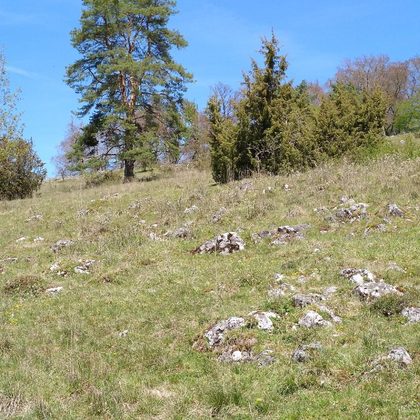
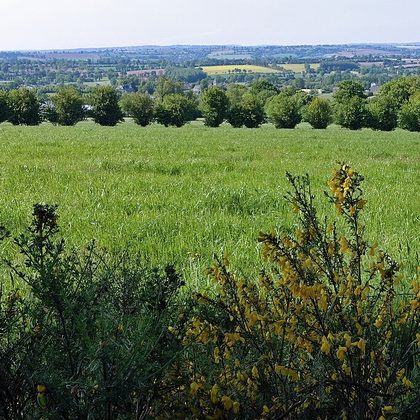
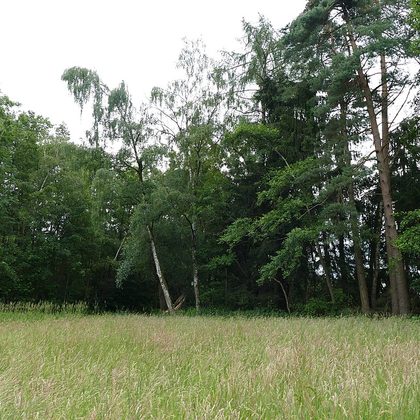
On the breeding grounds, warm, sunny, thorny half-open country: rank grassland with blackthorn and hawthorn clumps, scrubby river valleys, wood edges, old orchards and hedgebanks — the same landscape as Red-backed Shrike, with which it often shares a thicket. On migration in north-west Europe it is almost invariably in sea-buckthorn, bramble and elder just behind the foredune, where it feeds on berries.
Where the bird is most at home, classified with EUNIS — the European standard for habitats.

Range and movements
Breeds from northern Germany, Denmark and southern Sweden eastwards through Poland, the Balkans and Ukraine to Central Asia, and winters in East Africa. The western edge of the range has clearly retreated eastwards over the past half century. In the Netherlands it is a rare passage migrant: a few to a few dozen birds each autumn, nearly all first-years, and almost exclusively on the Wadden islands, in the coastal dunes and on the Maasvlakte, between mid-August and early October. In Spain it is a genuine vagrant with only a handful of records.
- Breeding (summer)
- Passage
- dark = core range, pale = thinly spread
Where and when to look
Late August and early September, in the sea-buckthorn thickets of Vlieland, Texel or Schiermonnikoog, when the berries are ripe and the scrub is full of migrants. Walk the edge of a large block of scrub and listen for a low, rattling alarm; then look for a strikingly large, heavily built, drab warbler working through the branches in fits and starts. Check the wing first: white tertial fringes and two wing bars occur on no Lesser Whitethroat or Whitethroat. A pale eye confirms it, but first-years often still have a dark one.
Conservation status
Not threatened globally and still numerous in the east of its range, but clearly declining along the western edge: in Germany and Denmark the species has fallen sharply and disappeared locally. The loss of extensively grazed thorny grassland, the drainage of river valleys and either the clearance or the closing over of scrub are the main causes. Conditions along the long eastern migration route and in the East African wintering grounds also play a part.