All species › Waders, gulls and terns › Sandpipers and snipes › Great snipe
Great snipe
Gallinago media | Poelsnip | Agachadiza real
Great Snipe is the only European snipe with a lek. From late May males gather at dusk on a traditional arena in the marsh and sing there through much of the night, while females walk the edge and choose.

Voice
Away from the lek it is nearly mute: a flushed bird gives at most a low, short errch, far quieter than the tearing note of Common Snipe. On the lek the male sings a long, tightly rhythmic sequence that opens with a soft clicking bib-bib-bib, accelerates into a bubbling rattle and runs on into a thin high whistle closed off by a dry snap of the bill. The whole thing sounds mechanical, like a wind-up toy or ice clinking in a glass, and carries well over three hundred metres on a still night. There is no aerial display and so no bleating from the tail feathers: it is all done standing on the ground.
No freely licensed recording is available for this species yet.
Identification
Heavier and more compact than Common Snipe but with a distinctly shorter bill, about one and a half times the head length. The underparts are heavily barred right across the belly, so the bird looks dark from below. On the closed wing three rows of white feather tips run across the coverts. In flight the outer tail feathers are largely white, giving the tail obvious white corners, and the underwing is densely and darkly barred.
Confusion species
Common Snipe is the comparison that matters. Look for the white tail corners, which Common Snipe lacks; the shorter, heavier bill; the barring that on Great Snipe crosses the centre of the belly where Common Snipe stays clean white; and above all the flush. Great Snipe goes up slowly and low, flies straight away without zigzagging and drops back in within a hundred metres, usually silent or at most giving a hoarse croak swallowed by wing noise. Common Snipe towers away rasping and jinking.
Habitat
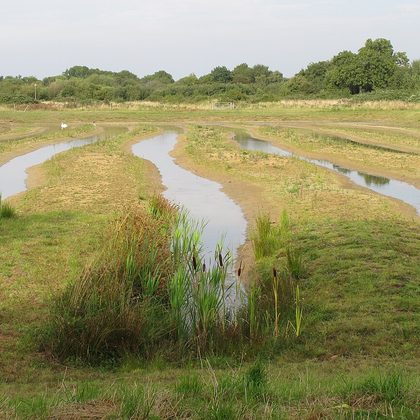
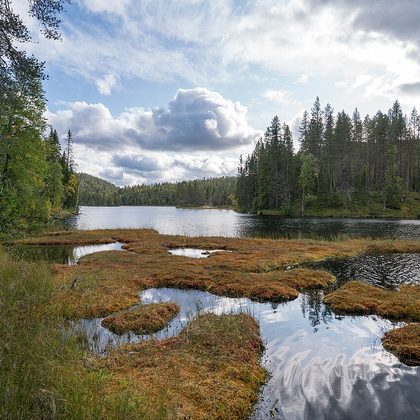
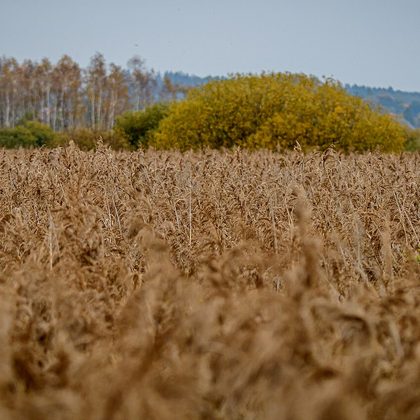
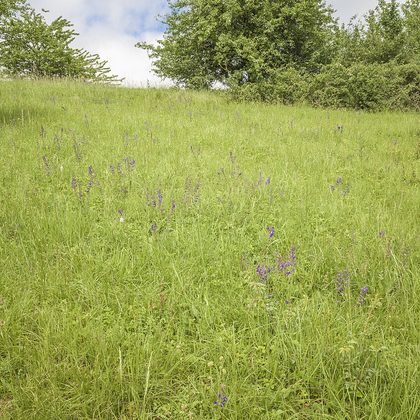
Breeds in sedge marsh, wet hay meadow and fen in stream valleys and river floodplains, and in Scandinavia in wet ground within the mountain birch zone. Lek sites lie on open, short, tussocky vegetation and are used year after year on almost the same few square metres. Outside the breeding season it favours drier ground than Common Snipe: stubble, rank pasture, coastal grassland and drying marsh edges.
Where the bird is most at home, classified with EUNIS — the European standard for habitats.
Range and movements
Breeds in Norway and Sweden, Poland, the Baltic states, Belarus, Ukraine and north-west Russia east to the Yenisei. The whole population moves to the Sahel and East Africa in non-stop flights of four to seven thousand kilometres lasting sixty to ninety hours, with birds tracked far above eight thousand metres. In Britain it is a rare autumn visitor with around 170 records since 1950, two-fifths of them in Shetland and Orkney and most of those in September.
- Breeding (summer)
- Passage
- dark = core range, pale = thinly spread
Where and when to look
For the lek, go to Ånnsjön in Jämtland, Sweden, or to the Biebrza marshes in Poland in the first half of June. Stand still at the edge of the marsh an hour before midnight and stay on the path; singing starts as the light goes and carries far enough to enjoy from a distance. For a British bird, walk rough dry coastal grassland in September and watch for the heavy, low, silent snipe that lifts from under your feet.
Conservation status
Near Threatened, with a decline of a little over twenty per cent across three generations. In western Europe it vanished as a breeder long ago through drainage of stream valleys and floodplains. Further east the loss of traditionally mown hay meadows, the scrubbing over of upland and valley grassland once grazing stopped, and hunting in eastern Europe and on the African wintering grounds all weigh on the population.