All species › Tubenoses › Petrels and shearwaters › Fea's petrel
Fea's petrel
Pterodroma feae | Gons' stormvogel | Petrel gon-gon
Fea's Petrel is the gadfly petrel of the eastern North Atlantic: grey above with a dark M across the wings, white below, and with a wholly dark underwing that shows as the bird throws itself up out of the swell. It is what seawatchers on Madeira, the Azores and the Iberian capes are waiting for, and it is also the bird they usually have to write down with a slash in its name.

Voice
Silent at sea. Over Bugio the birds call in flight after dark with a long drawn moaning wail that rises and then breaks, and from the burrow comes a repeated two-part gon-gon, low and nasal; that call is the source of the bird's Cape Verde name and of its Spanish one. Calling is at its heaviest on dark nights in the second half of the summer.
No freely licensed recording is available for this species yet.
Identification
About 35 cm long, with long narrow wings that look broad-based and slightly bowed, and a short, deep, heavy black bill that gives the head a blunt, bull-necked look. The upperparts are grey with a blackish M running from wingtip to wingtip, and the rump and tail are a paler, colder grey that stands out against the darker mantle and inner wing — a genuinely useful mark at range. The face is white with a dark smudge round the eye, the crown grey. The underparts are white, with a grey patch at each side of the breast that does not close into a band. The underwing is dark throughout, without a pale central stripe. The flight is fast and high-arcing in wind, the bird rising many metres and shearing over on stiff wings; in calm it flaps and glides low with quick, snappy beats.
Confusion species
This is the section that matters, and it has to be written honestly. Zino's Petrel breeds in the mountains of Madeira and shares the same plumage exactly: the same grey back, the same M, the same pale tail, the same dark underwing. The differences are structural — Zino's is smaller and slighter, with narrower wings and, above all, a distinctly shallower and finer bill, roughly 11 to 12 mm deep at the base against 13 to 15 mm in Fea's. Bill depth of a few millimetres is not something anyone judges through a moving telescope on a pitching boat. In practice a bird is nameable only from sharp photographs that show the bill in profile, and a great many photographed birds still cannot be named, so the correct field label is Fea's/Zino's Petrel. The Bugio breeders have been treated by a number of authorities since the 2000s as a separate species, the Desertas Petrel, and they are not separable in plumage from the Cape Verde birds either, which adds a third name to the same silhouette. Soft-plumaged Petrel, a southern vagrant, is the one bird in the group that can be settled on plumage: it has a grey band closing right across the chest and no pale contrast in the tail. Great Shearwater is larger and browner, with a white collar and a white underwing; Cory's and Scopoli's Shearwaters are much bigger and slower with heavy yellow bills.
Habitat
Deep open ocean, particularly along fronts and over seamounts where prey rises at night, and normally well out of sight of land. It takes squid and small fish from the surface, mostly after dark, in fast passes without settling. Birds tracked from the Desertas make long looping foraging trips across the mid-Atlantic and are known to work the winds around passing storms. On land it uses burrows and rock cavities on steep, high slopes.
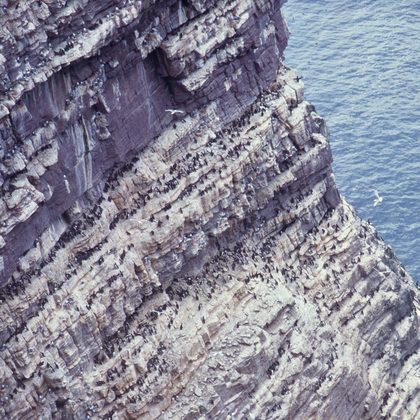
Where the bird is most at home, classified with EUNIS — the European standard for habitats.

Range and movements
Within the area of this guide the only breeding site is Bugio, the southern island of the Desertas group off Madeira; the rest of the world population breeds on four islands of Cape Verde, outside the map. At sea the birds range from Madeira and the Canaries north to the Azores, into the Bay of Biscay and up to the approaches of Ireland and Britain, with a regular autumn passage past the north-west corner of Iberia. Sightings north of Biscay are rare but annual, and almost all of them are logged as Fea's/Zino's.
- Breeding (summer)
- Passage
- dark = core range, pale = thinly spread
Where and when to look
The reliable place is Madeira. Take a full-day or multi-day pelagic out of Machico or Funchal towards the Desertas between late July and early October; the boats work the deep water in the afternoon and chum brings birds in close enough for the bill photographs the identification needs. Off mainland Europe the best chance is a seawatch from Estaca de Bares or Cabo Vilán in Galicia in late August or September, in the first hours after dawn with a strong north-west wind behind a low; a Biscay ferry crossing in the same weeks is a reasonable second choice.
Conservation status
Near Threatened (IUCN). The total population is small — a few hundred pairs on Bugio and something around a thousand on Cape Verde — and confined to a handful of islands, which is what keeps the species on the list. Rats and cats take eggs, chicks and adults; goats and rabbits once stripped the slopes of Bugio and their removal has allowed the vegetation and the burrows to recover, and numbers there are slowly rising. Light pollution draws fledglings down onto roads and harbours, and the whole population would be exposed to any single introduction of a new predator.