All species › Kingfishers, bee-eaters and rollers › Rollers › European roller
European roller | Coracias garrulus
Scharrelaar | Carraca europea
A heavy, crow-like bird in turquoise and cinnamon that sits motionless on a wire or dead branch for long spells, then drops onto a beetle on the ground. Only when it flies does the blue become obvious, with blue-black wingtips flashing dark in the sun.

Voice
A hard, crow-like rak-rak or krek-krek, Jay-like but deeper and drier, usually from a post or in flight. In display an accelerating rattling series accompanies a steep tumbling dive from side to side, the action the English name refers to.
No freely licensed recording is available for this species yet.
Identification
About the size of a Jackdaw, with a big head, a straight black bill with a slightly hooked tip and broad, fairly long wings. Head, neck and underparts are turquoise to sky-blue, the mantle warm cinnamon, the rump purple-blue and the primaries blue-black, giving a sharp contrast in flight. The flight is heavy and flapping, with strong deliberate beats; juveniles are duller, greyer and browner and lack the vivid blue.
Confusion species
Beginners are far more likely to turn a Jay or a passing pigeon into a Roller than a Bee-eater. A Jay is pinkish brown with a white rump, a black tail and rounded wings carrying a small blue-barred panel, and flies in an irregular flapping manner; a pigeon overhead is small-headed, sharp-winged and evenly grey. The Roller against those is blue with a brown back and blue-black wingtips, and sits still on a lookout for far longer. Bee-eater, which can also look bluish at range, is much slimmer, with a decurved bill and pointed streamers.
Habitat
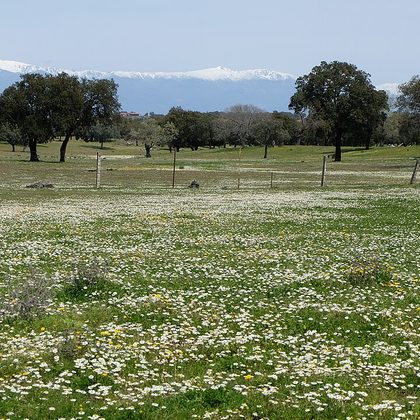
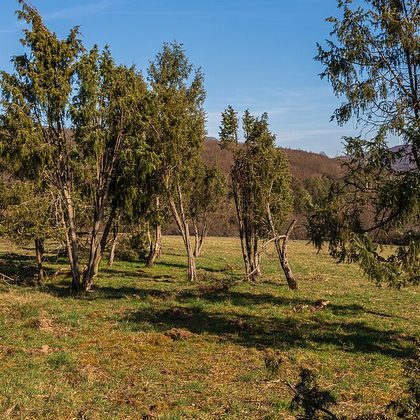
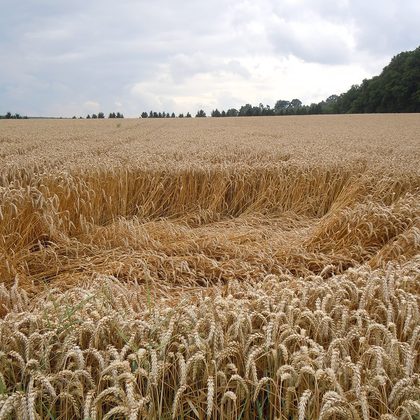
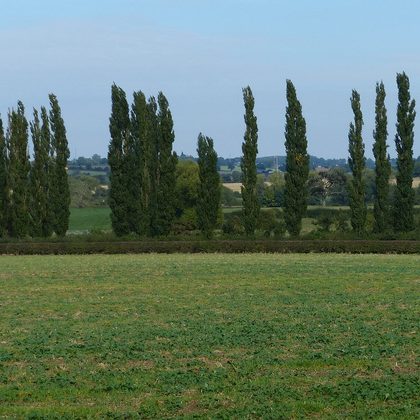
Warm open and half-open country with lookout perches: dehesa and other sparsely wooded grassland, steppe and dry grassland, extensive arable, lines of trees and hedgerow timber along fields, and the edges of open woodland. Feeds by dropping from a branch, post or wire onto large beetles, grasshoppers and lizards on bare or short ground; old hollow trees in or beside that land provide the nest cavity.
Where the bird is most at home, classified with EUNIS — the European standard for habitats.
Range and movements
Breeds in southern and eastern Europe, north-west Africa, Turkey and the Middle East, east to south-west Siberia, with strongholds in Iberia, the Balkans, Hungary and the Baltic states; it has been lost as a breeding bird from Denmark, Germany and Sweden. In Britain and Ireland it is a rare vagrant, recorded since 1664 and now averaging only a few birds a year, most of them in late spring and early summer, with lingering individuals occasionally staying for days. It winters in the savannas of southern Africa.
- Breeding (summer)
- Passage
- Migration direction
- dark = core range, pale = thinly spread
Where and when to look
Rather than waiting for a British bird, take a slow drive along quiet farm roads in Spain, Hungary or the Baltic states between May and July, early or late in the day, and scan wires, fence posts and isolated dead trees. The bird is picked up by its bulky, upright, big-headed shape rather than by colour, because against the sky it looks simply dark.
Conservation status
Not globally threatened: listed as Near Threatened in 2005, it was returned to Least Concern in 2015, but it has gone from much of northern and central Europe. The decisive factors are the loss of old hollow trees, insecticides that remove large beetles and grasshoppers, field enlargement, and shooting along the migration routes. Nest boxes combined with extensively managed grassland and arable demonstrably work.