All species › Waders, gulls and terns › Pratincoles and coursers › Collared pratincole
Collared pratincole
Glareola pratincola | Vorkstaartplevier | Canastera común
A wader that hunts like a tern and rests like a plover. Over saline flats, ricefields and drying lake margins it takes insects on the wing, on long pointed wings and a deeply forked tail, then drops onto baked mud and becomes almost impossible to relocate.

Voice
Noisy, and usually heard before it is seen. The call is a sharp, rattling kik-kik-kirrik, closest to a tern; over a colony, circling birds keep up a drawn-out kyerrr. At dusk, when the flock spreads out over the surrounding land, that sound carries for several hundred metres.
No freely licensed recording is available for this species yet.
Identification
Plain olive-brown above with no pattern, white below, with a warm buff wash across the breast. The throat is cream, neatly ringed by a thin black border; the bill is black with a red base and the eye-ring is white. Legs short and black. At rest the tail streamers reach or just pass the wing tips. In flight the white rump stands out against the black tail, and the underwing coverts are chestnut, with a narrow white trailing edge along the secondaries.
Confusion species
Everything hinges on flight views. The underwing coverts are chestnut; on Black-winged Pratincole (Glareola nordmanni) they are black. Along the trailing edge of the secondaries runs a thin but clean white line, which both Black-winged and Oriental Pratincole (Glareola maldivarum) lack. Neither point can be settled on a perched bird. What the perched bird does give is tail length: on Collared the streamers reach the wing tips, on the other two they fall short.
Habitat
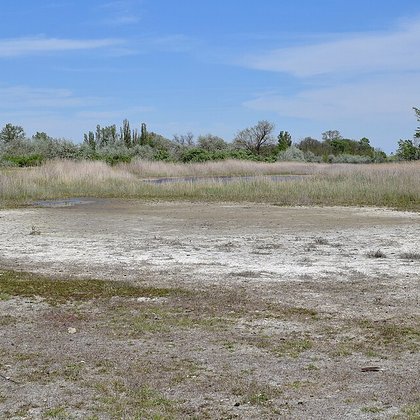
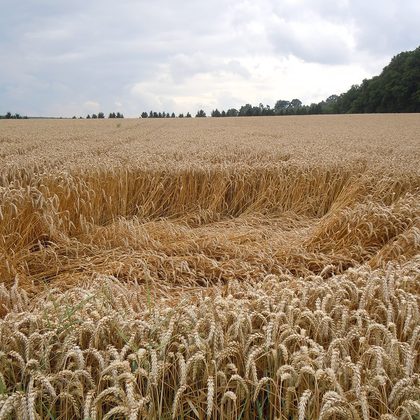
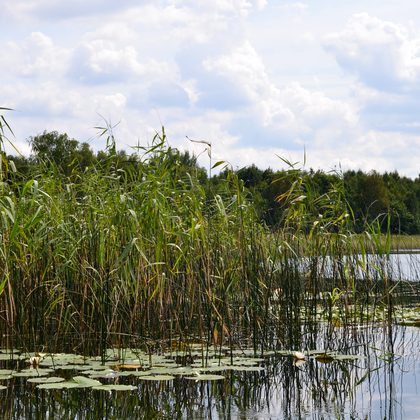
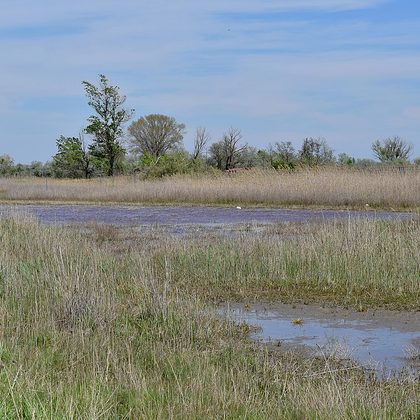
Bare saline flats with short vegetation or none, drying lake shores, salt pans and the bunds between ricefields. Nests in loose colonies on open ground, often on dried mud, a salt crust or a fallow corner beside water. Feeds on the wing over grassland, rice and saltmarsh, kilometres from the colony, and is most active at first light and at dusk.
Where the bird is most at home, classified with EUNIS — the European standard for habitats.
Range and movements
Breeds around the Mediterranean and in North Africa, east to central Asia, with European birds wintering in the Sahel. The strongholds are southern Spain, the Ebro delta, southern France, Italy, Greece and Turkey. British records number fewer than a hundred, concentrated in southern and eastern England and heavily biased to late May, June and July, with the occasional bird settling on a coastal grazing marsh for weeks.
- Breeding (summer)
- Passage
- Migration direction
- dark = core range, pale = thinly spread
Where and when to look
In Britain the bird tends to find you: a pratincole hawking over a coastal marsh, often among terns and hirundines. Work the flight views and let the perched bird wait. One frame of the open underwing taken from below, with the secondaries sharp, separates chestnut from black and shows the white trailing edge, and that is what a description will stand or fall on.
Conservation status
Not globally threatened, but European numbers are falling. The pressures are loss of seasonal wetland and saline flats, cultivation and mowing of ricefields during the breeding season, trampling of nests by stock, and insecticide use, which removes the flying insects on which the species depends entirely.