All species › Passerines › Waxwings › Bohemian waxwing
Bohemian waxwing | Bombycilla garrulus
Pestvogel | Ampelis europeo
A Waxwing in a rowan is one of those sights you can wait years for and then walk straight into on a supermarket car park. A silky, cream-pink bird with a swept-back crest, a black mask and a row of glossy red tips on the wing that look exactly like drops of sealing wax. It is a bird of the far northern taiga that most people only ever meet in a suburb, and only in some winters.

Voice
Sound is the most reliable way to find a Waxwing, and many birders hear more than they see. It is a high, silvery, ringing trill — sirrrr — best compared to a small bell or a finely ticking clock: clear, without edge, and without the Starling's rasp. A party gives the trills in a continuous overlapping jingle, both in flight and from the treetop where they settle to doze after a meal. It carries surprisingly far across a still winter morning, and nothing else in western Europe makes that sound. The species has hardly any true song: what the male produces in spring is little more than those same trills strung together with soft clicks between them. That fits a bird which defends no feeding territory and breeds somewhere different from one year to the next, and which therefore has little use for a fixed song post.
No freely licensed recording is available for this species yet.
Identification
About the size of a Starling but much fuller and softer in shape: compact, short-tailed, with broad pointed wings and a long backswept crest that can be laid flat. The plumage is warm cream-pink to pale cinnamon, without spot or streak, with a grey rump. A black mask runs from the base of the bill through the eye and ends in a point behind it; beneath the chin is a neatly bounded black bib. The undertail coverts are deep chestnut — a mark you see only from below, but one that is never missing. The wing carries an almost painted pattern: white and yellow marks on the primaries, and at the tips of the secondaries a row of red, horny plates, the waxy drops that give the bird its name. The tail ends in a sharp, broad yellow band. First-winter birds are duller, with a smaller mask, a faintly streaked belly and often only a few red tips or none at all; the number and length of them increase with age.
Confusion species
In the Low Countries Starling is the real confusion, and it lies in flight — see its own species page. Both are compact, short-tailed and sharp-winged, fly fast and direct and travel in dense, manoeuvrable flocks, so a party of Waxwings over a housing estate is dismissed as Starlings more often than the other way round. Perched, one glance settles it: the Waxwing has a crest, uniform cream-pink plumage and a yellow tail tip, while the Starling is dark, heavily white-spangled in winter, with a longer yellow bill and a peaked head without a crest. Voice settles it too: the Starling calls a hoarse grating tcherr, the Waxwing a high silvery bell. Seen at distance in a bare treetop, a flock can also suggest Fieldfares, but those are longer, long-tailed and show a grey head and rump. For the very careful: Cedar Waxwing very rarely reaches Europe from North America — smaller, yellower on the belly, with white rather than yellow edges to the primaries and white undertail coverts.
Habitat
The breeding grounds are the northern taiga: open, mature conifer forest of spruce and Scots pine, often mixed with birch, heavily hung with lichen and usually near a bog, a lake or a slow river. There the nest of twigs, moss and lichen sits on a side branch at low to middle height, and there the birds catch insects on the wing over the water to raise the young. Outside the breeding season the picture changes completely, and it is that picture readers know: berry-bearing shrubs and trees, wherever they stand. Rowan above all, then hawthorn, snowberry, firethorn, cotoneaster, apple and guelder rose — in western Europe almost always planted, in town parks, amenity plantings, car parks, gardens and around business parks, and in the countryside in old hawthorn hedges and hedgebanks. Water is essential alongside: after a meal of berries the birds drink heavily, or eat snow.
Where the bird is most at home, classified with EUNIS — the European standard for habitats.
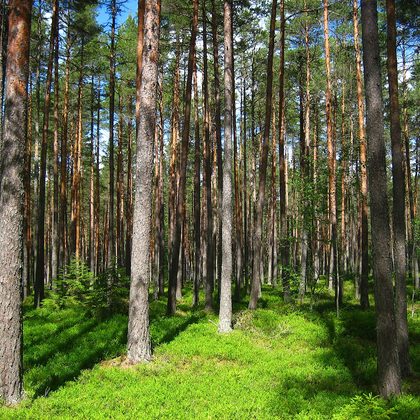
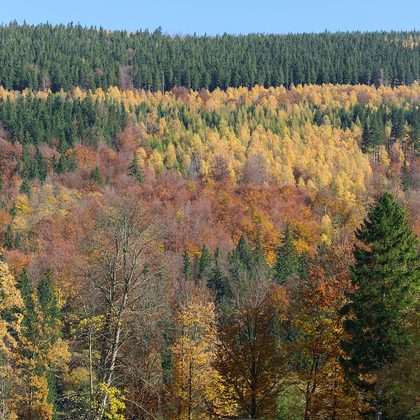

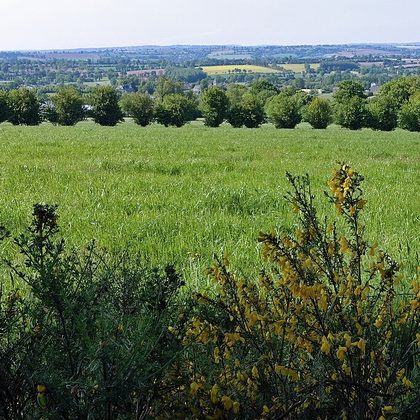
Range and movements
Breeds in a belt through the taiga from northern Scandinavia, Finland and Russia into Siberia, with small numbers reaching northern Norway and Swedish Lapland — inside this guide's map area, though hardly any reader will meet it there. The winter distribution is another matter and follows the berries. Rowan fruits on a mast rhythm in Fennoscandia: in some years the trees hang full across a whole region at once, in others they carry almost nothing. When a good breeding season coincides with a heavy berry crop, a large population enters the autumn; if the following berry crop then fails, that whole population moves south-west on a broad front and reaches Britain, the Netherlands, Belgium and Germany in thousands. In the years between, a few dozen turn up, or none at all. Such irruptions come roughly every three to ten years; recent large ones were 2004/05, 2010/11, 2012/13 and 2023/24. Spain is reached only in the very heaviest irruption winters, and then by a handful of birds in the far north.
- Resident
- Breeding (summer)
- Winter
- Passage
- Migration direction
- dark = core range, pale = thinly spread
Where and when to look
In an irruption winter, do not go to the woods — go to the town. In November and December search rowans on car parks, along shopping precincts, in new housing and around business parks; that planting is still loaded with fruit at the moment the open countryside has been stripped. Walk with your ears open: the silvery jingle reaches you before you pick the birds out. A flock strips a tree in an hour and then vanishes, so returning to the same spot is rarely worth it — but the birds usually spend the next half hour resting in the highest bare treetop nearby, and that is the moment for a proper look at the waxy tips and the yellow tail band. Follow the national sightings pages in such a winter; Waxwings are strikingly unshy and will often let you approach to five metres.
Conservation status
Not globally threatened, with a very large population across the Russian and Fennoscandian taiga and no sign of a structural decline. The great trap with this species is to read the number of winter records as a trend: a winter without a single Waxwing says nothing about the population, only something about the berry crop in Lapland. Averaged over decades, the picture is stable. The pressures lie mainly on the breeding grounds, where large-scale logging replaces open, lichen-rich mature conifer forest with dense even-aged plantation. In the wintering areas there are annual casualties from collisions with shop and office glass and from traffic along berry-rich verges; birds also become intoxicated on fermented fruit during a thaw, though their livers cope with it remarkably well.